A marketing automation consultancy is more than a service provider—it’s a strategic partner dedicated to helping B2B companies maximize their investment in technology, processes, and data.
They provide the specialized expertise needed to transform platforms like Salesforce, HubSpot, or MCAE (formerly Pardot) from standalone software into a powerful, unified revenue engine. The goal is to move beyond basic setup and architect a system that delivers measurable, predictable growth for marketing operations, sales operations, and your overall RevOps strategy.
Why Smart B2B Companies Hire a Consultancy
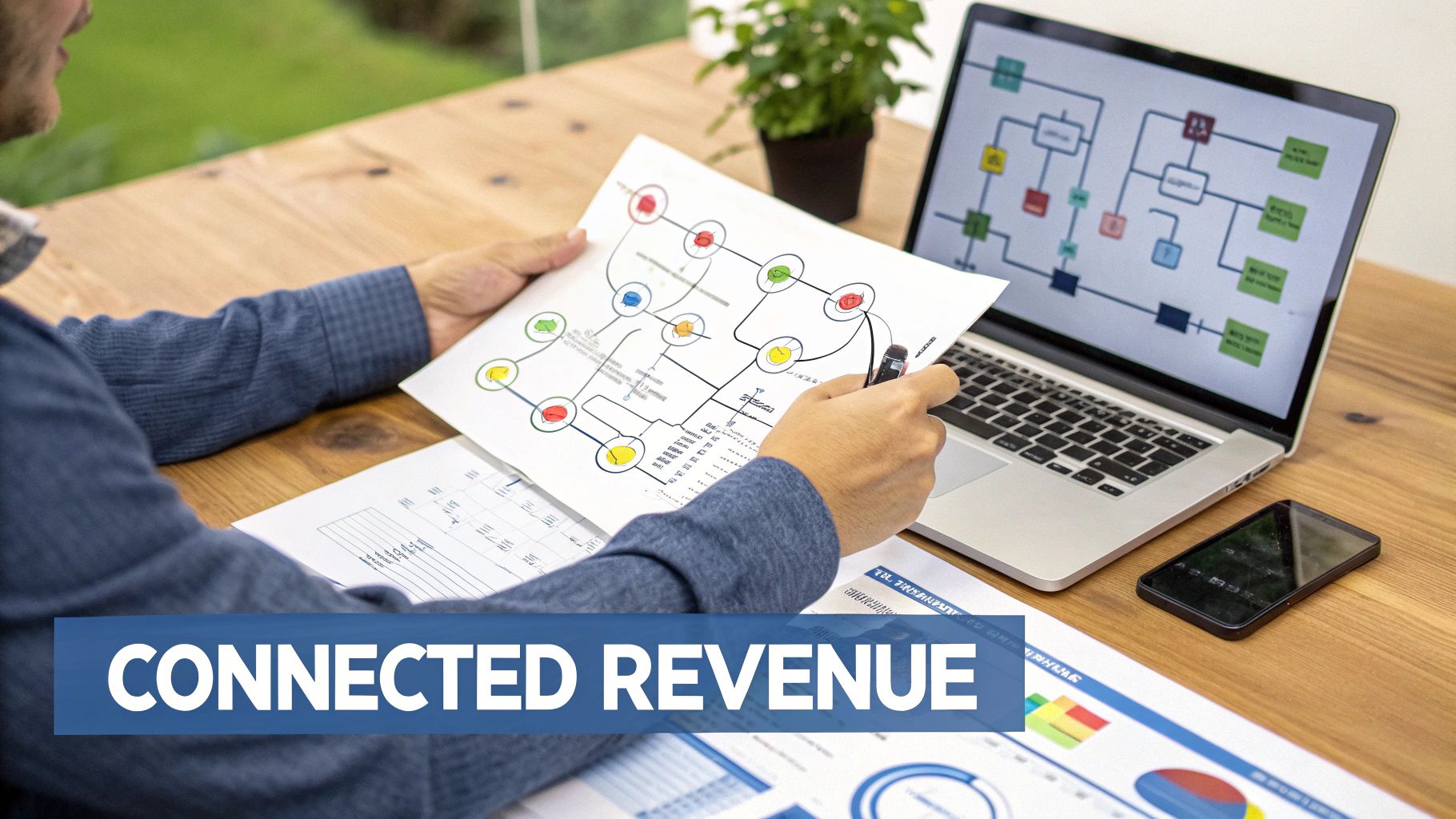
Does this sound familiar? Your data is fragmented, promising leads are falling through the cracks, and your team is bogged down by clunky workflows that waste time and money. Your marketing automation platform was sold as the solution, but right now, it feels like part of the problem. This is precisely when high-performing B2B companies engage a marketing automation consultancy.
Think of a consultant as the architect for your revenue engine. You wouldn’t build a house without a blueprint; a consultant designs a detailed plan to ensure every part of your go-to-market strategy connects and functions seamlessly. Their job is to configure your Salesforce, HubSpot, or MCAE platforms not just to work, but to actively support scalable growth.
The Architect for Your Revenue Engine
An expert consultancy provides an objective, experienced viewpoint that an internal team—juggling daily tasks and urgent priorities—simply cannot. Having worked inside hundreds of tech stacks, they know exactly where common pitfalls and hidden opportunities exist, especially in complex B2B environments.
Their value extends beyond technical fixes. A true partner aligns your technology with core business goals by asking the tough questions that drive strategic clarity.
- Is our lead lifecycle truly built for revenue? They dissect your entire lead management process, from initial touchpoint to closed-won, pinpointing bottlenecks and identifying optimal points for automation.
- Are sales and marketing operations aligned? They diagnose and resolve data sync issues between your CRM and MAP, ending the friction over lead quality and attribution.
- Can our system support our growth plans? They don’t just apply temporary patches; they build foundational processes designed to scale with your business, eliminating the need for a linear increase in headcount.
From Reactive Cost Centre to Growth Machine
Without expert guidance, your MarTech stack can quickly become a reactive cost centre—an expensive collection of tools that fails to deliver a clear return on investment. A marketing automation consultancy flips that script, transforming your operations into a predictable, proactive growth machine. They implement the systems required for accurate reporting, reliable lead scoring, and smooth, automated handoffs between marketing and sales.
A consultant’s primary mission is to install best-practice processes that make revenue predictable. By optimizing your system’s architecture, they ensure every marketing dollar and sales effort is tracked, measured, and tied directly to business outcomes, proving a clear ROI.
This strategic oversight is invaluable. For example, understanding how different business units can leverage automation is critical; exploring effective franchise marketing automation strategies demonstrates how tailored approaches can significantly impact revenue.
Ultimately, a consultancy delivers the roadmap and expertise to build a fully integrated RevOps framework. This frees your team to stop wrestling with technology and focus on high-value, strategic work. If you’re ready to build a system where marketing and sales operations work in harmony, a skilled partner can guide you through our proven marketing automation implementation services to ensure you achieve your goals.
What to Expect From a Consultancy Engagement
Engaging a marketing automation consultant isn’t about handing over the keys and hoping for the best. It’s a structured, collaborative process designed to transform your revenue operations from the inside out. The engagement is methodical and transparent, focusing on delivering measurable value at every stage to turn your tech stack into a true revenue-generating machine.
The process is similar to a full diagnostic on a high-performance vehicle before a long journey. You wouldn’t start driving without checking the engine, tires, and oil. A skilled technician runs tests to find the root cause of any performance issues. Likewise, a consultancy engagement follows a logical path, starting with a deep diagnostic before moving to strategic implementation.
This approach ensures every solution is built on a solid foundation of data and a clear understanding of your specific business challenges and goals.
Stage 1: The Deep-Dive System Audit
The first step is a comprehensive audit of your Salesforce, MCAE (Pardot), or HubSpot instance. This is not a cursory glance at dashboards; it’s a forensic investigation into the health and efficiency of your entire RevOps ecosystem. Consultants examine the technical backend to uncover the “why” behind your symptoms, whether it’s lead leakage or underperforming campaigns.
During this phase, a consultant will:
- Assess Data Integrity: They identify and flag duplicate records, incomplete fields, and inconsistent data formats that cripple reporting and personalization efforts.
- Review Automation Rules and Workflows: This involves checking for inefficient, outdated, or conflicting automations that slow down your system or cause critical errors.
- Analyze System Configuration: They evaluate your platform’s setup against industry best practices, looking for security vulnerabilities or performance bottlenecks.
This initial audit provides a critical baseline, creating a clear picture of what’s working, what’s broken, and where the greatest opportunities for improvement lie.
Stage 2: Strategic Process Mapping and Design
With a clear diagnosis, the focus shifts to designing your future state. This is where a marketing automation consultancy moves from technical analysis to strategic planning. Process mapping is a crucial exercise where consultants work alongside your team to visually outline key workflows, such as the lead-to-revenue journey or the customer onboarding experience.
This collaborative mapping helps all stakeholders see the flow of data and responsibility from marketing to sales and customer success. It is highly effective at uncovering hidden friction points and clarifying handoffs, ensuring a seamless customer experience.
The goal of process mapping is to create a shared blueprint for success. It aligns teams around a single, optimized workflow, eliminating departmental silos and establishing a unified process that directly supports your revenue goals.
Once ideal processes are mapped, the consultancy designs the technical architecture to support them. This includes defining lead scoring models, creating attribution frameworks, and planning necessary system integrations.
Stage 3: Tech Stack Rationalization and Implementation
The final stage brings strategy to life. It begins with tech stack rationalization—a critical evaluation of every tool in your marketing and sales arsenal. Many companies accumulate redundant or underutilized software. A consultant provides an objective analysis to help you consolidate tools, reduce unnecessary costs, and ensure every platform serves a clear purpose.
This step is critical for maximizing ROI. The Canadian marketing automation market, for example, is projected to grow at a CAGR of 14.9% from 2025 to 2030, driven by SMEs adopting these tools for greater efficiency. Government programs are also fueling this trend, helping businesses integrate automation for everything from email campaigns to lead nurturing. Properly rationalizing your stack ensures you invest only in tools that deliver genuine value. You can find more details in the research on Canadian marketing automation market trends.
After rationalization, implementation begins. This involves reconfiguring your platform based on the new process maps, performing data cleanup, and building new automations. It is also when critical integrations are established, ensuring a seamless flow of data between your CRM and marketing automation platform. For a closer look at this connection, our guide on CRM and marketing automation integration offers valuable insights.
Throughout these stages, a strong consultancy acts as a partner, providing regular updates, training your team, and ensuring the final solution is one you can confidently own and manage long-term.
The Real-World Benefits for Your RevOps

Let’s focus on tangible results. Engaging a specialized marketing automation consultancy is not about tidying up dashboards; it’s about re-engineering your revenue operations to build a predictable, measurable, and scalable growth engine.
For RevOps leaders, the impact is immediate. A consultant’s first priority is to establish a single source of truth for all customer data. This means ensuring platforms like Salesforce, HubSpot, or MCAE communicate correctly, so marketing and sales operate from the same playbook. It eliminates the circular arguments about lead quality and attribution.
Achieve a Single Source of Truth
Consider a common scenario: a B2B tech company faces a data crisis. Marketing is celebrating a high volume of MQLs from a recent webinar, but sales claims the leads are unqualified. The culprit? Disconnected systems. Rich engagement data from HubSpot isn’t syncing properly with Salesforce, leaving sales reps without context for relevant conversations.
A consultant addresses this by building a robust, bidirectional sync between the platforms, establishing clear data governance and field mapping. Suddenly, every touchpoint—from a whitepaper download to a pricing page visit—is tracked in a unified record. Sales reps now see the entire lead history, allowing them to pinpoint the most engaged prospects and tailor their outreach effectively.
By architecting a single source of truth, a marketing automation consultancy eliminates data silos and builds trust between teams. This foundational alignment is the bedrock of any successful RevOps strategy, making all other improvements possible.
Sharpen Lead Scoring and Lifecycle Management
Generic lead scoring is a primary source of marketing and sales friction. A model that treats every form submission equally is ineffective. An experienced consultant refines your lead scoring and grading based on what actually drives conversions—your historical data and ideal customer profile (ICP).
This is a data-driven process. It involves analyzing your CRM to identify the common behaviors and firmographic traits of your most profitable customers. These insights are then used to build a dynamic scoring system that accurately reflects buying intent. The result is a significant increase in your MQL-to-SQL conversion rate because sales no longer wastes time on unqualified leads. This focus is essential for calculating true marketing automation ROI and demonstrating your department’s value.
Build Accurate Revenue Attribution Models
“Which marketing channels are actually driving revenue?” Every RevOps leader must answer this question with confidence. A consultant helps you move beyond simplistic first-touch or last-touch models to a multi-touch attribution framework that reflects the complex customer journey.
By properly configuring Salesforce Campaigns and linking them to your automation platform, they ensure every touchpoint receives appropriate credit. This provides a clear, data-backed view of which channels, campaigns, and content assets are most effective at closing deals. You can learn more about maximizing the ROI of marketing automation to see how this impacts the bottom line.
Scale Operations Without Increasing Headcount
Ultimately, the goal is scalable growth. By automating manual work, optimizing workflows, and implementing smarter processes, a consultant empowers your team to achieve more with less. This isn’t about replacing people; it’s about elevating them from tedious data entry to high-impact, strategic work. Your operations can expand to handle more leads and customers without a proportional increase in staff, creating a more efficient and profitable revenue engine.
How to Choose the Right Consultancy Partner
Selecting the right consultancy is the most critical decision in your marketing automation journey. The wrong choice can lead to a wasted budget, a failed project, and a system that’s more chaotic than when you started. The right partnership, however, acts as a force multiplier, accelerating your path to a streamlined, revenue-driving machine.
Think of it like hiring a specialized surgeon. You wouldn’t choose someone with a generic “we fix things” sign. You would review their credentials, understand their surgical plan, and verify their track record with your specific procedure. The same diligence is required when selecting a marketing automation consultancy.
Beyond Technical Skills to Strategic Alignment
Platform expertise is a baseline requirement, but it goes beyond certifications. You need a partner who understands the complexities of B2B companies, especially those using Salesforce, MCAE (formerly Pardot), and HubSpot. A consultant with only theoretical knowledge will struggle with your unique business processes, custom objects, and legacy data challenges.
To assess their capabilities, ask sharp, strategic questions that cut through the marketing fluff.
- How do you define and measure success? Vague answers like “improved efficiency” are a red flag. Look for partners who speak in terms of measurable RevOps metrics, such as MQL-to-SQL conversion rates, sales cycle velocity, and marketing-attributed revenue.
- Can you walk me through your project management process? You need a partner with a structured, transparent approach. Ask how they handle communication, manage timelines, and adapt to unforeseen challenges.
- Show me an example of a complex integration you’ve built. Don’t just take their word for it. Ask them to detail a project similar to yours, explaining the business problem, the solution they implemented, and the tangible results it produced.
The Non-Negotiable: They Must Understand GTM Strategy
A purely technical consultant can connect the systems, but they can’t ensure your strategy is sound. A valuable partner brings deep go-to-market (GTM) expertise to the table. They understand that every technology decision impacts everything from lead generation to customer retention.
They don’t just ask, “what do you want to build?” They ask, “what business goal are you trying to achieve?”
The best consultants are business strategists first and technologists second. Their primary goal is to align your MarTech stack with your GTM objectives, ensuring every automation and workflow directly contributes to revenue growth.
This strategic mindset distinguishes a good consultant from a great one. They will challenge your assumptions, suggest process improvements you hadn’t considered, and ensure the solution they build is designed for future growth, not just current needs.
An Evaluation Framework for Making Your Choice
To simplify your decision, compare potential partners across key areas. The market for these services is growing, particularly in Canada, as more companies adopt digital strategies. This growth provides more options but also makes a structured evaluation more important. You can explore this trend in the research on the Canadian market for marketing automation consultancy services.
Here’s a checklist to help you weigh the factors that matter for a successful partnership.
Consultancy Evaluation Checklist
Use this table as a scorecard to compare potential partners.
| Evaluation Criteria | What to Look For | Red Flags to Avoid |
|---|---|---|
| Platform Expertise | Demonstrable experience with complex Salesforce, MCAE, and HubSpot instances in B2B environments. They provide specific case studies and client references. | Generic answers. They discuss features but cannot connect them to solving specific business problems. |
| Strategic Acumen | They ask probing questions about your GTM strategy, ICP, and revenue goals before discussing technology. | They jump directly to technical solutions without understanding business context. Their focus is on completing tasks, not achieving outcomes. |
| Cultural Fit | They feel like an extension of your team. Communication is clear, collaborative, and professional. | Communication is infrequent or unclear. They rely on excessive jargon or seem dismissive when asked to explain their process. |
| Proven Methodology | They have a clear, documented process for audits, implementation, and training. They provide defined milestones and deliverables. | A lack of a clear plan. They seem to be “winging it” or cannot provide a straightforward project timeline. |
Ultimately, choosing the right marketing automation consultancy is an investment in your company’s future. By prioritizing a combination of deep technical skill, strategic business acumen, and strong cultural fit, you will find a partner who can help you build a truly scalable and predictable revenue engine.
The Future of AI in Marketing Automation

The conversation around marketing automation has evolved beyond triggers and workflows; the new frontier is artificial intelligence. AI is rapidly transitioning from a buzzword to a practical tool embedded within the platforms you already use, including Salesforce and HubSpot.
For B2B companies, this represents a fundamental shift in go-to-market strategy. AI is reshaping everything from lead scoring to content personalization, expanding the possibilities for marketing and sales operations.
This is not just an incremental update—it’s a paradigm shift. AI is not here to replace jobs but to augment them. It automates the monotonous, data-intensive tasks that consume valuable time, freeing your team to focus on strategic thinking, creative problem-solving, and building customer relationships.
This is precisely why partnering with a specialized marketing automation consultancy has become so critical. You need a guide who not only understands the technology but can also help you apply it strategically to drive revenue growth.
How AI Is Redefining Marketing Operations
AI’s primary impact lies in its ability to analyze massive datasets and identify patterns that are impossible for humans to detect. This capability is transforming core marketing functions by adding a new layer of intelligence and precision. Instead of relying on static, rule-based campaigns, your automation can now learn and adapt in real time.
Consider what is already possible:
- Predictive Lead Scoring: Traditional scoring models assign points for simple actions. AI-powered tools, like Salesforce Einstein, analyze historical sales data to identify behaviors that genuinely signal buying intent, resulting in dramatically more accurate lead prioritization.
- Dynamic Content Personalization: AI can instantly customize website content, emails, and calls-to-action for each visitor based on their real-time behavior. This moves beyond inserting a first name to delivering truly one-to-one experiences at scale.
- Automated Audience Segmentation: Instead of spending hours building complex lists, AI algorithms can identify and create hyper-specific micro-segments based on subtle behavioral cues, enabling highly targeted and effective campaigns.
This isn’t just theory. In Canada, businesses are adopting AI at a remarkable pace. Recent statistics show that 25.6% of Canadian businesses plan to use AI-driven marketing automation in the next year, a significant increase from 19.4% the previous year. This trend signals a major shift: marketing roles are becoming less about execution and more about strategic oversight. You can review the findings on AI adoption in Canadian businesses for a complete picture.
The Human Role in an AI-Powered World
As AI handles more tactical execution, the human element becomes more strategic. The most valuable team members will be those who can direct the AI, interpret its findings, and connect its power to high-level business goals. The focus is shifting from doing the work to designing the system.
The true power of AI in marketing automation isn’t just its ability to automate tasks, but its capacity to provide predictive insights. An expert consultancy helps you translate these insights into a coherent go-to-market strategy, ensuring technology serves the business, not the other way around.
This new reality requires a different skillset. Your team’s success will depend less on their ability to build a complex workflow and more on their ability to ask the right questions of the data. A consultancy delivers immense value here by training your team and fostering a culture of data-driven strategic thinking.
Future-Proofing Your MarTech Stack
Successfully implementing AI is not as simple as flipping a switch. It requires clean data, a well-structured CRM, and a clear map of your customer journey. A marketing automation consultancy acts as your strategic partner in this evolution, preparing your systems and processes for an AI-first future.
They begin by ensuring your foundation is solid, from establishing data hygiene protocols in Salesforce to correctly mapping processes in HubSpot. By building this strong base, you position your organization not just to adopt the latest AI tools, but to turn them into a sustainable competitive advantage.
Answering Your Top Questions About Marketing Automation Consulting
If you are considering engaging a marketing automation consultant, you likely have questions. As a B2B leader, you need straightforward answers to determine if this is the right investment for your business. Let’s address the common questions we hear from operations and revenue leaders.
This section provides practical clarity to help you move forward with confidence. We will cover project timelines, ROI, and the collaborative process between a consultant and your internal team.
How Long Does a Typical Consultancy Engagement Last?
This is a frequent first question, and the answer depends on your objectives and the complexity of your current systems. However, based on our experience with B2B companies on platforms like Salesforce and HubSpot, we can provide a general guideline.
A foundational project—including a full system audit, process mapping, and initial high-impact implementations—typically takes between three and six months. This timeframe allows for a thorough deep dive, strategic design, and the rollout of improvements that deliver immediate value while building a solid foundation for future growth.
More ambitious projects, of course, require a longer timeline. These might include:
- Multi-system integrations connecting marketing and sales platforms to other business-critical tools, such as an ERP or BI suite.
- A major data migration from a legacy system, which requires meticulous planning to maintain data integrity.
- A complete RevOps transformation that impacts every aspect of your go-to-market motion, from lead management to customer onboarding.
Regardless of the scope, a reputable consultant will provide a detailed project plan with clear milestones from day one. The objective is to ensure you see progress and value at every stage, not just at the project’s conclusion.
What Is the Expected ROI of Hiring a Consultancy?
The return on your investment in a marketing automation consultancy is multifaceted, appearing across your entire revenue engine through cost savings, efficiency gains, and direct revenue growth. The primary goal is to build a more predictable and profitable operation.
The business case is built on several key pillars:
- Greater Operational Efficiency: By automating repetitive tasks and streamlining workflows, a consultant can save your team hundreds of hours annually. This frees your talent to focus on strategy and high-value initiatives instead of manual data entry.
- Improved Lead Conversion Rates: With expertly configured lead scoring and lifecycle stages, your sales team can focus on high-intent prospects instead of unqualified leads. This directly improves the MQL-to-SQL conversion rate and the ROI of your marketing spend.
- Higher Marketing-Attributed Revenue: Correctly implemented attribution models allow you to prove marketing’s direct impact on the bottom line. This data-backed clarity is invaluable for securing budgets and making smarter investment decisions.
- Reduced Tech Stack Waste: Many companies pay for redundant or underutilized tools. A consultant provides an objective analysis of your tech stack, helping you eliminate unnecessary software and consolidate platforms to reduce both cost and complexity.
While exact figures depend on your company’s size and starting point, it is common for businesses to see a significant improvement in these key RevOps metrics within the first year.
Can a Consultancy Work With Our Existing In-House Team?
Absolutely—in fact, collaboration is essential for success. The best results are achieved through a strong partnership. A great marketing automation consultant is not there to replace your team; they are there to augment it with specialized expertise and a strategic, outside perspective.
Think of a consultant as a coach who elevates your in-house talent. Their role is to empower your team for long-term success, not create dependency.
The real value of a great consultancy is in knowledge transfer. They work side-by-side with your team to implement best practices, document new processes, and provide the training your people need to confidently run the show long after the engagement is over.
This model ensures that improvements are sustainable. The consultant brings lessons learned from hundreds of other companies, helping your team avoid common pitfalls and achieve success faster. They are a strategic partner invested as much in building your team’s capabilities as they are in optimizing your technology.
Ready to transform your revenue operations? MarTech Do is a revenue operations agency that specializes in aligning your marketing, sales, and customer success teams on platforms like Salesforce and HubSpot to drive measurable growth.