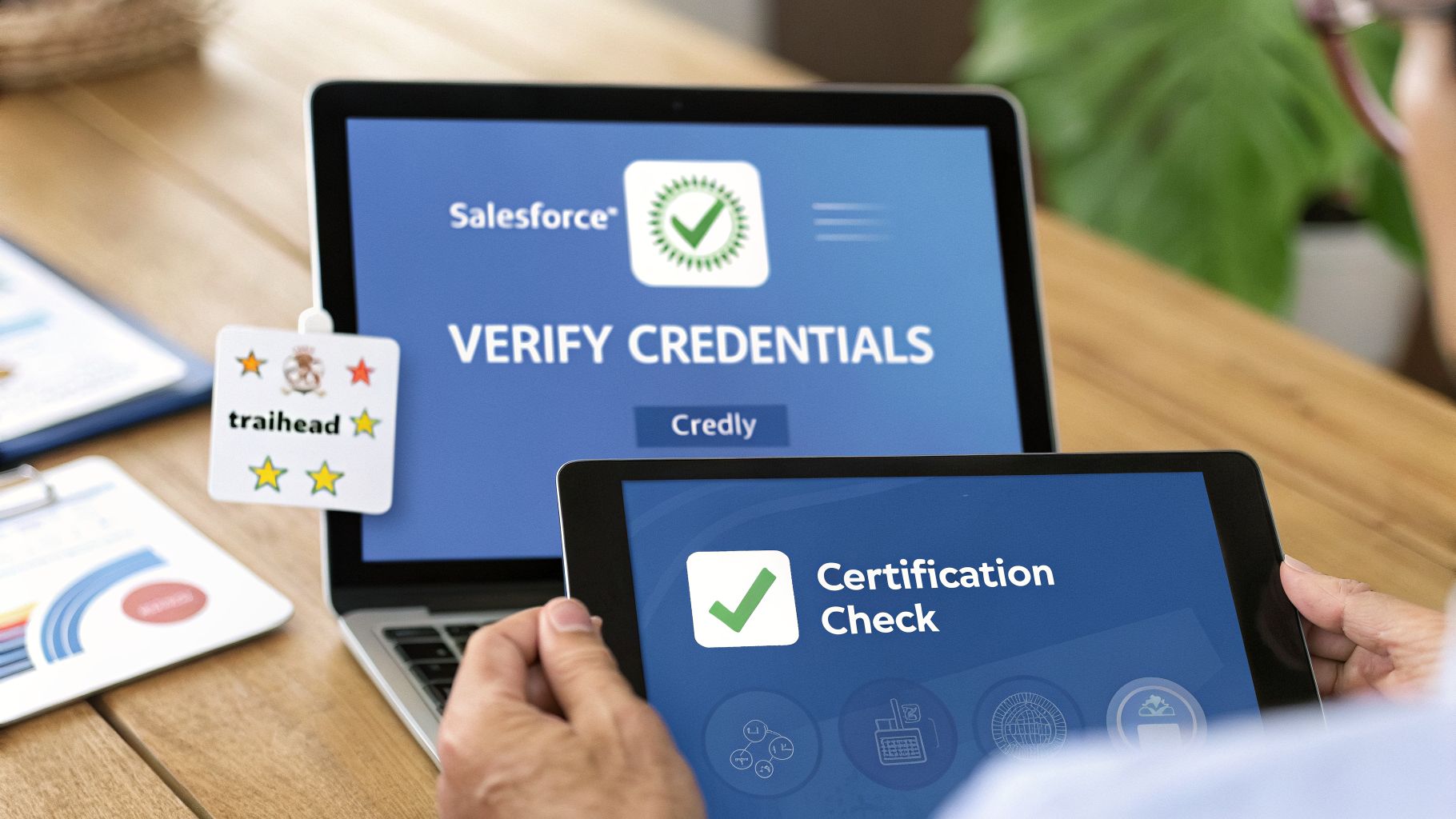
The most reliable way to handle a Salesforce certification verification is by looking up a professional’s credentials on Salesforce’s official Trailhead verification site. This quick search confirms if their certifications are active and legitimate, providing a clear picture of their expertise and mitigating risk to your CRM.
Why Verification Is Your RevOps Safety Net
In any B2B company, your Salesforce org is the heart of your Go-to-Market (GTM) strategy. It’s the engine that powers everything from marketing campaigns in Account Engagement and sales cycles in Sales Cloud to customer service. That’s why letting someone with unverified credentials into your system is a massive, often overlooked, risk that can quietly sabotage complex projects and jeopardize your entire RevOps function.
This is why you must think of Salesforce certification verification as more than a compliance checkbox. It’s a core business strategy for protecting your technology investment.
Rigorous verification acts as your first line of defense. It ensures that any consultant, new hire, or even an existing team member touching your CRM has the proven, current skills required for the role. You’re not just taking their word for it; you’re mitigating risk, guaranteeing proficiency, and protecting the operational center of your business. Without this step, you’re essentially flying blind and trusting a resume that may not reflect reality.

The Real-World Cost of Skipping Verification
Let’s walk through a scenario I’ve seen play out before. A mid-market B2B company decides to implement Revenue Cloud to fix its messy quote-to-cash process. They bring in a consultant whose profile proudly lists “Salesforce CPQ Specialist.” The project starts, but three months later, it’s completely stalled. Product rule configurations are a mess, quotes are full of pricing errors, and the sales team is refusing to use the system.
After some frantic digging, a belated verification check shows the consultant’s certification actually lapsed two years ago. They were completely out of their depth with recent platform updates that were critical for the project.
The fallout was disastrous:
- Financial Loss: The company was out tens of thousands in consulting fees for work that had to be scrapped and redone from scratch.
- Operational Disruption: Their entire quote-to-cash process was broken. Deals were delayed, revenue forecasting was a nightmare, and the bottom line took a direct hit.
- Lost Opportunity: All the time wasted on the failed project was time their competitors used to pull ahead.
This entire expensive mess was completely avoidable. Building verification into your vetting process from day one is non-negotiable. It’s not just a gut feeling; research shows a direct link between verified skills and business outcomes. In fact, a study showed companies that mandated verified certifications for their operations teams reported a significant improvement in forecasting accuracy and overall system performance.
Verification as a Strategic Advantage
Ultimately, committing to verification builds a culture of excellence and accountability. It signals to your organization that you value proven, demonstrable expertise. This principle extends far beyond Salesforce. As leaders explore a wide range of professional certifications, they quickly realize that verification is the universal standard for ensuring quality across their tech stack.
By making verification a non-negotiable step in how you hire and manage vendors, you build a stronger, more resilient RevOps function. This practice is a cornerstone of strong data governance and system integrity.
This simple act of diligence directly fuels a successful GTM engine. It guarantees that every single person working in your Salesforce ecosystem is qualified, current, and capable of delivering results. For any RevOps leader, this isn’t just a background check; it’s a strategic imperative for protecting the business. To build a more resilient framework around your data, check out our guide on data governance best practices.
How To Verify Salesforce Credentials in 2026
Alright, you understand why verifying Salesforce credentials is so important. Now for the practical part: how do you actually do it?
For anyone in hiring or RevOps, having a quick and reliable verification process is non-negotiable. Thankfully, Salesforce provides a few official ways to confirm if a candidate’s or consultant’s claimed expertise is the real deal. Let’s walk through the options.

Using The Official Trailhead Verification Tool
The single best place to start is the official Salesforce credential verification site on Trailhead. Salesforce has made this the central hub and your ultimate source of truth for every certification an individual holds.
This tool has become a standard part of the vetting process for B2B companies. In fact, by 2026, it’s estimated that a majority of Salesforce-certified professionals will have their credentials checked through this platform at least quarterly as part of ongoing compliance and project staffing. If you want to dig deeper into its use in the industry, you can read more about how Salesforce verification is used on Aprika.com.
The process itself is straightforward. All you need is the person’s full name or—even better—the email address they use for their certification account. Using their email is always more accurate and avoids any mix-ups with common names.
The search returns a clean list of their certifications and, most importantly, a status. You’re looking for that green “Active” tag, which confirms they’re current on their maintenance exams.
Understanding Other Verification Channels
While Trailhead is your primary tool, it’s good to know about a couple of other platforms you might encounter.
First, there’s Webassessor. Many long-time Salesforce pros will have a history with it, as it was the main exam platform for years. While it doesn’t have a public search function, a candidate can always log in and pull their transcript for you as proof. It’s a valid method, just less direct.
Then there’s Credly. Now part of Pearson, Credly is the official digital badging platform for Salesforce. When someone passes an exam, Salesforce issues a verifiable digital badge on their Credly profile. It’s a great way for professionals to showcase their achievements.
A Credly badge gives you key info at a glance:
- Verification Status: Confirms the badge is legit and issued by Salesforce.
- Issue Date: Shows when they originally earned the cert.
- Skills: Breaks down the specific competencies the certification covers.
A Credly badge is a fantastic first impression, but it’s not the final word. I always treat it as a strong starting point and then cross-reference with the official Trailhead verification site. That’s the only way to be 100% sure the certification is still Active and that they’ve kept up with maintenance.
Comparing Your Verification Options
So, which tool should you use? It depends on what you’re trying to accomplish. A quick pre-screen for a job applicant has different needs than a deep-dive audit of a potential consulting partner.
For example, a fast search on the Trailhead site is probably enough for an initial phone screen. But if you’re about to sign a six-figure contract for a complex Marketing Cloud Account Engagement (MCAE) project, you’ll want more. In that case, I’d ask for the Trailhead verification and a link to the consultant’s Credly profile to get a complete view of their skills.
Here’s a quick comparison to help you decide which platform is right for the task at hand.
Salesforce Verification Platforms Compared
Choosing the right verification method depends on your specific needs—whether you’re conducting a quick pre-screen for a job candidate or a formal audit of a consulting partner. This table breaks down the three primary platforms and their best use cases for RevOps leaders and hiring managers.
| Platform | Information Required | Information Provided | Best For |
|---|---|---|---|
| Trailhead Verification | Full Name or Email | Full list of certifications, status (Active/Inactive), maintenance completion | The definitive final check. Confirming current, valid status for hiring, onboarding, or partner audits. |
| Credly | Link to public profile | Digital badges for each cert, issue date, expiration, skills demonstrated | Quickly assessing skills. Great for social media profiles (e.g., LinkedIn) and getting a high-level view. |
| Webassessor | Candidate provides a transcript | Exam history, dates passed | Historical verification. Useful when a candidate offers it as proof, especially for long-time professionals. |
Ultimately, using these tools in combination gives you the most complete and reliable picture. Start with Credly for a quick look, but always, always finish with the Trailhead verification site to make your final decision.
Reading Between The Lines Of A Verification Report

Finding a candidate’s certification is just the starting line. The real skill for any RevOps or marketing leader is knowing how to interpret what you find. Simply seeing that a certificate exists doesn’t tell you the whole story, and a simple pass/fail check can lead you to hire someone whose skills are years out of date.
Verifying a Salesforce certification isn’t a checkbox exercise. It’s about digging into the details to understand a professional’s commitment to their craft in an ecosystem that changes constantly. This is the kind of deep dive that separates a good hiring decision from a great one.
Deciphering Certification Status and Maintenance
When you look up a credential, your eyes should go straight to its status. This single field tells you almost everything you need to know about its current validity.
- Active: This is the gold standard. It means the person not only passed the exam but has also kept up with all required annual maintenance. Their knowledge is current with the latest Salesforce platform releases.
- Inactive: This is a major warning sign. An inactive or expired certification means the holder missed their maintenance deadlines. As far as Salesforce is concerned, their expertise is out of date, and you should not consider the credential valid for any role requiring current platform knowledge.
The maintenance date is just as crucial as the status. With Salesforce pushing out three major releases every year, a certification earned a couple of years ago without any recent maintenance is practically obsolete. For a role that depends on the nuances of Marketing Cloud Account Engagement (fka Pardot) or the complexities of Revenue Cloud, a recently maintained cert is infinitely more valuable than one that’s a year old but still technically “active.”
In my experience, a candidate who stays on top of their maintenance modules shows a level of discipline and professional accountability that almost always carries over into their work. It’s a small detail that speaks volumes about their professional commitment.
Matching Certifications to Your RevOps Needs
Not all certifications are created equal, especially when you have a specific role to fill. A Salesforce Certified Administrator has an excellent foundational skill set, but you wouldn’t task them with a complex CPQ implementation on their own. As a hiring or RevOps manager, your job is to map the credential directly to the demands of your go-to-market strategy and tech stack.
For instance, if you’re bringing on a Marketing Operations Manager to own your lead management processes in Account Engagement, you should be looking for a combination of certs:
- Marketing Cloud Account Engagement Specialist: This proves they have the hands-on skills to build, execute, and manage campaigns within that specific marketing automation platform.
- Salesforce Certified Administrator: This shows they understand how Account Engagement’s data model syncs and interacts with the core Sales Cloud database—a critical piece for data integrity and process flow.
On the other hand, if you’re hiring a RevOps Analyst to build your team’s forecasting dashboards and analyze pipeline trends, you’d need a completely different profile. Here, I’d prioritize a Salesforce Certified Sales Cloud Consultant or someone with Tableau certifications, as their expertise is centered on sales process automation and data visualization.
This level of strategic thinking is what builds a powerhouse team, and it’s just as fundamental as maintaining strong CRM data hygiene.
Embedding Verification Into Your Hiring and RevOps Workflows

Sporadic, manual checks for Salesforce certifications don’t scale. As your team grows or you bring on more partners, that approach quickly falls apart. To truly protect your tech stack and keep your RevOps engine humming, you have to move beyond one-off lookups.
It’s time to build Salesforce certification verification right into your core business processes. For a hiring manager, it should be as routine as a background check. For a partner manager, it’s a must-have for every new agency RFP and onboarding plan.
When you operationalize this step, you’re creating a baseline for quality. It’s not about micromanaging people; it’s about making sure every person with access to your Salesforce org has proven, up-to-date skills. That’s how you safeguard your entire go-to-market motion.
Systematizing Verification in Hiring and Vendor Management
The key is to formalize the process so there’s no guesswork. Start by updating your internal playbooks and checklists to make credential checks a mandatory part of screening and onboarding.
Here’s what that looks like in a typical hiring process:
- The Application: Require candidates to provide a link to their public Credly or Trailhead profile right on the initial application.
- The Interview: The hiring manager should perform an official Salesforce certification verification search before a candidate moves to the final round. No exceptions.
- The Offer: Add a clause to the offer letter stating it’s contingent on successfully verifying all claimed certifications.
When you’re dealing with outside partners, build verification directly into your procurement and onboarding. Your RFPs should clearly state that all team members assigned to the project must hold active, relevant certs. If it’s a marketing automation project, you need to see Marketing Cloud Account Engagement credentials. This one step filters out unqualified vendors from the get-go and sets crystal-clear expectations.
A certificate tells you what someone knows, but references tell you how they work. Beyond official Salesforce certification verification, knowing how to get job references that win you the offer gives you a much fuller picture of a candidate’s real-world skills and how they collaborate with a team.
A GTM Engineering Approach to Automating Checks
For RevOps teams seeking a competitive edge, the next logical step is automating these checks. A GTM Engineering mindset is about using smart processes and tools like Clay to drive efficiency—and credential checking is a perfect candidate for automation.
Imagine you’re evaluating a shortlist of potential consulting partners. Instead of having a team member spend hours manually searching for each consultant, you could set up an automated workflow. Just feed it a list of names and emails, and it can run web scraping or API checks against verification sites, appending the certification status right back into your partner database or CRM.
This is a massive efficiency gain. It frees up your team from manual work and lets you vet dozens—or even hundreds—of contacts in a fraction of the time. You can be confident you’re always working with the most qualified people without slowing down your operations.
Solving Common Verification Roadblocks
You’ve got a promising candidate for a key RevOps role, you head over to verify their Salesforce certifications, and… nothing. The search comes up empty. It’s a frustrating moment, especially when you’re working against a tight deadline.
Before you jump to conclusions, take a breath. In my experience, these verification hiccups are almost always caused by a simple mix-up, not deliberate deception. A bit of practical troubleshooting can usually clear things up in minutes and get your hiring process back on track.
What to Do When a Search Fails
When an individual doesn’t show up in the official verification database, it’s easy to assume the worst. But before you flag the application, run through a quick checklist of the most common culprits.
Here’s what is likely going on:
- Name Variations: People often use different names. Is their legal name “Robert” but they go by “Rob” on their resume? Did they recently get married and use a maiden name for the exam? Even a simple typo can throw off the search.
- Email Mismatch: This is the most common issue. Most professionals register for certifications using a personal email address. The credential belongs to them, not their employer. The resume or LinkedIn profile you’re looking at probably lists their work email.
- Recent Certification Lag: The systems need time to sync. A brand-new certification can take 24-48 hours to sync between Webassessor, Credly, and the public Trailhead verification site. If they just passed the exam yesterday, it might not show up yet.
My go-to move is to simply reach out to the candidate. I’ll send a quick, non-accusatory note: “Hi there, I’m having a little trouble locating your certification on the Trailhead verification site. Could you please confirm the full name and email address you have linked to your Salesforce account?” This solves the problem nine times out of ten.
Navigating Discrepancies and Inactive Credentials
So what happens if you do find the credential, but it’s stamped with an “Inactive” or “Expired” status? This isn’t an immediate deal-breaker. Life happens, and even the most diligent professional can miss a maintenance module deadline.
When you see an inactive status, it’s actually a great opportunity to start a conversation. You can learn more about what these statuses mean by digging into the potential impact of invalid credentials on your system.
Ask the candidate about it directly. Their answer will tell you a lot. A proactive person might say, “Yes, I missed the last maintenance window during a project crunch, but I’m already scheduled to recertify next month.” That shows accountability. On the other hand, a candidate who seems surprised or dismissive about their expired credential might not have the attention to detail your team needs.
Answering Your Salesforce Verification Questions
Let’s tackle a few common questions that always seem to pop up when we’re talking about Salesforce certification verification. Getting these details right is what gives you total confidence in your team’s credentials.
How Often Should We Re-Verify Credentials?
Verification isn’t a one-and-done task, especially in the fast-moving Salesforce ecosystem. For both your internal team and any external consultants you bring on, you need a regular check-in schedule.
I’ve found the most practical way to handle this is to tie re-verification to existing business rhythms, such as quarterly or annually. This makes it a natural part of your process, not another chore to remember.
Here are a few moments where it makes perfect sense:
- Kicking off a new project: Before you start a major implementation or enhancement, make sure everyone’s skills are current.
- During performance reviews: This is a great time to review an employee’s professional development and ensure their certifications are actively maintained.
- When renewing vendor contracts: A quick check confirms your consulting partners are still holding the qualifications you hired them for.
Building this habit protects your projects from the risks of outdated expertise and ensures you always know the true state of your team’s skills.
Are LinkedIn Badges Enough Proof of Certification?
In a word, no. While seeing a digital badge on a LinkedIn profile or in an email signature is a good sign—it shows someone is proud of their work—it should never be your only source of proof. It’s just too easy for someone to copy and paste a badge image.
Think of a badge on social media as a claim, not confirmation. As a hiring manager or RevOps leader, your job is to verify that claim against an official source, like the Trailhead verification portal or their public Credly profile. That’s the only way to be certain a certification is both authentic and active.
Can I Verify Every Type of Salesforce Certification?
Yes, you can. The official verification tools from Salesforce cover the entire spectrum of their publicly available certifications. This gives you a complete picture, from foundational certs like Administrator all the way up to the specialised certifications in the Architect track.
The key here is to not just verify, but to understand what you’re verifying. The skills needed for a Marketing Cloud Account Engagement project are worlds away from what’s required for a Sales Cloud optimization. Matching the right certification to the demands of the role is just as important as the verification itself.
At MarTech Do, we specialize in helping B2B companies build stronger, more efficient RevOps functions. We do this by embedding best practices like certification verification directly into their day-to-day workflows. If you’re looking for a strategic partner to audit your systems and help you optimize your GTM strategy, learn more about how we can help.