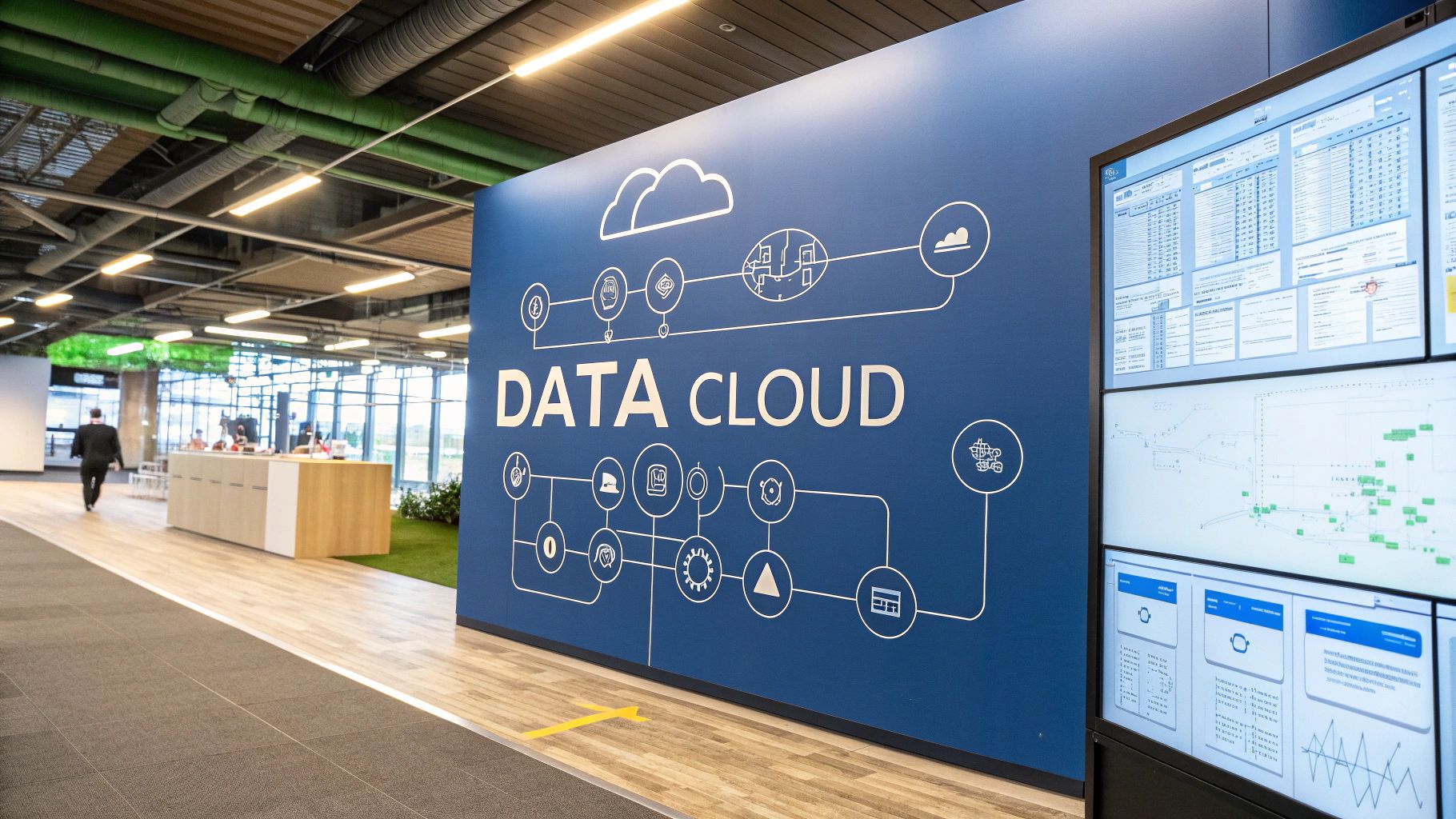
Salesforce Data Cloud acts as the central nervous system for your customer data. It connects every scattered piece of information—from your CRM, marketing automation platform, and beyond—into a single, intelligent profile. For B2B companies using platforms like Salesforce and HubSpot, this resolves the persistent problem of data silos, creating one source of truth so your go-to-market teams operate in perfect alignment.
What Is Salesforce Data Cloud for B2B Growth?

At its core, Salesforce Data Cloud is a hyperscale customer data platform (CDP) built directly into the Salesforce ecosystem. Its function is to ingest massive volumes of data from disparate systems, harmonize it, and build a real-time, 360-degree view of every customer.
This unified profile becomes the bedrock for intelligent marketing, effective sales execution, and proactive customer service.
Imagine your Sales Cloud holds critical account details, while Account Engagement (formerly Pardot) tracks prospect engagement with your content. Meanwhile, your ERP system contains billing and order history. Each system holds a valuable but incomplete piece of the puzzle. Data Cloud unifies these pieces to reveal the complete customer picture.
The RevOps Competitive Advantage
For Revenue Operations professionals, the value is immense. It shifts your team’s focus from reactive data cleanup to proactive, strategic decision-making. Instead of debating whose department holds the “correct” data, everyone can focus on interpreting insights and defining the next best action.
This alignment is the key to operational excellence. A single source of truth eliminates departmental friction and drives efficiency across the entire revenue lifecycle. This is a key differentiator from a standard CRM, which is primarily designed to manage direct customer interactions. For a deeper analysis, see our detailed comparison of a CDP vs. a CRM.
For RevOps leaders, Data Cloud isn’t just about cleaner data; it’s about unlocking strategic alignment. When marketing, sales, and service all work from the same real-time customer profile, you eliminate friction and accelerate the entire revenue engine.
Key Benefits for B2B Operations
A unified data strategy built on Salesforce Data Cloud delivers tangible results, especially for organizations already using tools like Sales Cloud, Account Engagement, or HubSpot. The impact is felt across the business.
- Smarter Segmentation: Move beyond basic firmographics. Segment accounts based on real-time buying signals, product usage patterns, and cross-channel engagement to build hyper-targeted campaigns.
- Clearer Attribution: Connect early-stage marketing touches to late-stage sales wins. Finally, you can accurately measure which channels and campaigns drive revenue, not just leads.
- More Accurate Forecasting: Enhance sales forecasts by layering engagement metrics and customer health scores—pulled from unified service and marketing data—onto your pipeline.
- Proactive Customer Service: Equip service teams with the complete customer history. This helps them resolve issues faster and identify potential upsell or cross-sell opportunities.
Ultimately, Salesforce Data Cloud provides the data foundation required to build a cohesive, intelligent go-to-market strategy that accelerates revenue growth.
Understanding the Core Architecture of Data Cloud

To understand what makes Data Cloud effective, you must look at its architecture, which is engineered for hyperscale and real-time speed. Think of it as a sophisticated assembly line for your customer data. It ingests raw, disconnected information from across your business and transforms it into a unified asset your entire go-to-market team can use.
The process begins by ingesting data from every customer touchpoint. This includes everything from Salesforce Sales Cloud and Account Engagement to website analytics, your ERP, or an external platform like HubSpot. This first step centralizes the disparate pieces of the puzzle.
The scale of this operation is genuinely impressive. Salesforce Data Cloud has seen a 130% year-over-year increase in paid customers, with significant adoption in Canada. It now processes over 2.3 quadrillion records quarterly, demonstrating its capacity to handle the immense data volumes common in B2B. You can explore these figures in Salesforce’s recent announcements.
The Data Model and Identity Resolution
Once data is ingested, the next critical step is harmonization. This is where Data Cloud’s flexible framework, the Customer 360 Data Model, comes into play. It maps all incoming information to a standard format, ensuring that a “contact email” from Sales Cloud and an “email address” from your finance system are understood as the same attribute.
Immediately following, identity resolution takes center stage. This process intelligently matches and merges records to build a single, unified profile for each person and account. Using a mix of exact matches and fuzzy logic, it determines that “Jon Smith,” “J. Smith,” and “jsmith@company.com” are the same individual, creating a “golden record.”
For RevOps professionals, this is where the value is realized. It transforms a chaotic collection of duplicate contacts and fragmented account data into a clean, reliable source of truth—a dataset you can trust for segmentation, analytics, and personalization.
The core function of Data Cloud’s architecture is to create a single, durable identity for every customer. This resolves the chronic issue of duplicate records that plagues B2B databases, providing a clean foundation for every revenue-generating activity.
Zero-Copy Integration: A Key Differentiator
A standout feature of the Data Cloud architecture is its zero-copy integration. Traditional methods of moving data between systems involved creating endless copies, leading to data drift, spiraling storage costs, and version-control nightmares. Zero-copy architecture circumvents this problem.
Instead of duplicating data, Data Cloud can directly access and query information residing in other data lakes (like Amazon Redshift or Snowflake) without moving it. This creates a secure window to view and use data right where it lives.
This approach delivers significant advantages for operations teams:
- Maintains a Single Source of Truth: Data remains in its original system, eliminating the risk of discrepancies between different copies.
- Reduces Costs: It bypasses the expensive and complex processes tied to data replication, ETL pipelines, and redundant storage.
- Ensures Real-Time Access: Teams can act on the most up-to-date information available, without delays from slow batch transfers.
This architectural design keeps your operations agile and efficient as your business scales and data volumes grow, turning disconnected data into a powerful, unified asset that fuels your entire revenue engine.
Driving Revenue with Practical B2B Use Cases

Understanding the architecture of Salesforce Data Cloud is important, but for RevOps leaders, the critical question is: how does it generate revenue? This is where the unified customer profile transitions from a concept into a powerful tool for your go-to-market teams.
Let’s break down three practical, high-impact use cases for tackling common B2B challenges. Consider these a starting point for turning your harmonized data into tangible growth, improved efficiency, and higher customer satisfaction.
Advanced Segmentation Beyond Firmographics
Most B2B segmentation is superficial. Firmographics—industry, employee count, annual revenue—tell you who a company is but nothing about their current needs or behaviors. Data Cloud enables you to build dynamic segments based on a much richer set of signals.
Imagine creating an audience called “High-Value Accounts at Risk.” Instead of manually pulling reports, you can build a segment that automatically groups customers based on real-time criteria from different systems:
- From Service Cloud: More than three high-priority support tickets logged in the last 30 days.
- From your product database: A 25% drop in key feature usage over the past two weeks.
- From Sales Cloud: No logged sales activity (calls or meetings) in the last quarter.
This segment is not static; it is a living audience that updates as customer behavior changes. Your marketing team can automatically trigger a re-engagement campaign in Account Engagement, while your sales team is assigned a task to schedule a business review. You shift from reacting to churn to proactively preventing it.
By unifying behavioural, transactional, and engagement data, you can build segments that reflect true customer intent and health. This moves your team from broad-stroke marketing to precise, context-aware outreach that drives retention and expansion.
Full-Funnel Attribution Modelling
Proving marketing ROI is a significant challenge for B2B RevOps teams. The customer journey is long, complex, and involves dozens of touchpoints. Traditional attribution models often assign full credit to the last touch, such as a demo request, ignoring the critical blogs, ads, and webinars that nurtured the lead months earlier.
With a complete customer profile in Data Cloud, you can finally build an attribution model that reflects the entire journey. It connects every interaction, from the first anonymous website visit and webinar signup to the final sales meetings and renewal conversations.
This allows you to answer the questions that truly matter:
- Which marketing channels attract our highest LTV customers?
- What is our true customer acquisition cost when factoring in the entire journey?
- Does engagement with thought leadership content lead to faster or larger deals?
Armed with these insights, you can stop guessing and start investing your budget in the channels and campaigns that demonstrably drive revenue.
AI-Powered Personalization at Scale
Personalization is often discussed, but difficult to execute well in B2B. Without high-quality data, it is often limited to using a contact’s first name in an email. Data Cloud changes the game by providing AI engines like Einstein with the clean, unified data they need to be effective.
With a solid data foundation, you can automate personalization that is genuinely helpful, not intrusive.
Predictive Lead Scoring: Move beyond basic demographic scoring. Einstein can analyze thousands of data points—from product usage and support history to engagement with specific marketing assets—to predict which leads are truly sales-ready. This helps your sales team focus their energy where it will have the most impact.
Next Best Action: Stop guessing what to offer next. By analyzing a customer’s product usage and comparing it to similar accounts, AI can suggest the ideal cross-sell or upsell opportunity. This recommendation can appear for an account executive directly within Sales Cloud or even trigger a personalized marketing campaign.
These examples demonstrate that Data Cloud is not just a database. It is an active engine for growth that empowers your teams to be more strategic, efficient, and customer-focused in every action they take.
Integrating Data Cloud into Your Existing Tech Stack
Integrating Salesforce Data Cloud is a strategic initiative, not just a technical one. It’s not another piece of software; it’s the new central hub for your customer data. For B2B teams, this requires seamless integration with essential tools like Sales Cloud, Account Engagement, HubSpot, or GTM intelligence platforms like ZoomInfo. A plan-first approach is critical to avoid creating a tangled mess instead of the single source of truth you need.
A phased approach is the most effective way forward—one that builds momentum, demonstrates value quickly, and secures stakeholder buy-in. Think of it as a journey, not a sprint. This methodology minimizes risk and keeps your marketing, sales, and service teams aligned on the possibilities. Nailing this requires a solid grasp of how platforms communicate. To deepen your understanding of a connected tech stack, mastering integration in Salesforce CRM is an excellent resource.
Adopting a Crawl-Walk-Run Methodology
Attempting a full-scale Data Cloud implementation at once is a common mistake. A far more effective approach is to break the project into three distinct, manageable phases. This helps you secure early wins and build a foundation for long-term success.
- Crawl (Weeks 1-4): Identify Key Data Sources. Start small and strategically. Your first step is connecting your most critical internal systems—typically Salesforce Sales Cloud and Marketing Cloud Account Engagement (MCAE). The goal is simple: create a basic unified profile using the core account and contact data you already trust.
- Walk (Weeks 5-12): Introduce External Data. With your Salesforce data harmonized, it’s time to layer in external information. This is where you might integrate marketing engagement data from a platform like HubSpot or enrich profiles with firmographic details from a GTM engineering tool like Clay.com or ZoomInfo. You are now building out customer profiles with more context and behavioral signals.
- Run (Week 13+): Activate and Automate. Now the real work begins. With a rich, unified profile available, you can activate your data. Build your first advanced segments for targeted campaigns, trigger automated journeys based on real-time customer actions, and start delivering powerful insights back to your sales and service teams.
Navigating Common Integration Pitfalls
Even well-structured plans can encounter obstacles. Understanding common integration pitfalls is half the battle. Two of the most frequent challenges are weak data governance and a lack of stakeholder alignment. A clear strategy for platform integration is your best defense against both.
First, address data governance. If you feed Data Cloud messy, inconsistent information, you will get messy, unreliable insights in return. It’s the classic “garbage in, garbage out” problem. Before connecting a single system, establish clear rules. Standardize data formats (e.g., country and state fields), define processes for data entry, and determine how you will identify and merge duplicates at the source.
A successful Data Cloud integration is 80% strategy and 20% technology. Without a clear data governance framework and aligned departmental goals, even the most powerful platform will fail to deliver its promised value.
The second major roadblock is stakeholder misalignment. If your sales team’s definition of a “qualified lead” differs from marketing’s, a unified profile will only magnify that disconnect. The RevOps leader must facilitate these conversations. Hammer out shared definitions, agree on common goals, and ensure every department understands how Data Cloud will help them achieve their objectives. This upfront collaboration is the most critical component of the entire rollout.
Ensuring Data Governance and Measuring Your ROI

Implementing Salesforce Data Cloud is more than a technical project; it is a commitment to maintaining data integrity and delivering measurable business results. For Canadian companies, strong data governance is a legal and operational necessity. A successful deployment balances powerful data capabilities with strict compliance, all while maintaining a sharp focus on financial return.
Beyond the initial integration, the long-term value of Data Cloud depends on establishing solid data governance best practices. This framework ensures your data remains high-quality, secure, and compliant, turning a powerful tool into a trusted, revenue-driving asset.
Building a Strong Governance Framework
In Canada, regulations like the Personal Information Protection and Electronic Documents Act (PIPEDA) are non-negotiable. Data Cloud is built on Salesforce’s Hyperforce infrastructure, which provides the tools to manage data residency and security, allowing you to control where your data is stored and processed.
However, technology alone is not enough. Your RevOps team must lead in defining clear governance policies from day one.
- Establish Data Stewardship: Assign ownership for key data domains (e.g., account, contact, opportunity data). Who is ultimately accountable for the accuracy of this information?
- Define Access Controls: Use role-based permissions within Data Cloud to ensure users only see the data necessary for their roles. This is fundamental for minimizing risk and protecting sensitive customer information.
- Create Data Standards: Document clear, consistent rules for data entry across all connected systems, from Sales Cloud to Account Engagement. Consistency is the bedrock of trustworthy analytics.
This disciplined approach ensures your unified data remains clean, compliant, and genuinely valuable. To refine your strategy, exploring these essential data governance best practices designed for operational success is a worthwhile step.
Measuring the RevOps Return on Investment
A unified customer profile is impressive, but stakeholders care about financial outcomes. The true value of investing in the data cloud – salesforce ecosystem is proven through core RevOps metrics. The business case must be built on tangible improvements to your revenue engine, not just platform features.
The ultimate measure of Data Cloud’s success is its ability to move the needle on key financial outcomes. Connect every use case directly to a core business metric to build a compelling and undeniable ROI narrative.
Start by benchmarking performance before implementing Data Cloud. Once live, track these key indicators closely:
- Reduced Sales Cycle Length: Are deals closing faster? By providing sales reps with richer insights and better-qualified leads, deal velocity should increase. Monitor the average time from opportunity creation to close-won.
- Increased Customer Lifetime Value (CLV): The 360-degree customer view is your primary tool for identifying cross-sell and upsell opportunities, helping reduce churn and grow expansion revenue from your existing customer base.
- Improved Lead Conversion Rates: Measure the lift in your MQL-to-SQL conversion rate. With superior segmentation and scoring powered by unified data, your sales team should receive higher-quality leads.
Canada’s cloud market has unique regional and industry dynamics. While Ontario and Quebec lead in adoption, the public sector constitutes approximately 15% of the market, demonstrating the broad applicability of these ROI principles. More specifics can be found in this Canadian cloud market analysis.
Where Do You Go From Here?
We’ve covered the technical architecture of Salesforce Data Cloud, its practical applications for B2B teams, and the critical importance of data governance. Now it’s time to turn this information into action.
Let’s be clear: mastering your customer data is the single greatest competitive advantage in today’s B2B landscape. A single, reliable view of your customer smooths out clunky handoffs between teams, aligns everyone on the same strategy, and enables decisions based on reality, not assumptions. This is the foundation for sustainable growth.
Your Action Checklist
Embarking on a project of this scale can feel daunting. A massive, “big bang” rollout is a recipe for failure. The intelligent approach is to start small, prove value, and build from there.
Here’s a simple checklist to get you started:
- Map Out Your Data. Before you begin, audit your current data landscape. Where does your customer data live? List every source: Sales Cloud, Account Engagement (Pardot), your ERP, the customer support platform, and even spreadsheets. Be honest about its quality and completeness.
- Pick One High-Impact Problem to Solve. Select a single, specific business problem where a unified view of data would deliver an immediate and significant impact. Perhaps your lead scoring model is unreliable, or you want to build a dynamic list of at-risk accounts. A quick, measurable win is your best asset.
- Build Your Crew. This is a business initiative, not just an IT project. Involve key stakeholders from marketing ops, sales ops, and customer service. Ensure everyone understands the goal of your pilot project and agrees on the definition of success.
The secret to a winning data strategy is starting with a small, focused victory. Once you prove the value on a single use case, you’ll get the momentum and executive support you need to expand your efforts across the entire company.
This step-by-step approach breaks a complex initiative into manageable phases. By starting with a clear audit, a focused pilot, and an aligned team, you are setting the stage for a successful journey with Salesforce Data Cloud. The path to building a truly data-driven revenue engine starts here.
Your Questions About Salesforce Data Cloud, Answered
As RevOps and marketing leaders explore Salesforce Data Cloud, several common questions arise. Let’s address the most frequent ones to clarify how it fits into a B2B technology stack.
How Is Data Cloud Different From Marketing Cloud Intelligence?
These are two tools with distinct but complementary functions. Think of Marketing Cloud Intelligence (formerly Datorama) as your marketing analytics command center. Its specialty is aggregating campaign performance data from disparate channels to report on what worked, what didn’t, and your return on investment.
Salesforce Data Cloud, in contrast, is the foundational Customer Data Platform (CDP). Its primary role is to create that single, unified, real-time view of the customer before you execute a campaign. Intelligence reports on past performance; Data Cloud fuels future actions with a complete customer profile.
Can We Use Data Cloud if Our Marketing Team Uses HubSpot?
Yes, absolutely. A key strength of Data Cloud is its platform-agnostic design. While native connections to Salesforce products are seamless, it is built to ingest data from any source. Using robust APIs or integration platforms like MuleSoft, you can connect it to your entire go-to-market stack, including HubSpot.
The key is a well-defined integration plan. You must carefully map HubSpot’s rich engagement data—form submissions, email clicks, website visits—back to your CRM records. This ensures you are building one harmonized customer profile, not creating another data silo.
What’s a Realistic Implementation Timeline?
While this depends on several factors, we can provide a reliable estimate. For B2B companies, a phased implementation is almost always the best practice, as it allows for quick wins and builds buy-in for the broader initiative.
A focused pilot project—for example, unifying account data from Sales Cloud and your ERP system—can often be completed in 8-12 weeks. A more comprehensive rollout involving multiple systems and complex data rules is more likely to take 4-6 months.
The timeline ultimately depends on three key factors:
- The quality and cleanliness of your source data.
- The number of systems to connect and the complexity of those integrations.
- The availability and commitment of your internal team.
This strategic investment is part of a larger economic trend. The shift toward powerful platforms like Salesforce Data Cloud is a significant growth driver. The Salesforce ecosystem is projected to create $36.8 billion in new business revenue in Canada by 2026. You can learn more about the Salesforce economy in Canada and its impact. This is not just about operational cleanup; it’s about positioning your company to capture a share of that growth.
Ready to build a unified data strategy that drives real revenue growth? MarTech Do specialises in auditing, implementing, and optimising Salesforce and HubSpot stacks for B2B companies. Let’s connect to discuss how we can align your tech, teams, and processes.