
For B2B leaders in marketing, sales, or revenue operations, Salesforce Sales Cloud is more than the world’s #1 CRM—it’s the central nervous system for your entire go-to-market strategy. It’s the platform engineered to unify your sales, marketing, and customer support teams, providing a complete, 360-degree view of every customer interaction. When implemented correctly, it transforms from a digital address book into the architectural foundation for scalable revenue.
The Conductor of Your Revenue Orchestra

Consider your go-to-market function as an orchestra. You have skilled professionals in sales, marketing, and customer success. Without a conductor, their efforts result in noise—missed cues, conflicting actions, and a disjointed customer experience. This is the operational reality when teams work from siloed systems.
Salesforce Sales Cloud serves as that conductor, synchronizing your revenue engine. For leaders in RevOps, marketing operations, or sales operations, this isn’t merely about managing contacts; it’s about engineering a single source of truth that drives predictable, scalable growth.
By unifying your teams and dismantling data silos, Sales Cloud provides a shared, unambiguous view of the entire customer journey—from the initial marketing touchpoint to the final sale and every subsequent renewal.
More Than Just a Database
Treating Sales Cloud as a simple data repository is a common but costly mistake. Its true power is realized when it connects disparate processes and transforms raw data into actionable insights. For B2B companies focused on scaling, a properly implemented instance resolves persistent challenges like inaccurate forecasting and a leaky sales funnel.
For a RevOps leader, Sales Cloud isn’t just software—it’s the architectural blueprint for scalable revenue. It provides the visibility and control needed to engineer a high-performance go-to-market machine.
A well-configured Sales Cloud provides the foundation for data-driven decisions, enabling you to confidently answer critical business questions:
- Which marketing campaigns are sourcing our most valuable opportunities?
- What is our true sales pipeline velocity, and where are the opportunities for acceleration?
- Where are the critical bottlenecks in our sales cycle that inhibit growth?
The Foundation for Growth in Canada
Salesforce’s role as a business accelerator is undeniable, especially within the Canadian market. It holds a commanding 30% of the CRM market share in the country. With the Canadian CRM market projected to grow at a compound annual growth rate (CAGR) of 14% between 2025-2026, driven by digital transformation in key sectors like finance and manufacturing, a robust CRM foundation is essential for competitive advantage.
Ultimately, selecting the right platform is one of the most critical GTM decisions you will make. If you are currently evaluating your options, our guide on how to choose a CRM can help clarify how a system like Sales Cloud aligns with your long-term strategic vision. A sound implementation creates an environment where efficiency, visibility, and scalable growth can be systematically achieved.
Mastering the Core Features for Peak Performance
To truly optimize your revenue operations, you must move beyond a surface-level understanding of Salesforce Sales Cloud features. Mastering their strategic application is key. These core components are the gears of your B2B sales engine; when configured and integrated correctly, they create a powerful system that drives efficiency and illuminates the path to revenue.
Let’s dissect the essential features from a RevOps perspective, focusing on how each element contributes to building a high-performance, go-to-market machine.
Building Your 360-Degree Customer View
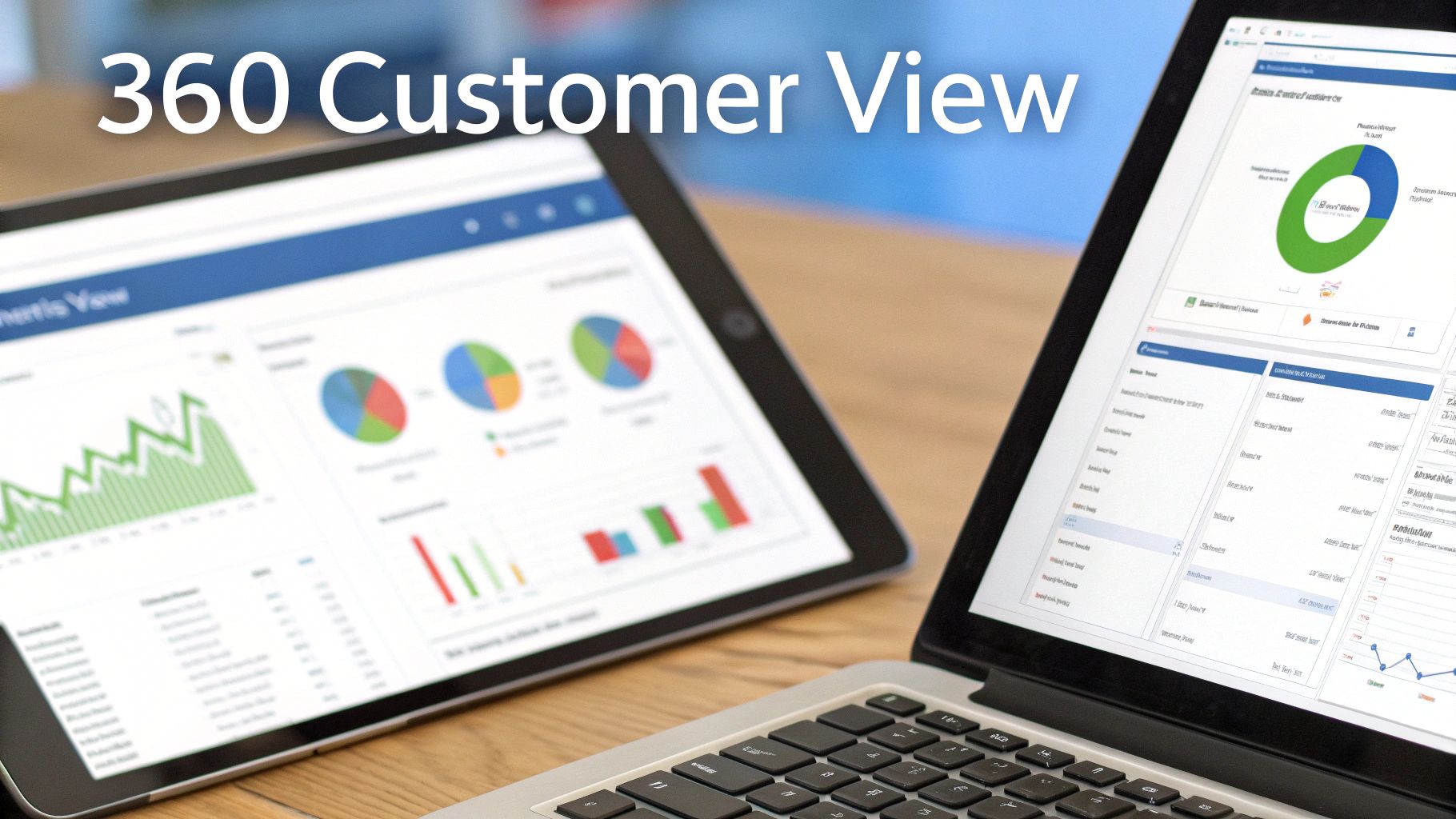
The foundation of any effective sales strategy is a comprehensive understanding of your customer. In Sales Cloud, this begins with Account and Contact Management. An Account record serves as the master file for a company, while Contacts represent the individual stakeholders within it.
For modern RevOps, these are not static records; they are the core of a dynamic, 360-degree view of the customer relationship. This means every touchpoint—an email opened in Account Engagement (fka Pardot), a support ticket logged in Service Cloud, or a conversation captured via a GTM engineering tool like Clay.com—is visible directly on the Account page.
This complete picture delivers significant strategic advantages:
- Identify Cross-Sell and Upsell Opportunities: A consolidated view of purchase and service history makes it easier to identify expansion potential within an account.
- Personalize Every Interaction: Sales representatives can see recent marketing engagement or support issues, enabling relevant, timely conversations rather than generic outreach.
- Enable Strategic Account Planning: Map key stakeholders, understand their roles, and track their interaction history to build stronger, more strategic relationships.
Optimizing Pipeline Velocity and Conversion
With a clear view of your prospects, the objective shifts to moving them through the sales funnel with maximum efficiency. This is the domain of Lead and Opportunity Management. Leads represent raw, unqualified interest; Opportunities are qualified potential deals with defined revenue potential.
The critical element is managing the handoff and progression. A well-designed lead conversion process ensures Marketing Qualified Leads (MQLs) are routed to the right sales reps instantly, complete with the contextual data from their marketing interactions.
An optimized Opportunity object is the cornerstone of reliable forecasting and pipeline analysis. Each stage should represent a verifiable step in your sales process, providing clear signals about deal health and momentum.
For example, when an Opportunity advances to the “Negotiation” stage, automation can notify the legal team or assign a task for sales management to review the proposal. This enforces your sales methodology and eliminates the manual friction that slows down deal cycles.
Driving Decisions with Data and Automation
Your sales process generates a wealth of data. Reports and Dashboards are the tools that translate this raw data into actionable business intelligence. For a RevOps or sales operations professional, this is the command center. A well-constructed dashboard provides an immediate, at-a-glance view of the key performance indicators (KPIs) that matter.
Instead of navigating complex spreadsheets, you can monitor critical metrics in real-time:
- Sales cycle length by industry or product line
- Lead-to-opportunity conversion rates by marketing source
- Pipeline coverage and forecast accuracy by sales team
Mastering data visualization is a core competency for any operations leader. If you’re building this skill, you can learn more about how to create dashboards in Salesforce that drive clarity and action across the business.
Finally, Salesforce Flow is the automation engine that unifies your processes. It allows you to build custom, declarative workflows without writing code. Flow is the tool that eliminates tedious tasks, enforces data integrity, and scales your business rules.
Practical B2B Use Case for Flow:
Consider a B2B SaaS company. A Flow can be built to automatically create and assign a renewal Opportunity 90 days before a customer’s contract expires. This simple automation ensures no renewal is missed, providing the account team ample time to engage, secure retention, and protect recurring revenue.
Weaving Sales Cloud into Your Tech Stack
A powerful CRM operating in isolation is like a world-class engine without a chassis—full of potential but unable to move the business forward. The strategic value of Salesforce Sales Cloud is unlocked when it becomes the central hub of your go-to-market tech stack, synchronizing data and automating processes across all your critical tools.
For any professional in RevOps, marketing operations, or sales operations, architecting these connections is a primary responsibility. It is how you engineer a single source of truth that fuels efficiency, intelligence, and growth.

The Salesforce AppExchange provides a marketplace of pre-built integrations, ready to connect your CRM to other business-critical systems. Each integration transforms Sales Cloud into a true command center, enabling you to streamline workflows, enrich customer records with third-party data, and deliver a superior customer experience.
Starting with the Native Salesforce Ecosystem
The most seamless and often most powerful integrations are within the Salesforce ecosystem itself. These native connections are designed for flawless interoperability, providing a unified view of the customer journey from initial engagement to renewal.
- Salesforce Sales Cloud + Account Engagement (fka Pardot): This is the quintessential integration for sales and marketing alignment. Connecting these two platforms surfaces rich marketing engagement data—lead scores, email opens, website visits—directly on the lead or contact record. This empowers sales representatives with the context needed to have intelligent conversations and prioritize the most engaged prospects.
- Salesforce Sales Cloud + Service Cloud: This integration dismantles the traditional barrier between sales and support. When a sales rep can view a customer’s recent support tickets before an upsell conversation, they are equipped with critical intelligence. Conversely, the service team can access the complete sales history, providing them with the full context of the customer relationship.
Connecting to Your Broader MarTech and SalesTech Stack
Your go-to-market teams rely on a diverse set of tools beyond the Salesforce product suite. A strategic approach to third-party integrations is essential for building a high-functioning RevOps machine.
Integrating tools like HubSpot, ZoomInfo, or Clay.com requires careful planning to ensure data flows correctly without creating data chaos. For most B2B organizations, this involves a combination of direct API connections and potentially middleware platforms to orchestrate data synchronization. A successful integration strategy is a core component of a high-performing https://martechdo.com/crm-and-marketing-automation-integration/.
An effective integration strategy is more than just connecting two systems. It involves mapping the flow of data, defining system-of-record ownership for key data points, and ensuring the integrated architecture adds measurable value rather than creating operational friction.
Best Practices for a Healthy, Integrated System
Simply connecting applications is not the end goal. These integrations must be managed strategically to maintain data integrity and user trust. Without proper governance, integrations can quickly lead to duplicate records, conflicting information, and a CRM that is no longer a reliable source of truth.
To prevent this, master these three fundamentals:
- Map Your Data Meticulously: Before activating any integration, perform a detailed field-mapping exercise. Define which field in one system corresponds to a field in another. Establish a single “source of truth” for critical data points like company name or lifecycle stage to prevent systems from overwriting each other with outdated information.
- Use Strategic Sync Rules: Not all data needs to be synchronized. Be deliberate. Define what data moves between systems and in which direction. For instance, marketing engagement data may flow one-way from Account Engagement into Sales Cloud, while core contact details should likely sync bidirectionally.
- Commit to Ongoing Data Hygiene: An integrated stack is not a “set it and forget it” project. It requires continuous maintenance. Establish a regular cadence for running duplicate-check reports, reviewing sync error logs, and performing data audits. Data hygiene is an ongoing discipline that protects the integrity of your entire revenue operation.
To further enhance efficiency, consider a guide for an effective chatbot for Salesforce integration to automate customer conversations and augment your team’s capacity. By building a thoughtful, well-managed tech stack, you will transform Sales Cloud from a simple CRM into the nucleus of your revenue engine.
Nailing Your Sales Cloud Implementation
Implementing Salesforce Sales Cloud is not just a technology project; it is the process of laying the foundation for your entire revenue engine. A successful implementation—or a strategic overhaul of an existing one—is an investment that delivers compounding returns for years. The key is a clear plan that directly connects the technology to your business objectives, creating a system that scales with your growth.
Whether you are starting fresh or optimizing a mature instance, a deliberate approach is critical. A rushed process inevitably leads to a system with low user adoption, plagued by messy data and inefficient workflows. The objective is to build a CRM that your sales team values because it genuinely makes their jobs easier and helps them close more business.
A Step-by-Step Guide to a Smooth Rollout
A structured, phased approach is the best practice for a successful implementation. It deconstructs the project into manageable stages, ensuring clarity and preventing critical details from being overlooked.
- Discovery & Planning: This foundational phase involves deep collaboration with sales, marketing, and RevOps stakeholders. The goal is to identify current pain points, process bottlenecks, and the specific reports leaders need for strategic decision-making. This is not a checklist exercise; it is the blueprint for the entire project.
- Design & Configuration: Using insights from the discovery phase, you begin architecting the solution. This includes mapping your sales process to opportunity stages, defining necessary custom fields, and configuring the technical framework that supports your go-to-market strategy.
- Data Migration & Cleanup: This stage involves moving data from legacy systems or spreadsheets into Sales Cloud. Crucially, this is an opportunity for data hygiene. Deduplicate records, standardize formatting, and archive irrelevant data before it pollutes your new system.
- Training & Adoption: A tool’s value is determined by its users. Training must be role-specific, demonstrating to reps precisely how Sales Cloud will help them achieve their targets and showing managers how it provides the visibility they need. This phase is about building user confidence and proving the platform’s value from day one.
To help you visualize this process, here’s a typical implementation plan:
Sales Cloud Implementation Phases
| Phase | Key Activities | Success Metric |
|---|---|---|
| 1. Discovery & Planning | Stakeholder interviews, process mapping, defining KPIs, project scoping. | Signed-off business requirements document (BRD). |
| 2. Design & Build | System architecture design, custom field/object creation, automation rules (Flows). | A fully configured sandbox environment that mirrors the BRD. |
| 3. Data Migration | Data extraction, cleansing and deduplication, validation, and import. | 100% of clean, relevant data successfully migrated. |
| 4. Testing & UAT | User Acceptance Testing (UAT), bug fixing, feedback sessions with end-users. | UAT sign-off from all key user groups. |
| 5. Training & Go-Live | Role-based training sessions, creating documentation, “go-live” launch. | High user adoption rates (>90%) within the first 30 days. |
| 6. Post-Launch Support | On-demand user support, system monitoring, initial optimization tweaks. | A steady decrease in support tickets after the first month. |
Following a structured plan like this ensures comprehensive execution and sets your team up for a successful transition.
Already on Salesforce? Time for a Tune-Up
For companies already using Sales Cloud, the work is never finished. Over time, even the best-designed systems accumulate technical debt, outdated workflows, and underutilized features. A regular System Audit is a non-negotiable best practice for maintaining operational excellence.
Think of a System Audit like a health check-up for your CRM. It helps you find and fix hidden problems—like process bottlenecks or data integrity issues—before they can do real damage to your revenue engine.
An audit will help you pinpoint common problems, such as:
- Process Bottlenecks: Identify stages in your sales cycle where deals consistently stall, often revealing manual tasks that can be automated with Salesforce Flow.
- Data Governance Gaps: Assess if user permissions are too permissive, leading to inconsistent data entry, or if data ownership rules are unclear.
- Underused Features: Discover paid features that your team is not leveraging, revealing opportunities to maximize the ROI of your Salesforce subscription.
Building for Scale and Security from Day One
A high-performance Sales Cloud instance is built on a scalable and secure architecture. This begins with a well-defined data governance model—a clear set of rules for how data is entered, formatted, and maintained to ensure it remains clean and trustworthy.
Equally critical is establishing clear user roles and permissions. This ensures that users can only access and edit the information necessary for their roles, protecting sensitive data and reducing the risk of costly user errors. Getting this right from the start creates a system that can grow with your business without descending into chaos.
Investing in a proper implementation isn’t just a technical expense; it’s a strategic business driver. The ripple effect of the Salesforce ecosystem on the Canadian economy reinforces this point, with projections showing it will help create 71,700 new jobs and spark $36.8 billion in new business revenues by 2026. This growth is powered by companies leveraging the platform to build smarter, more scalable operations. You can dive deeper into the data about the Salesforce economy in Canada. Your implementation is your entry point into this powerful ecosystem, and executing it correctly is the first step toward building a durable competitive advantage.
Using AI and Data for Smarter Selling
For any ambitious RevOps team, the objective is to elevate Salesforce Sales Cloud from a passive system of record to a proactive revenue engine. This requires moving beyond reactive data entry and embracing AI-powered insights. The goal is a system that not only stores information but actively helps your team sell smarter and faster.

Salesforce’s native AI, Einstein, is the ideal starting point. It is designed to deliver immediate value by automating routine tasks and surfacing critical insights directly within the user’s workflow. This is not futuristic technology; it is a practical toolkit ready to enhance sales productivity today.
Einstein addresses common sales bottlenecks directly:
- Predictive Lead Scoring: By analyzing historical conversion data, it identifies which new leads are most likely to convert, enabling your team to focus their efforts on high-potential prospects.
- Opportunity Insights: The AI functions as an early warning system, flagging deals that are at risk or progressing slower than expected, allowing managers to intervene proactively.
- Automated Activity Capture: Einstein can automatically log emails and calendar events, freeing representatives from manual data entry and ensuring CRM data remains consistently accurate.
Bringing All Your Data Together for a Clearer Picture
While Einstein provides a powerful starting point, the true game-changer is integrating Salesforce Data Cloud. Think of Data Cloud as the central hub that ingests and harmonizes customer data from every corner of your business—your marketing automation platform, ERP system, product usage logs, and more. It unifies this disparate information into a single, comprehensive customer profile.
This unified view fundamentally changes how your sales team operates. They transition from making educated guesses to acting on holistic, data-driven insights. A sales representative can now see a contact’s complete sales history, recent support tickets, product usage levels, and entire marketing journey in a single, consolidated view.
By harmonizing data from across the business, Data Cloud transforms Sales Cloud from a simple sales tool into a true revenue intelligence platform. It provides the complete customer story needed for proactive engagement and accurate forecasting.
The strategic value of this approach is clear. Salesforce reported that Data Cloud adoption surged by 140% in its fiscal year 2025 reports. This technology, combined with other AI offerings, now generates approximately $900 million in annual recurring revenue (ARR), demonstrating the decisive shift towards data-driven sales strategies.
A Practical B2B Example
Consider a B2B software company focused on reducing customer churn. By integrating their product analytics platform with Data Cloud, they can identify customers whose product usage has declined significantly over the last 30 days.
This data signal orchestrates a proactive workflow within their Salesforce Sales Cloud:
- Spot the Signal: A rule in Data Cloud flags any high-value account exhibiting a 40% or greater decrease in user activity.
- Trigger the Action: This signal automatically creates a task in Sales Cloud for the account manager, complete with a summary of the usage decline.
- Launch an Engagement Play: Simultaneously, the customer is added to a re-engagement campaign in Account Engagement (fka Pardot) that delivers helpful content to encourage product re-adoption.
This proactive, data-fueled workflow enables the company to address potential churn before the customer considers leaving, thereby protecting revenue and strengthening the relationship.
One of the most powerful applications of this methodology is advanced lead scoring. You can explore how AI for lead scoring helps SaaS companies accelerate growth by focusing their teams on the highest-quality leads. When you combine intelligent AI tools with a unified data strategy, your CRM becomes the command center for intelligent, proactive selling.
Answering Your Salesforce Sales Cloud Questions
Even the most well-structured plans generate questions, especially when evaluating a tool as central to your business as Salesforce Sales Cloud. Addressing these common concerns early ensures alignment across RevOps, sales, and marketing, building confidence in the strategic direction.
Here are direct answers to the questions we hear most frequently from B2B leaders.
What’s the Real Difference Between Sales Cloud and Service Cloud?
This is the most common question we encounter. The simplest distinction lies in where each platform fits within the customer journey.
Salesforce Sales Cloud is focused on the pre-sale customer lifecycle. Its design is entirely oriented toward acquiring new business. Key functionalities include lead management, opportunity pipeline tracking, sales forecasting, and quote generation. It is purpose-built to help your sales team close deals.
Service Cloud, in contrast, governs the post-sale experience. It is designed to enhance customer satisfaction and retention. Here, you will find tools for managing support cases, building knowledge bases for self-service, and handling omnichannel customer service communications.
Leading B2B companies do not view them as an either/or choice but as two integrated components of a single customer view. When connected, they provide a complete, 360-degree profile. Your sales team can see if a key account has open support tickets before initiating an upsell conversation, and your service representatives have the full purchase history when resolving an issue.
How Do We Get Our Team to Actually Use It?
A CRM is an expensive database if it is not adopted by your team. Driving user adoption is not about issuing top-down mandates; it’s about making the platform so indispensable that users cannot imagine working without it. This is achieved through three core principles:
- Build It With Them, Not for Them: Your sales and RevOps teams are on the front lines daily. Involve them in the design process from the beginning. When the system is configured to solve their real-world problems, it transitions from being “management’s reporting tool” to their personal productivity asset.
- Make Their Lives Easier: The fastest way to win over a salesperson is to save them time. Leverage automation tools like Salesforce Flow to eliminate manual data entry. If logging a call or updating an opportunity becomes faster in Salesforce than in any alternative workflow, they will use it.
- Lead from the Front: Adoption begins with leadership. When the sales director runs the weekly pipeline review directly from a Salesforce dashboard, it sends an unambiguous message: this is our single source of truth. Reinforce this with continuous, role-specific training to build lasting habits.
Is Sales Cloud a Good Fit for a Small Business or Startup?
Yes. It is a common misconception that Salesforce is exclusively for large enterprises. The platform offers different editions, such as Sales Cloud Essentials, which are specifically designed to meet the needs—and budgets—of smaller, growing companies.
Starting with Salesforce Sales Cloud early provides a scalable foundation for growth. It enables you to establish your sales processes correctly from day one, helping you avoid the significant operational disruption of migrating data and retraining teams when you inevitably outgrow spreadsheets or a less robust CRM.
By selecting a platform that can scale with your business, you are making a strategic investment in your future success. You will not be constrained by your systems as your team and revenue grow.
We Already Have Sales Cloud, but It’s a Mess. Where Do We Start Cleaning Up the Data?
Data hygiene is not a one-time project; it is an ongoing discipline. If you are facing a disorganized Salesforce instance, the first step is to stop further data degradation before beginning the cleanup.
Initiate a data audit to understand the scope of the problem. Run reports to identify the primary issues—are you inundated with duplicate contacts? Is your pipeline cluttered with stale opportunities? Is critical contact information missing from key accounts?
Next, establish a clear data governance standard. This is your rulebook. Define required fields, naming conventions, and data ownership. Then, leverage tools from the AppExchange or native features like Duplicate Rules to merge and cleanse your records. The final, critical step is to implement Validation Rules to prevent bad data from re-entering the system and to train your team on the new standards.
At MarTech Do, we specialize in transforming Salesforce Sales Cloud from a contact database into the engine that powers your revenue growth. Whether you are implementing from scratch or seeking to optimize your current setup through a system audit, we help you engineer the processes and integrations needed to achieve measurable results. Learn more about our RevOps services.