

What exactly is B2B marketing analytics? It’s the discipline of gathering and dissecting data to see how your marketing campaigns are performing—and, more importantly, how those efforts tie directly to revenue. This isn’t about vanity metrics like clicks and email opens. In RevOps, this means connecting marketing actions to pipeline growth, shorter sales cycles, and overall business success, especially within complex B2B buying journeys.
For marketing and sales operations leaders, B2B marketing analytics provides the evidence needed to justify budgets, optimize go-to-market strategies, and prove marketing’s direct contribution to the bottom line.
Why B2B Marketing Analytics Is Your RevOps Engine
In modern B2B companies, marketing is a core part of the revenue engine. The problem is, without a solid analytics framework, its true contribution is often a mystery.
Think about it. Your CRM holds deal information, your marketing automation platform has engagement stats, and your ad platforms are spitting out impression numbers. When that data is disconnected, you’re flying blind. RevOps leaders can’t see the full picture, and that’s where B2B marketing analytics becomes essential.
Imagine your entire RevOps strategy is a high-performance engine. Marketing, sales, and customer success are the critical parts, but data is the fuel that makes it all run. If that fuel is stored in separate, un-connected tanks—Salesforce over here, HubSpot over there—the engine sputters. You’re left guessing on fundamental questions:
- Which campaigns are actually generating qualified pipeline?
- How long does it take for a lead to become a customer?
- What’s the true ROI on our content marketing and demand generation efforts?
Connecting Data to Dollars
A unified analytics approach is the only way to solve this. It connects all the dots. This is precisely what platforms like Salesforce B2B Marketing Analytics (B2BMA) or HubSpot’s reporting suites are built for—to pull these scattered data sources together. They give you a single, actionable view of the entire customer lifecycle, from the first website visit to the signed contract and beyond.
For anyone in RevOps, the goal isn’t just to report on what happened. It’s to explain why it happened and predict what will happen next. B2B analytics gives you the hard evidence needed to shift from reactive reporting to a proactive, revenue-driven strategy.
When you have this consolidated view, marketing and sales ops can finally work from the same playbook. Instead of arguing over lead quality, they can analyze which channels deliver customers with the highest lifetime value. Instead of guessing at budget allocation, they can see exactly which programs are influencing the most revenue.
Ultimately, B2B marketing analytics is what proves marketing’s value. It makes accurate revenue attribution possible and delivers the intelligence to make smarter investments. It transforms your go-to-market strategy from a collection of disconnected activities into a cohesive, predictable, and scalable revenue machine.
Building Your B2B Analytics Framework
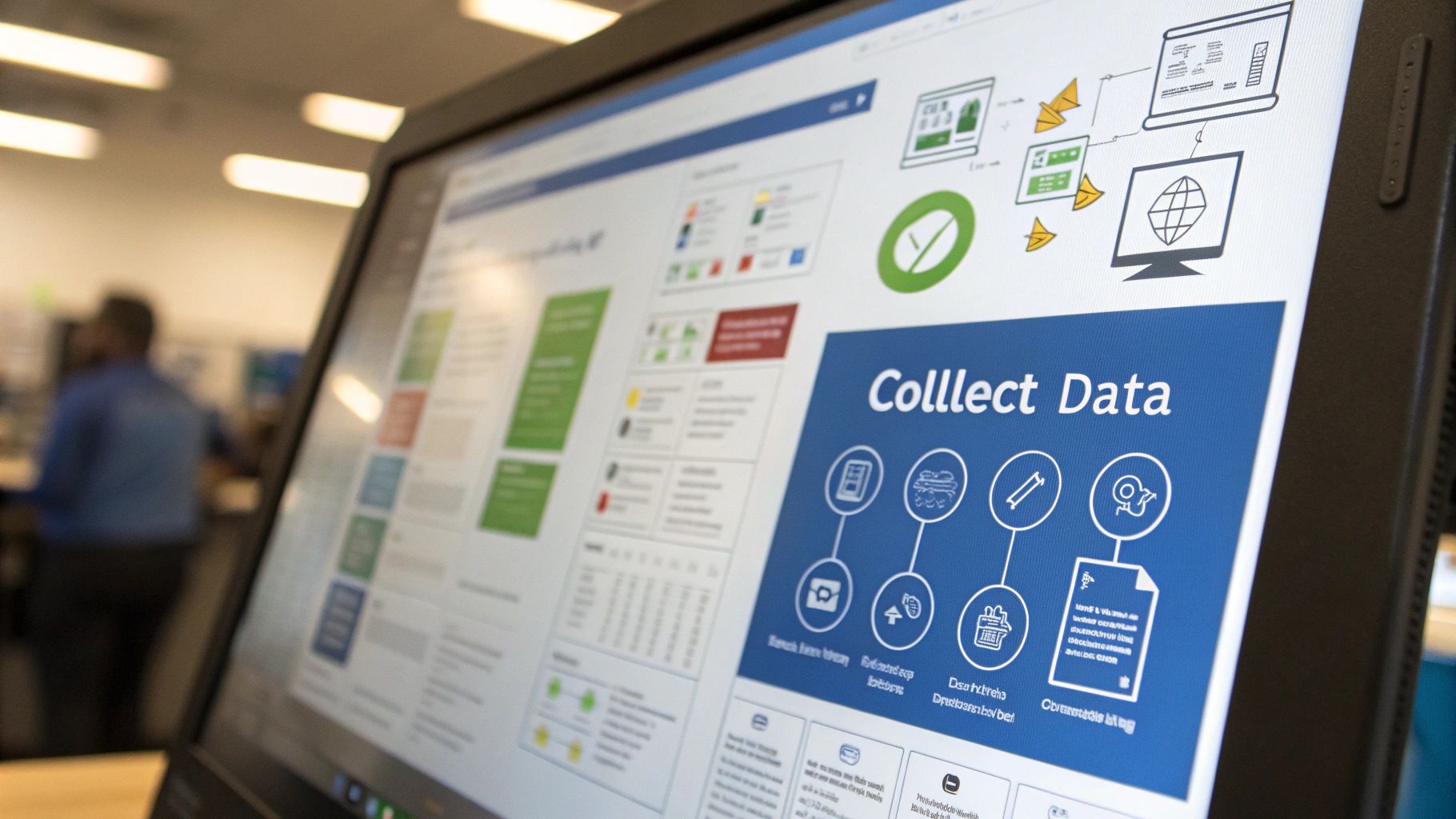
A powerful B2B marketing analytics strategy needs a solid blueprint. Think of it as building a high-performance engine: you need the right fuel (data sources), high-quality parts (platforms), and accurate gauges (key metrics) to ensure everything is driving toward your revenue goals.
This framework starts with identifying and unifying the data sources that feed your RevOps engine. A scattered view means you’re flying blind; a unified one provides the clarity needed for smart, strategic decisions.
Fueling Your Engine: The Core Data Sources
Your analytics framework is only as good as the data you put into it. For any B2B company, two data sources are the non-negotiable foundation for meaningful analysis.
First is your CRM data. Systems like Salesforce and HubSpot are your single source of truth for customer relationships, deal stages, and revenue. This is where you find the facts—which accounts are moving through the pipeline and which deals are closing.
Second is your marketing automation platform (MAP) data. Tools like Marketing Cloud Account Engagement (formerly Pardot) or the HubSpot Marketing Hub track the rich engagement history of your leads and contacts—email opens, webinar sign-ups, content downloads, and website visits. This is the digital body language that signals buyer intent.
Connecting these two is the critical first step. It allows you to draw a straight line from a marketing campaign to a sales opportunity and, eventually, to closed-won revenue. This is how you translate abstract engagement into tangible financial impact. Explore our guide on marketing automation best practices to ensure your platform is set up to capture clean, usable data from the start.
The Gauges That Matter: Key Metric Categories
Once your data is flowing, it’s time to choose the right gauges for your dashboard. In B2B marketing analytics, this means focusing on metrics that measure progress across the entire customer journey, not just top-of-funnel vanity metrics.
Organize your metrics into categories that tell a complete story:
- Lead Velocity & Quality: Monitor your Marketing Qualified Lead (MQL) to Sales Qualified Lead (SQL) conversion rate and the time it takes for a lead to progress through stages. This helps you understand not just lead volume, but lead quality and momentum.
- Pipeline Health & Influence: Look beyond simple lead generation and measure marketing-influenced pipeline and marketing-sourced pipeline. This is how you demonstrate that marketing is creating and accelerating real sales opportunities—a crucial point when proving your team’s value.
- Customer Economics: Focus on Customer Lifetime Value (CLV) and Customer Acquisition Cost (CAC). The ratio between these two (CLV:CAC) is a powerful indicator of your company’s long-term health and the efficiency of your growth engine.
- Revenue & ROI: The metrics that matter most to leadership are Marketing ROI and attribution reporting. These connect your marketing spend directly to the revenue it generates, finally answering the question, “What are we getting for our money?”
By focusing on these metric categories, RevOps leaders can change the conversation from marketing costs to marketing investments. The goal is to build a predictable model where every dollar spent can be traced to a clear, measurable impact on the bottom line.
The B2B market is projected to hit $28 trillion in 2024, intensifying competition for buyer attention. While most marketers produce content like articles (92%) and videos (76%), a staggering 56% struggle to track the customer journey effectively, making it nearly impossible to prove what’s working.
This is why a structured analytics framework isn’t a luxury—it’s essential for survival and growth.
Activating Analytics in Salesforce with B2B Marketing Analytics (B2BMA)
For B2B companies operating within the Salesforce ecosystem—especially those using Marketing Cloud Account Engagement (Pardot)—the path to powerful analytics is clear. Salesforce’s B2B Marketing Analytics (B2BMA) is designed to be your command center, unifying your CRM and marketing automation data into a single, actionable view.
Think of B2BMA as the control panel for your entire RevOps engine. It eliminates the need for manual CSV exports from Pardot and painful data matching in Sales Cloud. B2BMA automates this heavy lifting, consolidating everything into pre-built, customizable dashboards that answer the most critical questions for any marketing, sales, or RevOps leader.
Unlocking Your Data with Pre-Built Dashboards
Out of the box, B2BMA provides several dashboards that offer immediate value by visualizing your entire funnel. These aren’t just random charts; they’re purpose-built tools designed to address specific strategic challenges you face daily. The real power lies in the automated link between marketing activities and sales outcomes. You can finally shift the conversation from “How many leads did we get?” to “How much pipeline did our last campaign influence?”
This unified view is what B2BMA delivers, connecting marketing spend directly to generated pipeline.

With a dashboard like this, a RevOps manager can instantly see how marketing-sourced opportunities are progressing through the funnel and contributing to revenue.
Answering Critical Business Questions
To understand B2BMA in practice, let’s examine its core dashboards and the strategic questions they help RevOps teams answer. Each one offers a specific lens into your go-to-market performance.
| Dashboard Name | Primary Data Sources | Key Business Questions Answered |
|---|---|---|
| Pipeline Dashboard | Salesforce Opportunities, Campaigns, Account & Contact data, Pardot Engagement Data | What is the total pipeline value marketing has influenced? Which campaigns are creating the most valuable deals? |
| Engagement Dashboard | Pardot Email Clicks, Form Submissions, Website Activity, Content Downloads | Which content assets are most effective at moving prospects forward? Are our nurture programs keeping leads engaged? |
| Marketing Manager Dashboard | Aggregated data from all marketing & sales sources | How is our overall funnel performing from top to bottom? Where are the biggest bottlenecks in our lead-to-revenue process? |
These dashboards create a single source of truth that aligns marketing and sales. The age-old arguments over lead quality dissolve when both teams can see exactly how a campaign impacts the sales pipeline in near real-time.
Customizing B2BMA for Your KPIs
The pre-built dashboards are an excellent starting point, but B2BMA’s true power is unlocked when you tailor it to your company’s unique KPIs. Your business doesn’t run on generic metrics, and neither should your analytics.
This is where you can track what truly matters to your organization. You might build custom views to analyze pipeline velocity for a specific industry segment or create a new dashboard to track the performance of an Account-Based Marketing (ABM) initiative.
This level of customization is crucial for deep performance analysis. As you refine your reporting, you’ll want to connect your efforts to financial results. Our guide on how to measure marketing ROI offers a framework that pairs perfectly with the data B2BMA provides.
By tailoring B2BMA, you empower your team with the confidence to shift budget to high-performing channels, resolve funnel friction, and prove marketing’s direct contribution to revenue with hard data.
Using HubSpot for Powerful B2B Marketing Analytics
If your B2B organization runs on HubSpot, you are sitting on a data goldmine. The platform’s core promise—a connected view of the customer journey—is built into its DNA. Forget the constant battle of patching together a fragmented tech stack. HubSpot’s all-in-one design ensures a seamless flow of data, from the first marketing touchpoint to the final sales call. For any RevOps team serious about B2B marketing analytics, this is a massive head start.
The real value isn’t in standard reports. It’s in moving past surface-level vanity metrics to draw a straight line from every marketing action to revenue. When you master HubSpot’s analytics tools, you can stop guessing and start proving your team’s direct impact on the bottom line.
Mastering Core HubSpot Analytics Tools
To turn HubSpot’s data into actionable business intelligence, you must master three core components of its analytics suite. Each provides a critical lens for viewing performance.
- Traffic Analytics: This is your command center for top-of-funnel activity. It goes beyond page views to show you exactly which channels drive visitors—organic search, social media, paid ads, referrals. More importantly, it helps you connect those sources to contact generation and, ultimately, customer acquisition.
- Campaign Reporting: This tool consolidates the performance of all your marketing assets—emails, landing pages, social posts, ads—under a single campaign. It’s how you measure the true impact of a coordinated marketing push, giving you a clear picture of what resonates with your audience and what falls flat.
- Attribution Reporting: For RevOps leaders, this is where it all comes together. HubSpot’s attribution reports connect marketing activities directly to closed-won deals. This is the hard evidence needed to justify your budget and double down on revenue-generating strategies.
The Campaign Analytics dashboard provides a clean, visual summary of campaign performance against key metrics.

This report allows a marketing manager to see at a glance how many sessions, new contacts, and influenced contacts a campaign generated, linking top-of-funnel activity directly to mid-funnel lead generation.
Digging Deeper with Advanced Features
While the core tools offer a fantastic overview, HubSpot’s advanced features enable truly granular analysis. For complex B2B sales cycles, these capabilities are non-negotiable for understanding the subtleties of the buyer’s journey.
One of the most powerful tools is behavioral event tracking. This allows you to track custom on-site interactions beyond simple page views, such as watching a product demo, using a pricing calculator, or clicking a specific CTA.
By tracking these high-intent actions, you can create hyper-targeted segments for your sales team, score leads more accurately, and trigger automated nurture sequences based on a prospect’s genuine interests. This is how you move from passive observation to proactive engagement.
Additionally, HubSpot’s custom reporting lets you build dashboards tailored to your specific business questions. You can pull data from the marketing, sales, and service hubs into one unified view. For instance, you could build a report showing the average sales cycle length for leads from different content downloads or track the lifetime value of customers acquired through specific LinkedIn ad campaigns.
This flexibility allows RevOps leaders to create a single source of truth that aligns every team around the same data and goals. By combining traffic and campaign data with advanced event tracking and custom reports, you transform your HubSpot portal from a marketing tool into a powerful engine for predictable revenue growth.
Integrating AI Into Your Analytics Strategy

Once your B2B marketing analytics framework is established, the next evolution is leveraging AI. AI is transforming analytics from a backward-looking report card into a forward-looking engine for your entire revenue operation.
This isn’t about replacing your team; it’s about giving them superpowers. AI can process massive datasets to spot subtle patterns a human could easily miss, providing a significant competitive edge. It’s about moving faster and making sharper, data-backed decisions.
Practical Applications of AI in B2B Analytics
What does this look like for a RevOps team? The applications are tangible and directly impact your bottom line. AI adds a predictive layer that changes how you approach core marketing and sales operations.
Key examples include:
- Predictive Lead Scoring: Forget manual, rules-based scoring. AI models analyze historical CRM and marketing automation data to identify the firmographic and behavioral traits of your best customers. The system then scores new leads with high accuracy, ensuring your sales team always focuses on opportunities most likely to close.
- Buyer Intent Signal Detection: Imagine knowing which accounts are in-market before they even visit your website. AI tools scan millions of data points across the web for early buying signals—like a target account researching competitors or posting a relevant job. This gives your team a head start to engage high-intent prospects proactively.
- Automated Campaign Optimization: Instead of manual A/B testing, AI can automatically shift budget to the best-performing ads, channels, and audiences in real time. This ensures you are always maximizing the return on every marketing dollar.
Integrating AI isn’t just about adding another tool to your tech stack. It’s a strategic shift that turns your data into your most valuable asset, enabling you to anticipate market changes and customer needs instead of just reacting to them.
Real-World Considerations for Getting Started
Implementing AI isn’t a plug-and-play solution. Success depends on establishing a solid foundation and having realistic expectations. Without it, even the most powerful algorithm will fail.
First and foremost, you need clean, high-quality data. An AI model is only as smart as the information it learns from. If your Salesforce or HubSpot instance is a mess of duplicate records and inconsistent fields, your AI’s predictions will be unreliable. A thorough data audit isn’t optional; it’s step one. Our guide on how to choose a CRM can help you understand the foundational role it plays.
It’s also crucial to manage expectations. Forrester’s 2025 predictions show that while AI adoption is accelerating, it takes time to see a full return. While 49% of decision-makers expect an ROI within one to three years, another 44% don’t expect results for three to five years. This is a long-term commitment, not a quick win.
By preparing your technology, cleaning your data, and setting clear goals, you can position your organization to benefit from AI and build the next evolution of a data-driven RevOps engine.
From Insights to Revenue: Putting Your Data to Work
Having powerful B2B marketing analytics tools is great, but dashboards and reports are just decorations without a clear plan to turn those numbers into revenue. This is where the real work begins. The goal is to build a culture where every decision is backed by data and aimed squarely at improving the bottom line.
It all starts with aligning marketing and sales. When both teams look at the same source of truth—whether it’s a Salesforce dashboard or a custom report in HubSpot—arguments over lead quality disappear. Instead, you can have productive conversations like, “Which campaigns are accelerating deals through the pipeline?” or “How can we replicate the success of our best-performing accounts?”
Building a Culture of Constant Improvement
An effective RevOps engine doesn’t just report on past performance; it uses that data to actively shape what happens next. This requires a commitment to a continuous cycle of measuring, analyzing, and optimizing your approach. Your analytics should fuel a feedback loop that constantly refines your go-to-market strategy.
In practice, this means regularly diving into your core metrics to:
- Spot Bottlenecks: Identify exactly where leads are getting stuck in the funnel so you can deploy targeted plays to get them moving.
- Bet on Your Winners: Stop wasting budget on underperforming channels. Instead, double down on campaigns proven to generate high-quality pipeline.
- Test and Learn: Use your data as a baseline to experiment with new messaging, content, or channels, knowing you can measure the impact of your changes.
Building this culture isn’t a one-time setup. It’s an ongoing commitment to asking smarter questions, challenging assumptions, and making every marketing dollar accountable for its contribution to revenue.
This shift toward data-driven strategy is happening everywhere. B2B marketing data spending in the US is on track to hit $4.13 billion by 2027, with annual growth accelerating to 4.0%. This investment reflects a laser focus on using data for smarter segmentation, pipeline growth, and predictive analytics. You can discover more about this growing investment in data-driven marketing strategies to see what it means for your business.
Your Next Actionable Step
Getting started doesn’t mean you have to overhaul everything at once.
Instead, pick one thing. Conduct a quick audit of your current processes and identify a single, high-impact area for improvement. Maybe it’s standardizing your UTM parameters, building one clean dashboard for marketing-influenced pipeline, or cleaning up messy lead source data.
By focusing on one tangible win, you create momentum. That small victory proves the value of B2B marketing analytics and lays the groundwork for a more strategic, revenue-focused operation.
Common B2B Marketing Analytics Questions
Diving into B2B marketing analytics can feel overwhelming, especially when leadership demands a clear connection between every marketing dollar and revenue. Most RevOps and marketing leaders we talk to are wrestling with the same core questions.
Getting straight answers is the first step. This section cuts through the noise and tackles the questions we hear most often from teams using platforms like Salesforce and HubSpot.
What Is the Difference Between B2B and B2C Marketing Analytics?
The short answer? The sales cycle. It’s a completely different beast.
B2B marketing analytics must make sense of a long, complex buying journey that can take months—or even years—and involves a committee of decision-makers. The focus is on account-level engagement, pipeline velocity, and attributing credit to the dozens of touchpoints that influence a deal.
B2C analytics, on the other hand, typically tracks a much shorter, more direct path to purchase made by an individual. The metrics are often immediate, like shopping cart abandonment rates or average order value. B2B requires a deep connection to a CRM to tie marketing efforts all the way to a closed-won deal, a far more complex puzzle to solve.
How Do I Start if My Marketing Data Is a Mess?
First, don’t try to boil the ocean. That’s a surefire way to get stuck in analysis paralysis. Start small and build momentum.
Begin with a focused data audit. Pinpoint your most critical systems—typically your CRM and marketing automation platform. Concentrate your initial energy on cleaning and standardizing the data in just those two places.
Next, select two or three metrics that truly matter to the business, like your MQL-to-SQL conversion rate or marketing-influenced pipeline. Then, get ruthlessly consistent with your UTM parameters and lead source tracking for all new campaigns. It’s far better to track a few things accurately than dozens of things poorly. This builds a solid foundation you can trust and expand on later.
A clean data foundation isn’t just a “nice to have”; it’s the bedrock of any successful analytics strategy. Without trustworthy data, even the most advanced tools will produce unreliable insights, leading to flawed decisions and wasted budget.
Which Attribution Model Is Best for B2B Marketing?
Anyone who tells you there’s one “best” attribution model for B2B doesn’t understand B2B. The right model depends entirely on your sales cycle and strategic goals.
Simple models like first-touch and last-touch are easy to explain, but they oversimplify the reality of B2B buying decisions and leave significant value unassigned.
For most B2B companies, a multi-touch attribution model is the way to go because it provides a more complete and honest picture. Models like Linear, U-shaped, or W-shaped assign credit to multiple touchpoints along the customer’s journey. A great place to start is with the native tools in your platform, like Salesforce Campaign Influence or HubSpot’s attribution reports. As you gain confidence, you can customize your model to better reflect how your customers actually buy.
Ready to transform your messy data into a powerful RevOps engine? MarTech Do specializes in auditing and optimizing Salesforce and HubSpot environments to provide the clear, actionable insights you need to drive predictable revenue growth. Schedule a consultation with our experts today.