
In today’s competitive B2B landscape, generic automation is no longer enough. Driving measurable growth requires sophisticated, data-driven B2B marketing automation strategies that align your entire revenue engine. For marketing operations, sales operations, and RevOps managers using powerful platforms like Salesforce, MCAE (fka Pardot), and HubSpot, the challenge isn’t just if you should automate, but how you can do so strategically to eliminate process gaps, clean up data, and accelerate your go-to-market strategy.
This guide moves beyond surface-level advice to provide 10 actionable strategies, complete with implementation tips tailored specifically for B2B companies leveraging the Salesforce, MCAE (fka Pardot), and HubSpot ecosystems. Each one is designed to help you leverage your existing tech stack to its full potential, transforming your marketing automation from a simple tool into a core driver of revenue optimization. We will explore how to refine everything from lead scoring and account-based marketing (ABM) workflows to integrating predictive analytics and building a unified customer profile.
The goal is to provide clear, professional insights that enable you to build scalable processes, improve pipeline visibility, and create efficient alignment between your marketing and sales teams. Let’s explore the strategies that will help you achieve true operational excellence.
1. Lead Scoring and Qualification
One of the most powerful B2B marketing automation strategies is implementing a systematic lead scoring and qualification process. This automates the ranking of prospects based on their behavior, demographics, and engagement levels, allowing your sales team to stop chasing low-quality leads and focus their efforts on high-value, sales-ready opportunities. An effective model combines explicit data like company size, industry, and job title with implicit signals like email opens, website visits, and content downloads to create a predictive score of sales readiness.

This strategy is foundational for aligning marketing and sales. Platforms like HubSpot and Salesforce’s MCAE (fka Pardot) use these scores to trigger workflows, automatically assigning high-scoring leads to sales development representatives (SDRs) while nurturing lower-scoring leads with targeted content. A foundational step for defining these scores is creating effective buyer personas to understand your ideal customer profile.
Implementation Tips
To get started, collaborate closely with your sales team to define the criteria for a marketing qualified lead (MQL) within your CRM.
- Start Simple: Begin with a basic scoring model in your marketing automation platform and add complexity over time as you gather more data.
- Use Positive & Negative Scores: Award points for engagement (e.g., attending a webinar) but also subtract points for negative signals (e.g., inactivity for 90 days, visiting the careers page).
- Review and Adjust: Analyze conversion data quarterly within Salesforce or HubSpot to refine your scoring criteria and ensure accuracy.
- Implement Lead Recycling: Create a workflow to automatically place leads who fall below the MQL threshold back into a nurturing campaign.
For more information, explore these lead scoring best practices from martechdo.com.
2. Account-Based Marketing (ABM)
Account-based marketing (ABM) flips the traditional B2B marketing funnel. Instead of casting a wide net to capture individual leads, ABM is a strategic approach that focuses marketing and sales resources on a defined set of high-value target accounts. This B2B marketing automation strategy treats each account as a market of one, orchestrating highly personalized, multi-channel campaigns designed to resonate with key decision-makers and influencers within that specific organization.

This strategy is exceptionally effective for B2B companies with complex sales cycles and high-value deals. Automation platforms like Demandbase, 6sense, and Terminus integrate with Salesforce and HubSpot, leveraging AI and intent data to identify which of your target accounts are actively researching solutions like yours. This allows you to engage the right accounts at the right time with the right message, creating a coordinated and relevant buying experience that significantly improves conversion rates from pipeline to closed-won.
Implementation Tips
To launch a successful ABM program, ensure tight alignment between your marketing and sales operations teams from day one.
- Start Small and Scale: Begin with a pilot program targeting 10-20 high-value accounts before expanding your efforts.
- Use Intent Data: Leverage third-party intent data to prioritize accounts showing active buying signals, ensuring your outreach is timely and relevant.
- Align Sales and Marketing: Both teams must agree on the target account list and the metrics for success, moving from lead-level to account-level reporting within your CRM.
- Personalize at Scale: Automate the delivery of personalized content, ads, and landing pages tailored to the specific needs and pain points of each target account.
3. Marketing Automation Workflows and Nurture Campaigns
Implementing automated workflows and nurture campaigns is a core B2B marketing automation strategy for guiding prospects through the buyer’s journey. These are automated sequences of emails, content, and touchpoints that trigger based on specific actions or criteria. This ensures you deliver the right message at the right time, moving leads from initial awareness to sales-readiness without constant manual intervention. A well-organized nurture campaign maintains engagement with prospects who are not yet prepared to buy, building trust and keeping your brand top-of-mind.
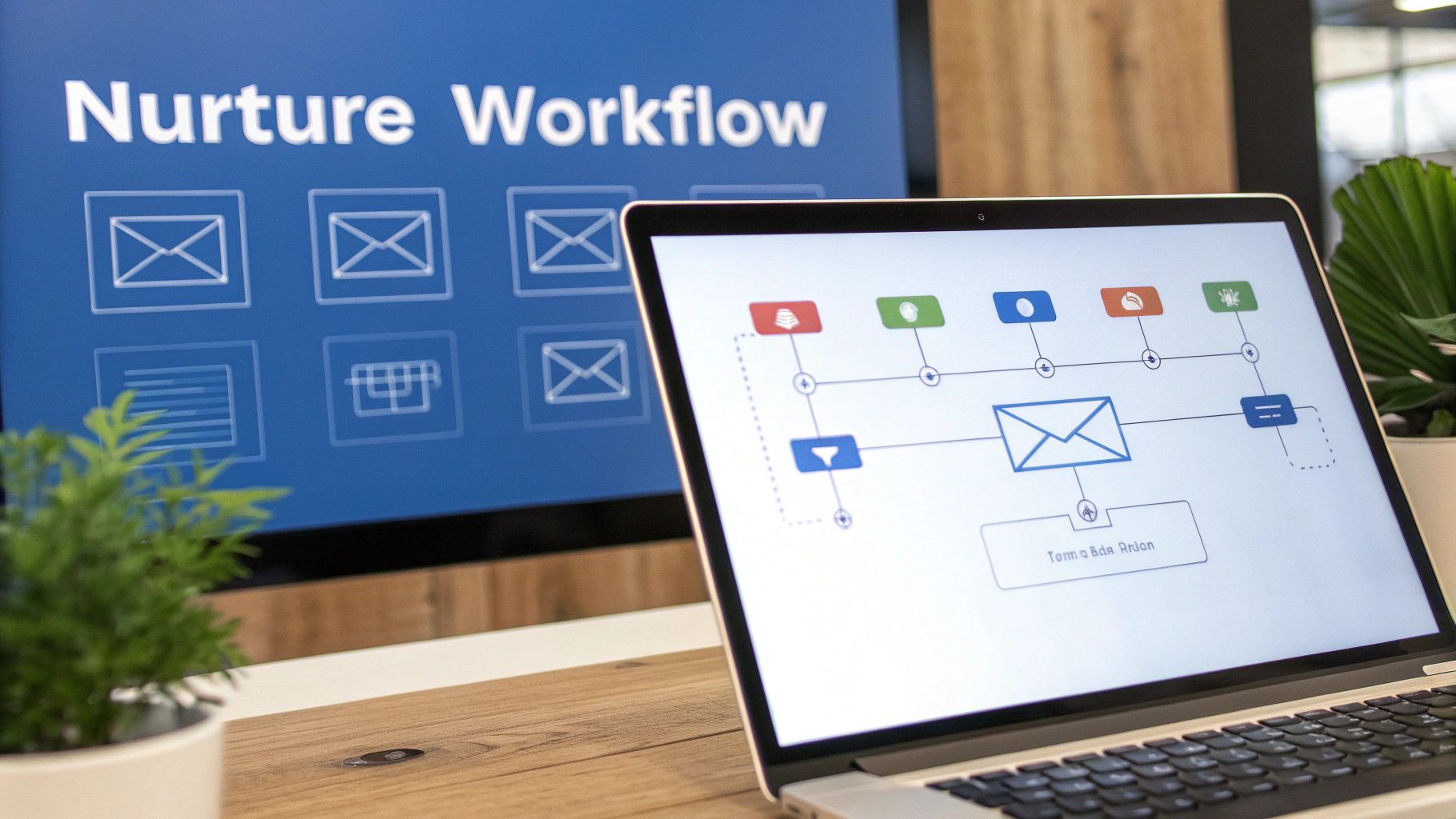
This strategy bridges the gap between marketing-generated interest and sales conversion. Platforms like HubSpot and MCAE (fka Pardot) excel at building these sequences, allowing you to create separate paths for different personas or segments. For instance, a workflow could onboard new leads from a webinar with educational content, while another sequence targets prospects in the financial services industry with tailored case studies. This targeted approach significantly improves engagement and conversion rates compared to generic email blasts.
Implementation Tips
To deploy effective workflows, start by mapping them directly to your defined buyer journey stages.
- Use Behavioral Triggers: Prioritize workflows that start based on user actions (e.g., downloaded an ebook, visited a pricing page) over simple time-based delays for higher relevance.
- Segment Your Workflows: Create distinct nurture paths for different personas, industries, or pain points to ensure your messaging resonates deeply.
- Limit Sequence Length: Aim for 5-7 automated touches. If a lead hasn’t engaged by then, trigger a task for a sales representative to perform a manual review.
- Test and Optimize: Continuously monitor metrics like open rates, click-through rates, and unsubscribe rates to adjust send times, frequency, and content for better performance.
For practical ideas, review these marketing automation workflow examples from martechdo.com.
4. Predictive Analytics and AI-Powered Insights
One of the most advanced B2B marketing automation strategies involves leveraging predictive analytics and AI to forecast future outcomes. This approach uses machine learning algorithms and historical data to identify which prospects are most likely to convert, the optimal timing for outreach, and potential customer churn. It analyzes vast datasets to uncover patterns that would be impossible for humans to detect, enabling more accurate forecasting and smarter, data-driven decisions.

This strategy empowers marketing operations to move from reactive to proactive engagement. For example, platforms like Salesforce Einstein can predict deal outcomes, while tools like 6sense use AI to identify in-market accounts displaying active buying signals. For a deeper understanding of how artificial intelligence is actively transforming lead acquisition, you might find additional insights from resources on AI-powered lead generation strategies. This allows teams to prioritize resources on accounts with the highest propensity to buy, dramatically improving efficiency.
Implementation Tips
To effectively integrate predictive analytics, focus on building a strong data foundation and a clear use case.
- Start with Clean Data: Ensure your historical Salesforce or HubSpot data is accurate, complete, and well-organized before implementing any AI models.
- Validate and Refine: Regularly test model predictions against actual outcomes to measure accuracy and refine the algorithms over time.
- Focus on Explainability: Choose AI tools that can explain the “why” behind their predictions to gain buy-in from your sales and marketing teams.
- Combine AI with Human Judgment: Use AI-powered insights to augment, not replace, the strategic expertise and contextual knowledge of your team.
- Monitor for Bias: Continuously check your models for biases across different customer segments to ensure fair and equitable predictions.
5. Email Marketing Automation with Segmentation
Beyond generic email blasts, one of the most impactful B2B marketing automation strategies is combining advanced segmentation with triggered email workflows. This approach involves dividing your contact database into smaller, distinct groups based on shared characteristics like industry, job role, company size, or past engagement. By doing so, you can deliver highly relevant and personalized messaging automatically, moving far beyond a one-size-fits-all strategy.
This method is crucial for nurturing leads effectively through a long B2B sales cycle. For instance, platforms like HubSpot or MCAE (fka Pardot) can automatically send a series of technical whitepapers to contacts with an “IT Manager” job title, while sending high-level ROI case studies to those identified as “C-Suite” executives. This ensures each segment receives content that directly addresses their specific pain points and priorities, significantly boosting open rates, click-through rates, and ultimately, conversions.
Implementation Tips
To effectively launch this strategy, start by identifying your most valuable customer segments and the data points needed to define them within your CRM.
- Start Small: Begin by creating 3-5 core segments based on firmographic data (e.g., industry, company size) and expand to behavioral segments over time.
- Use Dynamic Content: Personalize sections of a single email template for different segments. For example, show different customer testimonials based on the recipient’s industry.
- Leverage Progressive Profiling: Use forms to gradually collect segmentation data over multiple interactions, which is less intrusive than asking for everything at once.
- Refine and Re-segment: Analyze engagement data quarterly to identify new behavioral patterns. Re-segment your lists to maintain relevance and improve campaign performance.
- Maintain List Hygiene: Regularly monitor bounce rates and engagement for each segment to remove inactive or invalid contacts, ensuring high deliverability.
6. Behavioral Trigger Marketing
One of the most immediate and impactful B2B marketing automation strategies is leveraging behavioral trigger marketing. This real-time approach automatically sends highly relevant messages and content at the precise moment a prospect exhibits a specific behavior. These triggers can include anything from visiting a key pricing page and downloading a whitepaper to prolonged inactivity, ensuring your communications are timely and directly related to the prospect’s current interests. This relevance dramatically improves engagement rates and accelerates the journey from prospect to qualified lead.
Platforms like HubSpot and MCAE (fka Pardot) excel at this, allowing you to build sophisticated workflows based on user actions. For instance, a trigger can enroll a prospect who downloaded an ebook into a relevant email nurture sequence or alert a sales rep via a Salesforce task when a known contact revisits the demo request page multiple times. The core principle of this strategy is to move from broadcasting messages to engaging in a contextual, one-to-one dialogue driven by the prospect’s own actions.
Implementation Tips
To deploy this strategy effectively, start by mapping your customer journey and identifying key conversion points where a timely message would be most valuable.
- Start with High-Impact Triggers: Begin with clear, high-intent actions, such as a content download or a pricing page visit, to ensure early wins.
- Implement Frequency Caps: Protect your audience from “trigger fatigue” by limiting the number of automated messages a single person can receive within a set period.
- Use Progressive Delays: Make your automation feel more human and less robotic by adding slight, randomized delays before a trigger fires.
- Coordinate Across Teams: Ensure triggers are aligned across marketing, sales, and customer success to create a seamless, cohesive customer experience.
7. Content Marketing Automation and Distribution
Content marketing automation and distribution is a strategy focused on using systems to create, distribute, and amplify content across multiple channels. This approach goes beyond simple scheduling, enabling you to deliver personalized content to the right user at the optimal stage of their journey. By automating recommendations and coordinating multi-channel campaigns, you ensure your valuable assets reach and resonate with your target audience without constant manual intervention.
This strategy is crucial for scaling your content operations and maximizing its impact. For instance, platforms like HubSpot use behavioral data to power dynamic content blocks within emails or on landing pages, showing different calls-to-action based on a prospect’s industry or previous engagement. This level of automation turns a static content library into a dynamic, personalized experience, ensuring your thought leadership drives tangible results within your sales and marketing operations.
Implementation Tips
To effectively automate your content strategy, focus on building a strong foundation and leveraging smart systems.
- Organize Content Assets: Create a comprehensive content library organized by topic, buyer persona, and buying stage to facilitate automated recommendations.
- Use Dynamic Content: Implement dynamic content blocks in your emails and on your website to personalize messaging and offers at scale, increasing relevance.
- Automate Social Sharing: Use tools like Hootsuite or Buffer to schedule and automatically share new and evergreen content across social media channels, extending your organic reach.
- Track Cross-Channel Performance: Set up automated reporting to track how content performs across different distribution channels, allowing you to optimize your strategy based on real data.
8. Marketing and Sales Alignment with Revenue Operations
True B2B marketing automation strategies extend beyond departmental silos to unify the entire revenue-generating engine. This is the core principle of Revenue Operations (RevOps), a framework that integrates marketing, sales, and customer success under a single, unified operational model. Automation is the connective tissue that makes RevOps work, orchestrating seamless handoffs, enforcing process discipline, and ensuring every team is working from the same data set toward shared financial goals. This creates a cohesive customer journey from initial awareness to long-term loyalty.
RevOps moves accountability from isolated team metrics to overarching business outcomes like pipeline velocity and customer lifetime value. Platforms like Salesforce Revenue Cloud and HubSpot’s Operations Hub are designed to support this model by automating data synchronization and providing a single source of truth. By using automation to connect disparate systems and processes, organizations can eliminate friction, improve forecasting accuracy, and deliver a consistent customer experience that drives sustainable growth. This strategic alignment is a powerful competitive advantage.
Implementation Tips
To get started with a RevOps-driven automation strategy, focus on creating operational unity between your teams.
- Establish Shared Metrics: Define and track cross-functional KPIs, such as lead-to-close conversion rates and pipeline velocity, using automated dashboards for real-time visibility.
- Automate Handoffs with SLAs: Create clear Service Level Agreements (SLAs) for lead follow-up and use automation to assign tasks and send notifications when thresholds are met or missed.
- Systematize Communication: Schedule regular sync meetings between marketing, sales, and success leaders, using automation to generate agendas and distribute performance reports beforehand.
- Celebrate Shared Wins: Reinforce alignment by publicly celebrating achievements that resulted from cross-departmental collaboration, highlighting how automation contributed to the success.
9. Conversational Marketing and Chatbot Automation
Among the most immediate B2B marketing automation strategies is the use of conversational marketing and chatbots. This approach leverages automated systems like live chat and messaging platforms to engage website visitors in real-time, right when their intent is highest. Instead of making prospects fill out a form and wait for an email, conversational tools capture interest, qualify leads, and provide instant support, dramatically shortening the sales cycle.
This strategy transforms a passive website into an active engagement channel. Platforms like Drift and Intercom use chatbots to ask qualifying questions, book meetings for sales reps, and route inquiries to the correct department automatically. By integrating with Salesforce or HubSpot, these conversations can be personalized from the very first interaction, creating a highly relevant and efficient experience for high-value prospects.
Implementation Tips
To effectively deploy conversational automation, focus on creating a seamless and helpful user journey.
- Start with Qualification: Begin with a simple chatbot script focused on core qualification questions (e.g., company size, role, primary challenge).
- Ensure a Human Handoff: Always provide a clear and easy path for a prospect to connect with a live human agent when needed.
- Integrate with Your CRM: Connect your chatbot to HubSpot or Salesforce to pass conversation transcripts and new lead data directly to your sales team for context.
- Test and Refine: Use A/B testing on your chatbot’s opening lines and questions. Regularly review chat transcripts to identify common questions and areas for improvement.
10. Customer Data Platform (CDP) Integration and Unified Customer Profiles
One of the most advanced B2B marketing automation strategies involves integrating a Customer Data Platform (CDP). A CDP acts as a central hub, collecting customer data from every touchpoint—your CRM, website, email platform, and even offline sources—to build a single, unified profile for each contact. This provides your automation tools with a complete, 360-degree view of the customer journey, from initial awareness to post-purchase engagement.
This unified profile is the key to unlocking true personalization at scale. Instead of running campaigns based on siloed data, marketing automation platforms like Salesforce or HubSpot can leverage the rich, contextual information from a CDP to deliver hyper-relevant messages. For instance, platforms like Segment and Tealium enable automation workflows to trigger based on a combination of online behavior, purchase history, and even customer support interactions, ensuring every communication is timely and impactful.
Implementation Tips
To effectively integrate a CDP, focus on building a solid data foundation from the start.
- Establish Data Governance: Begin by creating clear standards for data quality, formatting, and management to ensure the information flowing into your CDP is reliable.
- Map All Data Sources: Before implementation, comprehensively map every system that collects customer data to plan how it will be consolidated and unified.
- Prioritize Privacy: Embed data privacy and compliance (like GDPR or CCPA) into your CDP strategy from day one to build trust and avoid regulatory issues.
- Start with High-Value Use Cases: Implement gradually by focusing on the use cases that will deliver the most immediate impact, such as personalizing onboarding sequences or identifying at-risk accounts.
For a deeper dive, explore these insights on CRM and marketing automation integration from martechdo.com.
B2B Marketing Automation: 10-Strategy Comparison
| Item | Implementation complexity | Resource requirements & cost | Expected outcomes | Ideal use cases | Key advantages |
|---|---|---|---|---|---|
| Lead Scoring and Qualification | Medium — scoring models + CRM integration | Medium ($2k–$10k/yr); clean data, CRM, analytics | Prioritized leads, higher conversion, shorter sales cycles | B2B firms with many leads; marketing-sales handoff | Focuses sales on sales-ready prospects; improves resource allocation |
| Account-Based Marketing (ABM) | High — personalized campaigns per account, cross-team coordination | High ($20k–$100k+/yr); dedicated teams, account research, tooling | Higher ROI, larger deal sizes, tighter alignment | Targeting high-value enterprise accounts | Highly personalized outreach; increases deal value and alignment |
| Marketing Automation Workflows & Nurture Campaigns | Low–Medium — workflow mapping and rule setup | Low–Medium ($500–$5k/yr); automation platform, content | Consistent engagement, improved conversions, time savings | Long sales cycles, onboarding, lead nurturing | Scales personalized sequences; reduces manual effort |
| Predictive Analytics & AI-Powered Insights | High — ML models, data pipelines, explainability efforts | High ($10k–$50k+/yr); large datasets, data science, compute | Better forecasting, smarter targeting, proactive actions | Large-data environments needing prioritization and forecasting | Data-driven predictions improve targeting and ROI |
| Email Marketing Automation with Segmentation | Low — list segmentation and template setup | Low ($300–$3k/yr); email platform, clean data | Higher open/click rates, improved engagement and retention | Email-centric campaigns, retention, scalable outreach | Increases relevance and engagement at low cost |
| Behavioral Trigger Marketing | Medium — real-time tracking and trigger rules | Medium ($2k–$8k/yr); event tracking, orchestration tools | Timely engagement, higher conversion rates | Time-sensitive actions, website-driven lead capture | Sends messages at optimal moments; boosts conversions |
| Content Marketing Automation & Distribution | Medium — content workflows and personalization | Medium ($1k–$5k/yr); content library, distribution and recommendation tools | Wider reach, consistent messaging, improved engagement | Content-heavy strategies, thought leadership, social distribution | Scales content delivery and personalization across channels |
| Marketing & Sales Alignment (Revenue Operations) | Very High — organizational change, integrated systems | Very High ($30k–$100k+/yr); cross-functional teams, integrated tech | Unified metrics, improved pipeline hygiene, accurate forecasting | Enterprises aligning revenue functions at scale | Single source of truth; enforces cross-team accountability |
| Conversational Marketing & Chatbot Automation | Low–Medium — bot design, NLP tuning, handoff flows | Low–Medium ($500–$3k/yr); chatbot platform, integration, training | Faster responses, higher lead capture, automated qualification | High-traffic sites, initial qualification, support triage | Immediate engagement; reduces response time and cost per lead |
| Customer Data Platform (CDP) Integration & Unified Profiles | Very High — identity resolution, data architecture | Very High ($50k–$250k+/yr); IT, data science, integrations | Unified customer profiles, improved personalization, omnichannel activation | Organizations with multiple data sources needing unified view | Eliminates data silos; enables accurate segmentation and activation |
Activating Your Strategy: From Plan to Profit
The journey through these advanced B2B marketing automation strategies reveals a powerful truth: automation is not just about efficiency, it’s about precision. Moving beyond basic email sends to embrace sophisticated tactics like predictive lead scoring, hyper-personalized ABM campaigns, and integrated CDP-driven customer profiles is what separates high-growth B2B organizations from the rest. The strategies we’ve explored are not independent tactics but interconnected components of a cohesive revenue engine.
From building dynamic nurture sequences in HubSpot or MCAE (fka Pardot) that adapt to prospect behavior to leveraging AI for predictive insights directly within your Salesforce CRM, the core theme is consistent. Success hinges on a deep understanding of your customer, clean and accessible data, and a commitment to aligning your sales and marketing functions under a unified Revenue Operations framework. These are the pillars that transform automation from a set of tools into a strategic asset.
Your Path to Automation Mastery
Mastering these concepts requires a strategic, phased approach. Jumping into every strategy at once is a recipe for wasted resources and disappointing results. Instead, focus on building a strong foundation and prioritizing initiatives based on their potential impact on your unique business goals.
Your actionable next steps should be clear and methodical:
- Start with an Audit: Before implementing any new B2B marketing automation strategies, conduct a thorough audit of your current tech stack, data hygiene, and internal processes. Identify bottlenecks, data gaps, and the most significant opportunities for improvement. A clear baseline makes it easier to measure success.
- Prioritize One or Two Initiatives: Do not try to boil the ocean. Select one or two strategies from this list that align directly with your most pressing business challenges. Is lead quality the biggest issue? Focus on refining your lead scoring model. Struggling to break into key accounts? Launch a pilot ABM program.
- Focus on Data & Alignment: Ensure your data is clean, centralized, and actionable before launching complex workflows. Simultaneously, work to strengthen the alignment between your marketing and sales teams. A shared understanding of goals, definitions (like MQLs and SQLs), and processes is non-negotiable for success.
Ultimately, the goal is to build an intelligent, scalable system that not only automates tasks but also delivers better buying experiences and drives predictable revenue growth. By moving from a high-level plan to tactical execution, you can harness the full power of your marketing automation platform and turn your strategic vision into tangible profit.
Ready to translate these powerful B2B marketing automation strategies into measurable results? MarTech Do specializes in auditing, implementing, and optimizing Salesforce, MCAE (fka Pardot), and HubSpot ecosystems to build high-performance revenue engines. If you’re ready to move beyond theory and activate a truly effective automation framework, contact us for a consultation.