

In the complex B2B landscape, selecting the right sales management software is a critical RevOps decision, not just an IT purchase. The ideal platform must seamlessly integrate with your existing MarTech stack—whether Salesforce, HubSpot, or Pardot (MCAE)—and provide actionable insights that align marketing and sales operations. Generic feature lists and marketing hype don’t drive strategic decisions; rigorous analysis of implementation, integration, and ROI potential does. This is why finding the best sales management software requires a focus on practical application for B2B RevOps.
This guide moves beyond surface-level reviews to offer a detailed breakdown for marketing operations, sales operations, and RevOps leaders. We dissect the top platforms, evaluating them on criteria that matter for sophisticated B2B teams: implementation complexity, integration capabilities with core marketing automation systems, and their ability to streamline complex go-to-market strategies.
Here, you will find an in-depth analysis of each tool, complete with screenshots and direct links, to help you identify the solution that best fits your revenue operations. We’ll equip you with the insights needed to choose a platform that empowers your sales team, optimizes your revenue engine, and drives sustainable growth.
1. Salesforce Sales Cloud
Salesforce Sales Cloud is the definitive enterprise-grade platform in the CRM and sales management software space. It provides an end-to-end solution designed for B2B organizations needing deep customization and scalability to manage complex sales cycles and GTM strategies. Its core strength lies in its ability to centralize every aspect of the sales process, from lead and opportunity management to intricate forecasting and revenue intelligence, making it the system of record for countless RevOps teams.
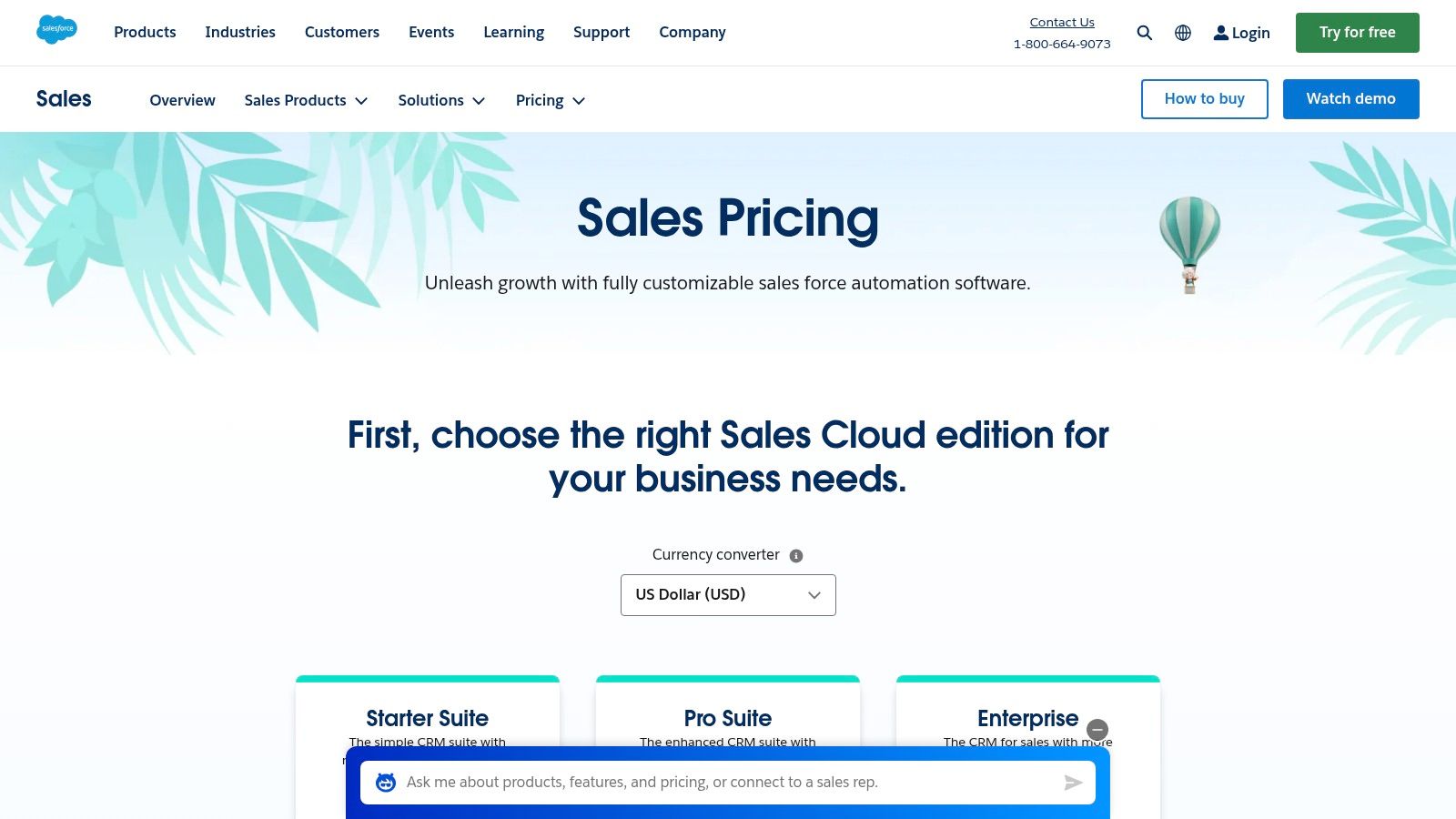
This platform excels where others fall short, particularly for enterprises managing multiple territories, complex quota structures, and sophisticated partner channels. The embedded AI, Einstein, provides predictive lead scoring and forecasting insights, moving teams from reactive to proactive decision-making. For operations leaders, its robust API and the vast AppExchange ecosystem ensure it can integrate with virtually any MarTech or business system.
Key Considerations
- Best For: Mid-market to enterprise B2B companies with dedicated sales operations or RevOps teams that can manage and customize the platform.
- Pricing: Starts at $25/user/month (billed annually) for the “Starter” tier, scaling up to $500/user/month for “Unlimited+”, with most B2B teams opting for the “Enterprise” or “Unlimited” tiers for full functionality. A 30-day free trial is available.
- Pros: Highly configurable, unparalleled AppExchange ecosystem, and robust native analytics.
- Cons: Higher total cost of ownership (TCO) due to implementation, customization, and administration costs; a steep learning curve often requires specialized implementation partners.
Website: https://www.salesforce.com/sales/pricing/
2. HubSpot Sales Hub
HubSpot Sales Hub has solidified its position as a leading sales management software, particularly for mid-market B2B teams prioritizing ease of use, rapid implementation, and tight marketing alignment. Built on its powerful Smart CRM, it offers a clean, intuitive platform that consolidates the entire sales toolkit—from deal pipelines and quoting to native email sequences and meeting scheduling. Its strength lies in its frictionless user experience, enabling reps to achieve high adoption with minimal training.
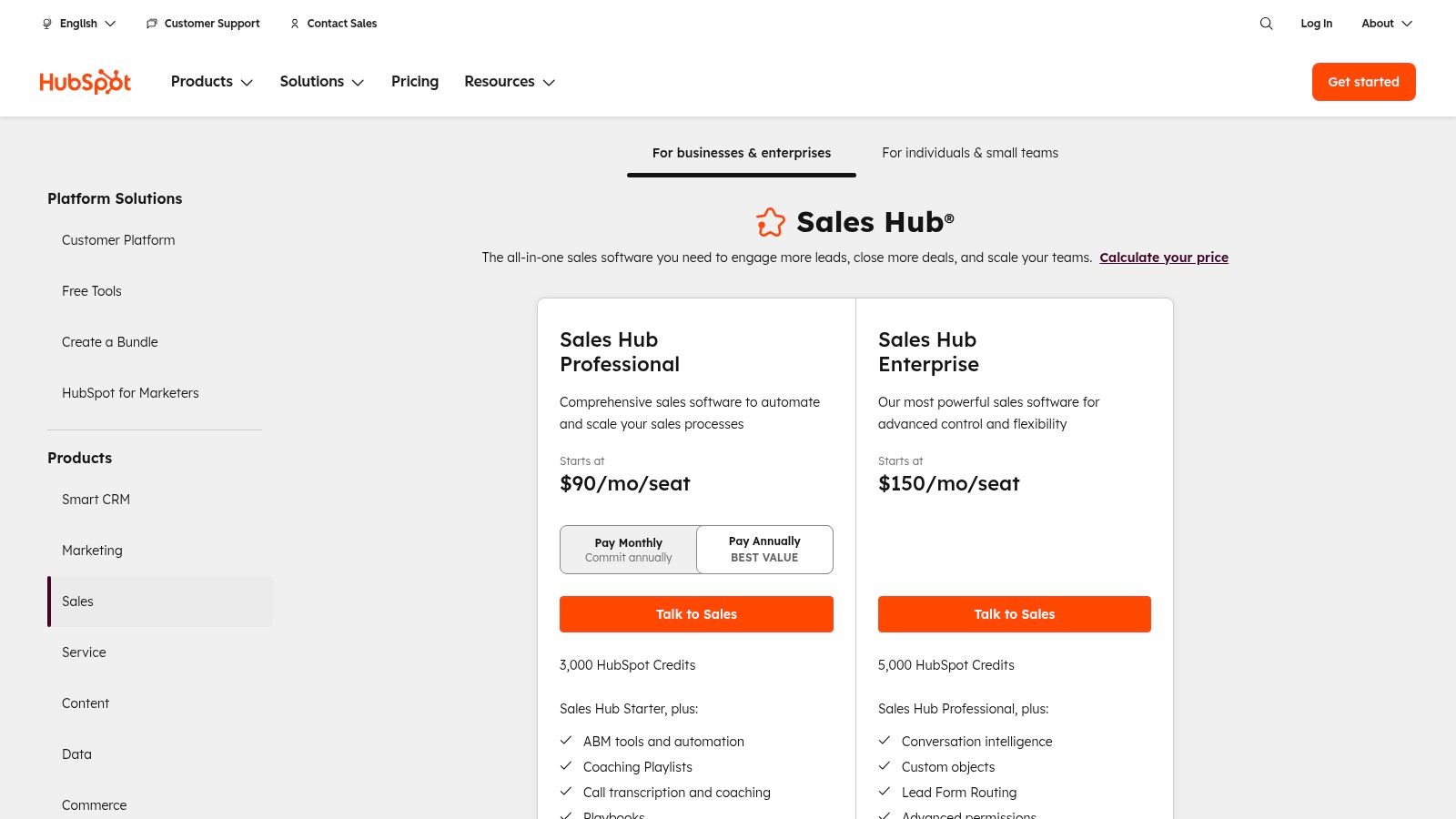
This platform excels for organizations seeking an all-in-one commercial engine, especially when paired with HubSpot’s Marketing and Service Hubs. Features like sales automation (sequences), playbooks, and forecasting are designed to streamline sales processes without the administrative overhead found in enterprise-grade alternatives. For RevOps leaders, the unified data model across the entire HubSpot platform provides a clear, 360-degree view of the customer journey.
Key Considerations
- Best For: Small to mid-market B2B companies looking for a user-friendly, all-in-one platform with a fast time-to-value and strong alignment between marketing and sales operations.
- Pricing: Starts with a generous free tier. Paid plans begin at $15/user/month (billed annually) for “Starter,” scaling to $150/user/month for “Professional” and $1,200/month (for 10 users) for “Enterprise.” A free trial is available.
- Pros: Excellent free tier for small teams, a clean user experience with fast time-to-value, and strong educational resources through HubSpot Academy.
- Cons: Advanced automation and reporting are available only in higher tiers, and mandatory onboarding fees apply for Pro and Enterprise plans.
Website: https://www.hubspot.com/pricing/sales
3. Microsoft Dynamics 365 Sales
Microsoft Dynamics 365 Sales is an enterprise-grade sales force automation platform that excels for organizations already embedded within the Microsoft ecosystem. Its primary strength is the seamless, native integration with Microsoft 365 and the broader Power Platform, creating a unified workspace for sales teams. This makes it a powerful contender in the list of best sales management software for companies standardizing on Microsoft technology for their go-to-market stack.
The platform centralizes core sales functions like lead and opportunity management while enhancing productivity with its embedded AI, Copilot. This assistant provides meeting summaries, generates email drafts, and surfaces key insights directly within Outlook and Teams, reducing context switching. For RevOps leaders, the extensibility through Power Apps and Power Automate allows for the creation of custom workflows and applications without extensive development resources, enabling deep process alignment.
Key Considerations
- Best For: Mid-market and enterprise organizations heavily invested in the Microsoft stack (Office 365, Azure, Teams) seeking a deeply integrated CRM to support their GTM strategy.
- Pricing: Starts at $65/user/month for the “Sales Professional” tier, with “Sales Enterprise” at $95/user/month and “Sales Premium” at $135/user/month offering advanced AI features. A 30-day free trial is available.
- Pros: Unmatched native integration with Microsoft 365, and highly flexible extensibility using Power Apps and Power Automate.
- Cons: Can be administratively complex for teams without dedicated IT or RevOps support, and add-on licensing for specific features can increase the total cost of ownership.
Website: https://www.microsoft.com/en/dynamics-365/products/sales/pricing
4. Pipedrive
Pipedrive is a sales-focused CRM built around the philosophy of activity-based selling, designed for small to medium-sized businesses that need a highly visual, intuitive platform to manage their sales pipeline. Its core strength is its drag-and-drop pipeline interface, which makes tracking deals and identifying next steps straightforward for sales reps and provides clear visibility for sales operations.
The platform strips away unnecessary features to concentrate on what matters most for closing deals: managing activities, automating follow-ups, and providing clear visibility into sales performance. This focus on usability makes it one of the best sales management software options for teams needing rapid adoption and minimal training, aligning well with modern sales operations best practices that prioritize efficiency and process adherence.
Key Considerations
- Best For: SMBs and startups that prioritize ease of use and a visual, pipeline-centric approach to sales management.
- Pricing: Starts at $14.90/user/month (billed annually) for the “Essential” plan, scaling to $99/user/month for the “Enterprise” tier. A 14-day free trial is available.
- Pros: Intuitive user experience tailored for sales reps, fast deployment with numerous integrations.
- Cons: Advanced reporting and automation are limited to higher tiers, and it lacks the comprehensive governance and customization features required for complex RevOps.
Website: https://www.pipedrive.com/pricing
5. Zoho CRM
Zoho CRM positions itself as a powerful yet accessible player in the sales management software arena, offering a broad suite of tools that appeal to businesses scaling from SMB to mid-market. Its core value lies in providing a comprehensive, all-in-one platform that centralizes sales activities without the enterprise-level price tag. The platform combines lead, contact, and deal management with powerful workflow automation and analytics, making it a viable option for a maturing sales operations function.
Where Zoho CRM excels is in its native integration with the wider Zoho ecosystem, including Zoho Books, Campaigns, and Desk. This creates a unified operating system for an entire business. For sales operations, this means seamless data flow from marketing and support, providing a 360-degree customer view. The AI assistant, Zia, available in higher tiers, offers predictive insights and helps automate routine tasks, supporting efficiency gains.
Key Considerations
- Best For: SMBs and mid-market companies seeking an all-in-one platform with a strong feature-to-price ratio and the ability to scale operations.
- Pricing: A free edition is available for up to 3 users. Paid plans start at $14/user/month (billed annually) for “Standard,” up to $52/user/month for the “Ultimate” tier. Free trials are available for all paid plans.
- Pros: Highly competitive pricing, an extensive ecosystem of integrated business apps, and a very capable free version explored in our review of the best free CRM for small business.
- Cons: The most valuable AI features are limited to higher-priced plans, and initial system setup and integration can be complex for administrators without prior CRM experience.
Website: https://www.zoho.com/crm/
6. Freshsales by Freshworks
Freshsales (part of the Freshworks Customer Service Suite) is a sales CRM designed for speed and simplicity, making it an excellent sales management software for teams that prioritize multichannel engagement. Its primary differentiator is the suite of built-in communication tools—including native telephony, chat, and email—which allows sales reps to connect with prospects directly from the CRM without relying on complex third-party integrations.
This platform is engineered for businesses that need a powerful, unified system without the extensive implementation overhead of enterprise-level CRMs. By consolidating sales activities and communication into one interface, Freshsales helps teams manage their pipeline and lifecycle stages efficiently. The addition of Freddy AI provides deal insights and forecasting capabilities, supporting a data-driven sales motion, though its most advanced features are reserved for higher-tier plans.
Key Considerations
- Best For: Small to mid-sized B2B businesses that need an all-in-one sales and communication platform with rapid time-to-value.
- Pricing: A free-forever plan is available for basic needs. Paid plans start at $15/user/month (billed annually) for “Growth” and scale to $69/user/month for “Enterprise.” A 21-day free trial is available.
- Pros: Competitive entry-level pricing and fast implementation, and native communication tools reduce tech stack complexity.
- Cons: The most valuable AI and forecasting features are restricted to the highest pricing tiers, and its app ecosystem is smaller than those of Salesforce or HubSpot.
Website: https://www.freshworks.com/crm/
7. monday Sales CRM
monday Sales CRM leverages its popular work management platform to create a highly visual and flexible sales management software solution. It is designed for teams that need to customize their pipelines and post-sale workflows without extensive technical resources. The platform’s strength is its board-based interface, which allows sales and operations managers to build and adapt processes for everything from lead capture to client onboarding in a single, collaborative workspace.
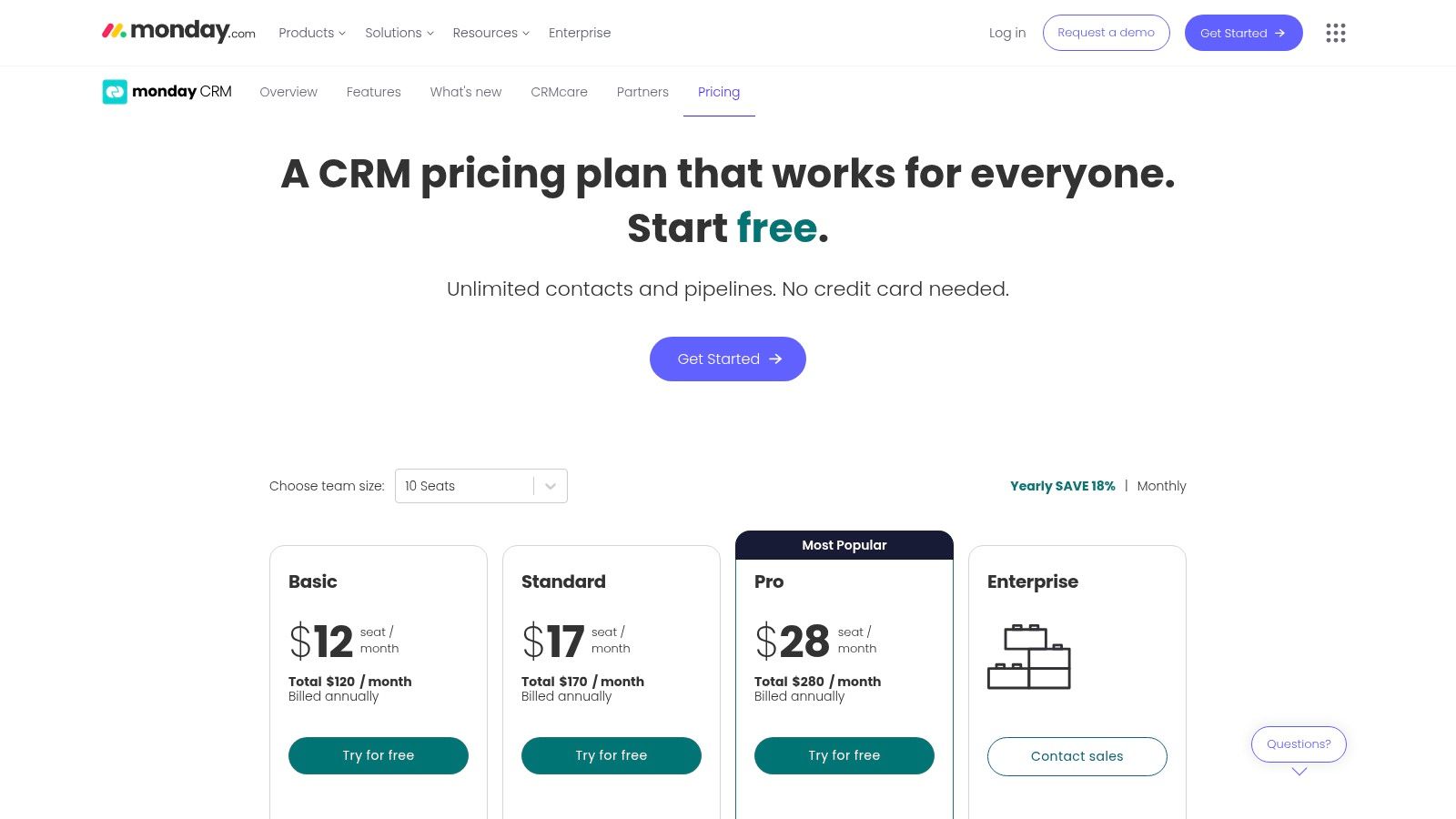
Unlike traditional CRMs, monday excels at bridging the gap between sales and other business functions like marketing, project management, and customer success. For RevOps, the built-in automation and integration capabilities streamline handoffs and provide a unified view of the entire customer lifecycle, making it an excellent choice for organizations prioritizing cross-departmental alignment and operational efficiency.
Key Considerations
- Best For: Small to mid-sized B2B businesses that require a flexible, all-in-one platform to manage sales alongside other core business operations.
- Pricing: Starts at $12/seat/month for the “Basic” plan (3-seat minimum), billed annually. Most growing teams will need the “Standard” ($17/seat/month) or “Pro” ($30/seat/month) tiers for crucial automations and integrations.
- Pros: Highly flexible structure adapts to unique sales processes, and its broad work management capabilities extend beyond just sales.
- Cons: Minimum seat requirements can be a barrier for very small teams, and critical automation features are gated behind higher-priced tiers.
Website: https://monday.com/crm/pricing/
8. Close CRM
Close CRM is purpose-built for high-velocity, outbound B2B sales teams that operate primarily via phone and email. Its core differentiator is tightly integrated, native communication tools—including a Power Dialer, Predictive Dialer, SMS, and email sequences—all housed within a unified interface. This design eliminates the need for separate telephony integrations, streamlining the rep’s workflow for maximum efficiency and providing clear activity data for sales operations.
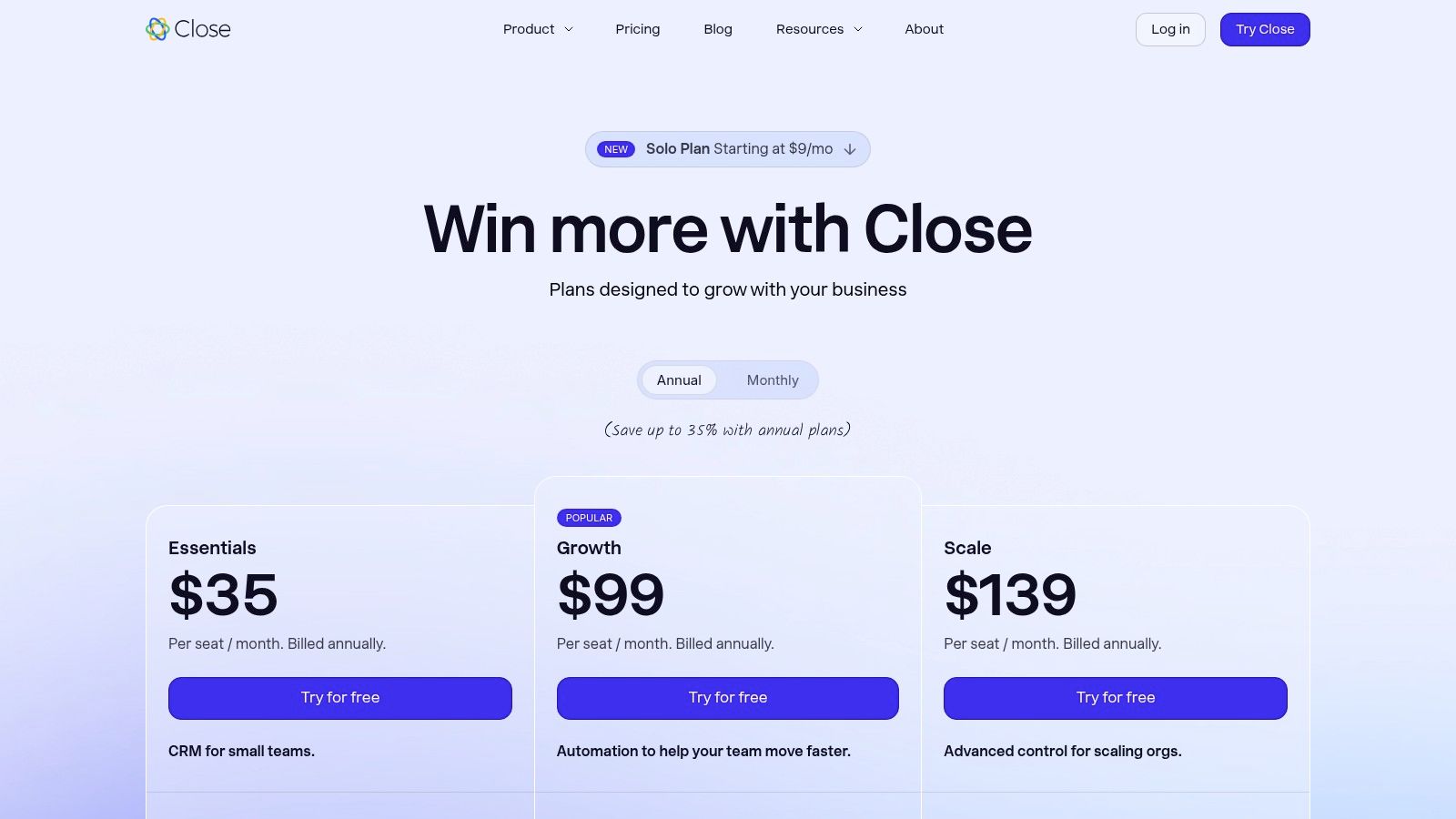
This platform is a powerful sales management software for SMBs and mid-market companies focused on call-heavy sales motions. It centralizes all prospect interactions into a single timeline, giving managers a clear view of activity levels and deal progression. The new AI features, like the AI email assistant and call summaries, further reduce administrative work, allowing reps to focus purely on selling activities.
Key Considerations
- Best For: Inside sales and SMB teams that rely heavily on calling, SMS, and email outreach and need an all-in-one communication and CRM solution.
- Pricing: Starts at $99/user/month (billed annually) for the “Professional” plan, with the “Business” plan at $149/user/month offering the Predictive Dialer and other advanced features. A 14-day free trial is available.
- Pros: Excellent native telephony and SMS capabilities, intuitive user interface designed for sales rep productivity, and transparent pricing.
- Cons: Dialer tiers and AI features involve additional costs, and it may be less suitable for complex, enterprise-level deployments requiring deep customization.
Website: https://www.close.com/pricing
9. Outreach
Outreach is a definitive sales engagement and intelligence platform designed to help revenue teams drive predictable growth by operationalizing their GTM strategy. It goes beyond simple automation by providing a comprehensive workflow that covers the entire sales cycle, from prospecting and deal management to conversation intelligence and forecasting. Its strength is in operationalizing sales plays at scale, ensuring every rep follows a proven process for maximum efficiency and effectiveness.
The platform excels at orchestrating complex, multi-channel communication through its renowned Sales Sequences and AI-powered assistance. Features like its conversation intelligence tool, Kaia, and robust deal forecasting modules provide leadership with deep visibility into pipeline health and rep performance. This makes it one of the best sales management software choices for RevOps teams focused on disciplined execution and data-driven coaching.
Key Considerations
- Best For: Mid-market to enterprise B2B organizations that need a powerful, unified platform to orchestrate and manage high-volume sales engagement activities across SDR and AE teams.
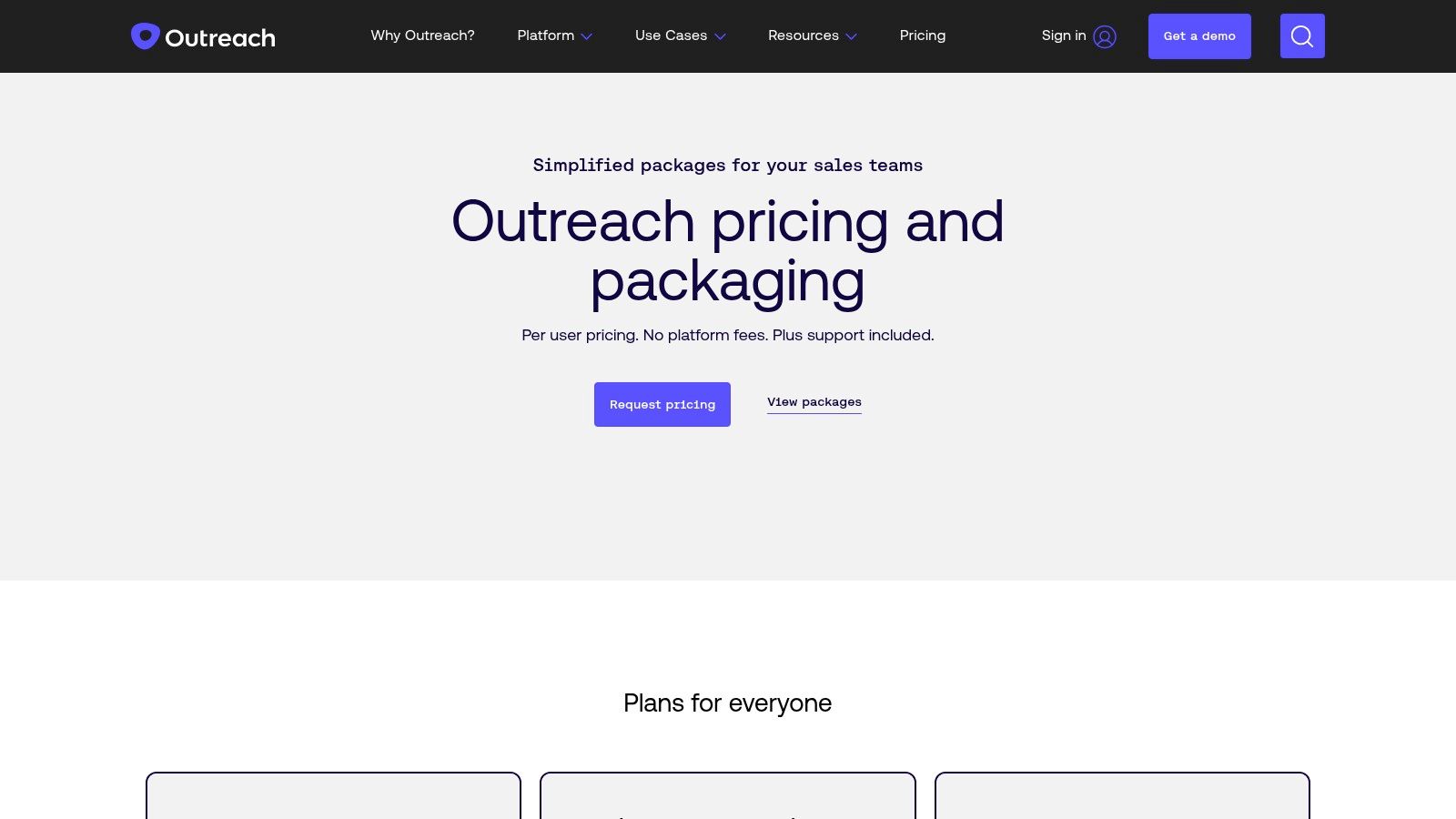
- Pricing: Pricing is customized and not publicly available; it is typically based on sales team size and required features. A demo is required for a quote.
- Pros: Enterprise-grade solution for scaling sales engagement, comprehensive features covering the entire sales workflow, and powerful automation and AI insights.
- Cons: Pricing is not transparent, telephony minutes and phone numbers are billed separately, and the platform may be too complex for very small teams or startups.
Website: https://www.outreach.io/pricing
10. Salesloft
Salesloft is a premier sales engagement and revenue orchestration platform, purpose-built to help mid-market and enterprise sales teams execute their GTM strategies with precision. It moves beyond basic CRM functionality by providing a unified environment for managing every seller action, from prospecting cadences and communication to deal management and forecasting. Its strength is in operationalizing sales plays at scale, ensuring reps follow best practices consistently and providing RevOps with the data to refine those processes.
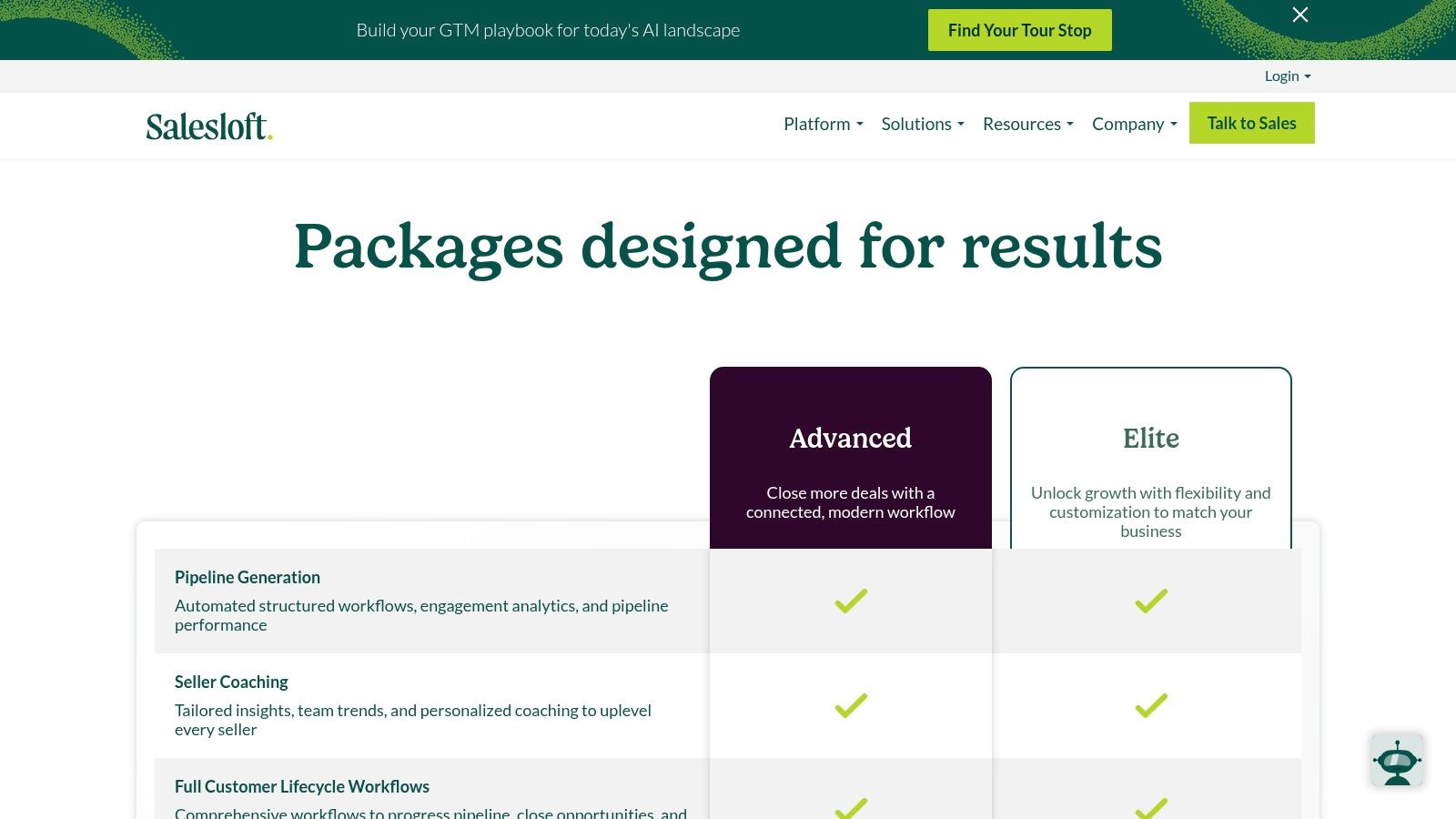
This platform excels at integrating seller workflows with powerful analytics and coaching tools. Features like AI-powered Conversation Intelligence analyze sales calls to surface coachable moments and highlight competitor mentions, while bi-directional CRM sync ensures all activity data flows seamlessly back to the system of record (e.g., Salesforce). Salesloft is a top choice for organizations looking to standardize their sales process and drive repeatable revenue outcomes through guided selling.
Key Considerations
- Best For: Mid-market and enterprise B2B companies with dedicated Sales Development (SDR) and Account Executive (AE) teams that need to orchestrate complex outreach and follow-up sequences.
- Pricing: Custom pricing is provided upon consultation with their sales team. There are no public pricing tiers listed.
- Pros: Market-proven for mid-market and enterprise sales teams, and a strong focus on sales coaching and analytics.
- Cons: Pricing is not publicly listed, and optimal value requires dedicated administrators and enablement resources to manage the platform effectively.
Website: https://www.salesloft.com/pricing
11. G2 Software Marketplace (Sales category)
While not a sales management platform, G2’s marketplace is an essential resource for researching and comparing the best sales management software. It acts as a comprehensive discovery engine, aggregating thousands of verified user reviews, detailed feature comparisons, and category rankings to help RevOps leaders make informed purchasing decisions. For any B2B tech stack audit or expansion, G2 is a foundational due diligence tool.
The platform’s strength lies in its user-driven data and filtering capabilities. You can segment solutions by company size, user satisfaction scores, and specific features, allowing you to build a shortlist tailored to your exact operational needs. Instead of relying solely on vendor marketing, G2 provides crowdsourced validation from real-world users, highlighting both strengths and weaknesses you might otherwise miss in a vendor demo.
Key Considerations
- Best For: Sales operations and RevOps teams in the discovery and evaluation phase of their software procurement process.
- Pricing: Free to use for research and comparison. Final purchase and pricing are handled directly on vendor websites.
- Pros: Extensive coverage across the sales technology stack, transparent user-driven insights, and powerful comparison and filtering tools.
- Cons: Sponsored placements can influence visibility in listings, and it does not facilitate direct sales; it’s a research-only platform.
Website: https://www.g2.com/categories/sales-management
12. Capterra (CRM and Sales software directories)
Capterra is not a sales management platform but an indispensable resource for finding one. As an established software directory, it serves as a critical first step for B2B teams in the discovery and evaluation phase. The platform aggregates hundreds of sales and CRM tools, allowing operations leaders to compare features, read verified user reviews, and create shortlists based on specific technical and business requirements.
Its strength lies in its vast database and structured comparison tools, which help RevOps and sales leaders cut through marketing noise. By filtering solutions by company size, industry, and required features, teams can quickly identify relevant vendors. The user-generated reviews provide practical insights into implementation challenges, customer support quality, and real-world usability, making it a valuable tool for validating a vendor’s claims before committing to a demo.
Key Considerations
- Best For: B2B organizations in the initial research stage of selecting the best sales management software, needing to build a vendor shortlist based on peer reviews and feature comparisons.
- Pricing: Free to use for software buyers. Vendors pay for listings and lead generation.
- Pros: Transparent methodology with verified user reviews and robust filtering capabilities that simplify the discovery process.
- Cons: The presence of sponsored listings requires critical evaluation, and as a directory, all purchasing and trials occur on third-party vendor websites.
Website: https://www.capterra.com/customer-relationship-management-software/
Top 12 Sales Management Software Comparison
| Solution | Core Features | User Experience & Quality | Target Audience | Unique Selling Points | Price & Availability |
|---|---|---|---|---|---|
| Salesforce Sales Cloud | Pipeline, forecasting, AI, AppExchange ecosystem | Highly configurable, robust reporting | Complex organizations | Embedded AI, extensive integrations | Higher cost, direct purchase, free trial |
| HubSpot Sales Hub | Pipelines, sequences, forecasting, native tools | Clean UX, fast setup, strong training | Small to growing sales teams | Excellent free tier, HubSpot Academy resources | Free tier + scalable paid plans, direct buy |
| Microsoft Dynamics 365 | Lead/opportunity mgmt, AI Copilot, MS integrations | Fits MS ecosystems, flexible extensibility | Microsoft-centric enterprises | Copilot AI, Power Platform integrations | Partner or online purchase, add-on costs |
| Pipedrive | Visual pipelines, email sync, AI, automation | Intuitive, fast deployment | SMB sales reps | Pipeline-first, easy workflow automation | Transparent pricing, 14-day free trial |
| Zoho CRM | Deals, automation, AI assistant, broad integrations | Competitive pricing, broad SMB-mid market fit | SMB to mid-market companies | Zoho Suite integration, affordable tiers | Online purchase, free trials |
| Freshsales by Freshworks | Pipeline mgmt, built-in phone/chat, AI insights | Quick implementation, native comms | SMBs, multichannel sales teams | Native telephony/chat included | Competitive entry price, 21-day free trial |
| monday Sales CRM | Unlimited pipelines, automations, dashboards | Flexible, broad work mgmt | Teams needing customization | Board-based CRM, broad work management | Direct purchase, confusing tier limits |
| Close CRM | Multi-channel inbox, dialers, AI email assistance | Great outbound sales fit | Inside sales teams | Strong telephony/SMS capabilities | Transparent pricing, free trials |
| Outreach | Sales sequences, AI assistance, conversation intelligence | Enterprise-grade, scalable | Enterprise sales teams | Comprehensive engagement and forecasting | Sales contact pricing, no public tiers |
| Salesloft | Cadences, AI workflows, CRM syncing | Proven for mid-enterprise | Mid-market & enterprise teams | Sales coaching focus, advanced analytics | Sales contact pricing, needs admin resources |
| G2 Software Marketplace | Category grids, filters, vendor links | User-driven reviews, extensive coverage | Buyers researching solutions | Large US-centric sales software marketplace | Free to use, no direct sales |
| Capterra | Reviews, shortlists, pricing snapshots | Verified reviews, transparent methodology | Early-stage buyers | Deep CRM and sales software directories | Free directory, purchase via vendors |
From Selection to Success: Integrating Your Next Sales Platform
Choosing the right platform is a critical milestone, but the journey to unlocking its full potential has only just begun. We’ve explored powerful tools, from comprehensive CRMs like Salesforce and HubSpot to specialized sales engagement platforms like Outreach and Salesloft. Each offers a unique blend of features designed to enhance pipeline management, automate workflows, and provide actionable insights. However, the true value of any software is realized not at purchase, but through strategic implementation, integration, and user adoption.
The selection process demands a clear understanding of your team’s specific pain points and strategic GTM goals. A high-velocity inside sales team might prioritize the powerful communication features of a platform like Close, while a large enterprise navigating a complex B2B sales cycle will likely benefit from the deep customization and ecosystem of Salesforce. Similarly, a mid-market team already invested in the HubSpot ecosystem will find the seamless integration of Sales Hub invaluable for aligning marketing and sales efforts.
Key Considerations Before You Commit
Before you sign the contract, it’s crucial to look beyond the feature list and evaluate the long-term impact on your revenue operations. The best sales management software for your organization is the one that not only meets your current needs but also scales with your growth.
Consider these critical factors:
- Integration Capabilities: How well does the platform integrate with your existing marketing automation (like Pardot/MCAE or Marketo), ERP, and other business-critical systems? A fragmented tech stack creates data silos and operational friction.
- Implementation & Onboarding: What internal or external resources will you need to dedicate to the rollout? Factor in the costs and timeline for data migration, system configuration, and user training to ensure your team can execute effectively.
- Total Cost of Ownership (TCO): Look beyond the subscription fee. Account for implementation costs, customization needs, potential third-party app dependencies, and the internal resources required for ongoing administration and support.
- Adoption Strategy: How will you drive adoption and ensure consistent usage? A platform is only effective if your sales reps use it correctly. Plan for tailored training that focuses on real-world use cases and highlights how the software improves their workflow and efficiency.
Turning Your New Platform into a Revenue Engine
Ultimately, the goal is not just to implement a new tool but to optimize your entire go-to-market strategy. The right sales management software, when integrated thoughtfully, becomes the central nervous system of your sales operations. It provides the data integrity needed for accurate forecasting, the automation required to increase seller productivity, and the visibility essential for strategic decision-making. By focusing on a deliberate, well-planned implementation, you transform a software investment into a powerful engine for predictable revenue growth.
Navigating a complex software implementation within an established tech stack like Salesforce or HubSpot can be challenging. MarTech Do specializes in system audits and RevOps implementation, ensuring your new platform aligns perfectly with your business processes and drives measurable results. If you’re ready to maximize the ROI of your sales technology, let’s connect and build a roadmap for success.