Before you configure a single setting in Salesforce or HubSpot, you need a strategic blueprint. Many companies treat their sales pipeline as a simple list of deals in progress, which is a significant operational mistake. A high-performance pipeline is the engine of your entire Go-to-Market (GTM) motion, connecting every marketing and sales action directly to revenue.

Think of it as the shared language between marketing and sales. When marketing hands over a qualified lead, both teams must have a clear, unified understanding of what that opportunity represents. Without this fundamental alignment, you build a system full of friction where high-potential leads get lost and accountability breaks down.
Weaving Your GTM Strategy Into Your Pipeline
Here’s a critical shift in thinking: your pipeline should mirror your customer’s buying journey, not just your internal sales process. Each stage must represent a verifiable action the buyer took, signaling they are moving forward.
This buyer-centric approach ensures your sales activities remain relevant and valuable. To achieve this, your pipeline must be built on the bedrock of your GTM strategy. For a deeper dive, review our guide on creating a go-to-market strategy framework.
A few key GTM elements will directly shape your pipeline design:
- Ideal Customer Profile (ICP): Your first pipeline stage must act as a filter. If a lead does not meet your ICP criteria, it should not enter the pipeline. This is how you prevent sales reps from wasting cycles on prospects who will never convert.
- Value Proposition: As an opportunity progresses, each stage should confirm the prospect understands your value proposition and sees how it solves their specific business challenges.
- Buyer’s Journey Mapping: Replace generic stage names with milestones relevant to the customer. For example, use “Initial Demo Completed” or “Technical Validation Passed” instead of vague terms like “Meeting Scheduled.”
It’s Time to Move Past the MQL
The traditional MQL-to-SQL handoff is often inefficient and a primary source of friction and lost revenue. Marketing may achieve its MQL targets, while the sales team contends with low-quality leads.
A well-architected pipeline foundation resolves this issue. It replaces ambiguous labels with a concrete, data-driven agreement on what constitutes a “sales-ready” opportunity.
This is where the Sales Accepted Lead (SAL) becomes critical. An SAL is a lead vetted against strict, mutually agreed-upon criteria—first by marketing automation and then validated by a BDR or sales rep.
A well-defined pipeline essentially functions as a service-level agreement (SLA) between marketing and sales. It clearly defines the rules of engagement, who owns what at every step, and holds both teams accountable for their part in generating revenue.
This shift is not just about process improvement; it’s about building a predictable revenue engine. The data supports this approach. Companies with an accurate, well-managed sales pipeline are 10% more likely to see year-over-year revenue growth. Furthermore, 68% of sales leaders report a significant improvement in lead quality after refining their qualification process.
Getting this foundation right is the most critical step. It ensures marketing and sales work in lockstep, advancing opportunities with clarity and a shared objective.
Designing Pipeline Stages That Reflect Reality
A theoretical pipeline is useful for strategy sessions, but it often fails in practical application. For a sales pipeline to be effective, it must mirror the daily activities of your sales team and your customers. Generic stages like ‘Prospecting’ or ‘Negotiation’ are too vague; they provide no clear direction for sales reps and generate unreliable data for RevOps leaders.
The goal is to shift from process-centric stages (what we do) to buyer-centric milestones (what the customer has done). This strategic change transforms your pipeline from a simple to-do list into a roadmap for closing deals.

From Vague Labels to Actionable Milestones
To make this practical, pinpoint the exact action that proves an opportunity is progressing. This approach simplifies pipeline management for your reps and provides clean, reliable data for forecasting. A solid first step is understanding the different stages of the sales funnel to get the foundational concepts right.
Here’s a comparison of how to elevate your pipeline stages:
| Generic Stage | Action-Oriented Stage | What It Signifies |
|---|---|---|
| Qualification | Initial Discovery Call Completed | The prospect has engaged in a conversation and confirmed a basic need-fit. |
| Presentation | Value Demo Delivered | We have demonstrated the product’s value to key decision-makers. |
| Evaluation | Technical Validation Submitted | The prospect’s technical team is actively evaluating our solution against their requirements. |
| Negotiation | Proposal Sent & Verbally Accepted | A formal offer has been delivered, and our champion has provided positive confirmation. |
| Closing | Contract Out for Signature | The final agreement is with the authorized signatory. |
This structure eliminates ambiguity. An opportunity enters the “Value Demo Delivered” stage only after the demo has occurred—not when it is merely scheduled. The distinction is critical for data integrity.
Customizing Stages for Your Business Model
Your pipeline stages must align with your customer acquisition model. A SaaS company with a product-led growth (PLG) model will have a vastly different pipeline than a high-touch professional services firm.
Scenario 1: The SaaS Trial-to-Paid Model
When free trials or a freemium offering are primary conversion drivers, the pipeline must track user engagement within the product as key milestones.
- Trial Activated: A user has signed up and is actively exploring the platform.
- Key Feature Adoption: The user has engaged with a “sticky” feature known to correlate with conversion (e.g., creating their first project or inviting a teammate).
- PQL (Product Qualified Lead): The account has met a specific usage threshold, triggering a notification for sales outreach.
- Upgrade Conversation Started: A sales rep is actively discussing a paid plan with the user.
- Proposal Sent: The prospect has received a formal quote for a subscription.
In a PLG motion, your CRM is more than a sales tool. It’s the central hub where product usage data from tools like Mixpanel or Amplitude feeds directly into sales actions. Your pipeline stages must reflect this data flow.
Scenario 2: The Consultative Services Firm
For a firm selling complex, high-ticket consulting projects, the pipeline must reflect relationship development and navigation of multiple stakeholders.
- Initial Consult Booked: A prospect has scheduled a deep-dive call to discuss their business challenges.
- Needs Analysis Completed: The sales lead has conducted a thorough discovery and documented the client’s core pain points.
- Solution Workshop Delivered: A collaborative session was conducted with the prospect’s team to outline a potential solution.
- Statement of Work (SOW) Presented: A detailed proposal—including scope, timeline, and cost—has been formally presented.
- Committee Review: The proposal is under review by the prospect’s internal buying committee.
- Verbal Commitment Received: Our primary contact has confirmed their intent to move forward, pending final approvals.
Notice how every stage is tied to a clear, verifiable event. This clarity is what allows you to build a predictable revenue engine and prevent your pipeline from becoming clogged with stalled opportunities. Your stages should empower your sales team, not create administrative burdens.
Implementing Your Pipeline in Salesforce and HubSpot
A strategic plan is essential, but it doesn’t close deals. The real work begins when you translate defined stages and entry criteria into a functional pipeline within your CRM. This is where theory becomes the daily operational reality for your sales team.
For most B2B companies, this implementation focuses on two platforms: Salesforce and HubSpot.
Both are powerful CRMs, but they approach pipeline construction differently. Proper implementation is paramount—it is the difference between a tool your team embraces and one they ignore. If you are still evaluating options, our guide on how to choose a CRM can provide valuable insights.
The ultimate goal is not just to track deals but to build a system that guides reps toward the next best action, making it intuitive to advance opportunities.
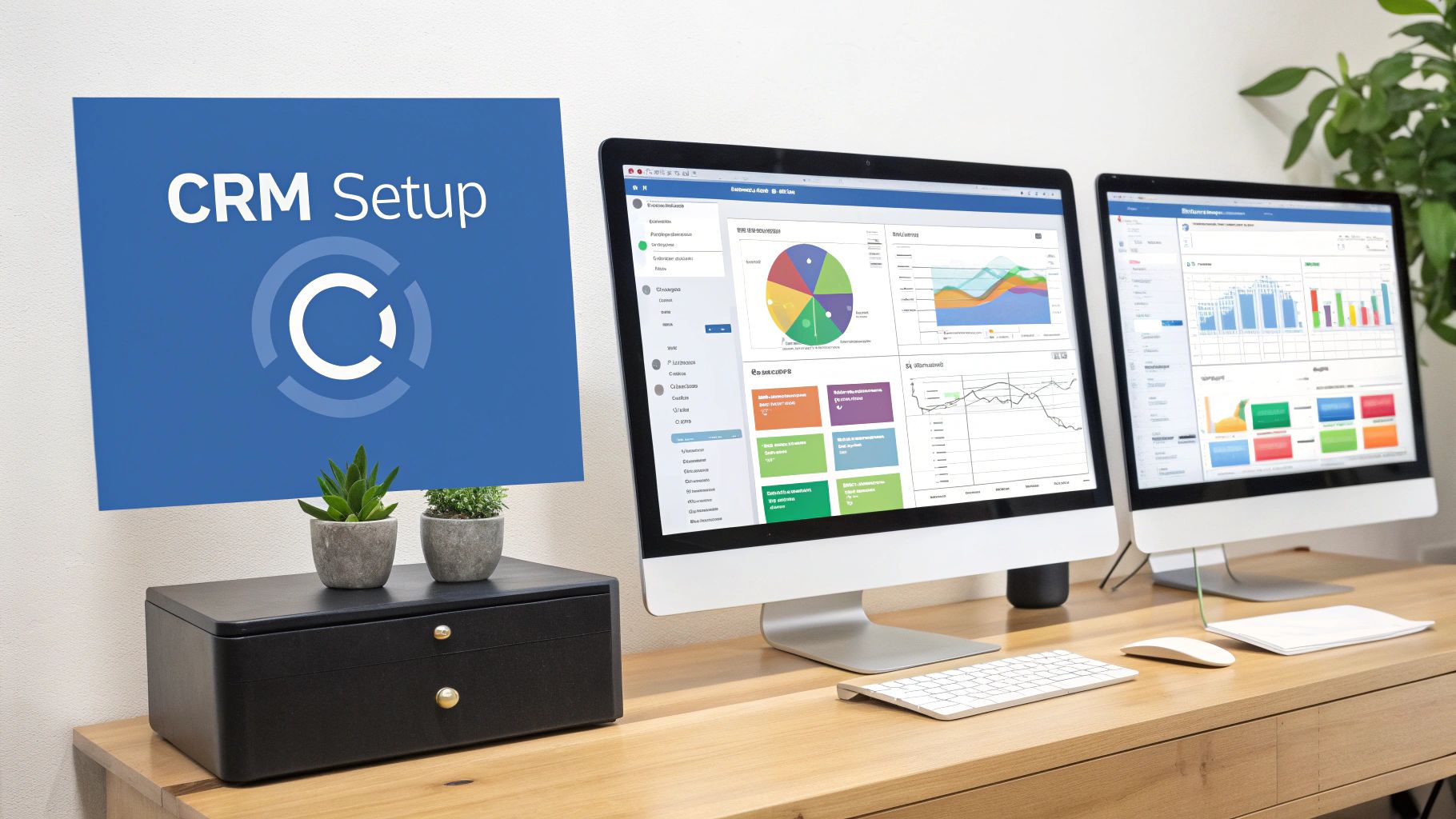
A well-configured pipeline dashboard provides this at-a-glance clarity, transforming complex data into real-time intelligence on deal flow, forecasts, and team performance.
Building Your Pipeline in Salesforce
Salesforce is renowned for its deep customization capabilities, making it a powerhouse for complex, non-linear sales processes. The core of your pipeline will be built around the Opportunity object.
First, customize your Opportunity Stages to mirror the buyer-centric milestones you have defined. This involves more than changing labels; each stage must be mapped to a specific probability percentage, which fuels your sales forecasting engine.
Next, configure Sales Processes. This feature allows you to create different sets of opportunity stages for various business units or product lines. For example, your “New Business” process might have seven distinct stages, while a “Renewal” process only requires four. This keeps the user interface clean and relevant for reps.
A critical but often overlooked step in Salesforce is creating Validation Rules. These rules enforce data integrity. For instance, you can prevent a rep from moving an opportunity to “Proposal Sent” unless a quote document is attached to the record. This enforces compliance and prevents inaccurate data at the source.
Finally, unify the user experience with Salesforce Path. This provides a visual guide at the top of the opportunity record, showing reps exactly where they are in the process. You can also add “Guidance for Success” for each stage, including checklists, links to sales collateral, or reminders about required fields.
Configuring Your Pipeline in HubSpot
HubSpot excels in user-friendliness and tightly integrated automation. Here, your pipeline is managed within Deals.
In HubSpot, you will create one or more Deal Pipelines and then customize them with your specific deal stages. Similar to Salesforce, you can assign a win probability to each stage, which powers your analytics and reporting dashboards.
One of HubSpot’s most effective features is the ability to set Required Properties for each stage. When a rep moves a deal to the next stage, a pop-up can prompt them to enter crucial information, such as “Budget Confirmed” or “Decision-Maker Identified.” This is a simple yet powerful way to ensure consistent data capture.
- Leverage Automation: Use HubSpot’s deal-based workflows to automate routine tasks. For example, when a deal enters the “Demo Scheduled” stage, you can trigger a workflow that automatically creates a task for the rep to send a preparation email two days before the call.
- Implement Properties Strategically: Avoid requiring too many properties at each stage, as this can frustrate reps and hinder adoption. Conversely, too few properties will result in data gaps. Focus on the one or two non-negotiable data points that validate a deal has successfully passed a given milestone.
A crucial part of building your pipeline in either platform is connecting your data sources. For example, a proper Google Analytics Salesforce integration can enrich your CRM with valuable web behavior data, giving reps deeper insights into a prospect’s interests before the first conversation.
Fueling Your Pipeline with Automation and AI
A modern sales pipeline is not a static tool; it is a dynamic system designed to help your team win deals more efficiently. Once you have mapped your stages and configured them in your CRM, the next step is to enhance the process with automation and AI. This is how you transition from having a good process to operating a high-performance revenue engine.
The primary objective is to eliminate the manual, repetitive tasks that consume your reps’ time. Let technology handle the administrative work so your team can focus on high-value activities: building relationships and closing complex deals.
This is not an optional enhancement but a fundamental shift in how top-performing sales organizations operate. The global CRM market is projected to reach $80 billion by 2025, highlighting its strategic importance. The investment yields tangible returns, as studies consistently show that effective CRM utilization can drive a 29% increase in sales and a 34% increase in sales productivity.
Using Automation to Nurture and Re-Engage
Long before an opportunity officially enters your sales pipeline, your marketing automation platform should be qualifying and warming leads. Tools like Pardot (Marketing Cloud Account Engagement) or HubSpot are designed to ensure reps only spend time on prospects who are ready for a meaningful sales conversation.
Strategic nurturing includes:
- Pre-Pipeline Nurturing: Implement automated email workflows that deliver relevant content based on a lead’s behavior. If a prospect downloads a whitepaper on a specific industry challenge, nurture them with related case studies or a webinar invitation before assigning them to sales.
- Re-Engaging Stalled Deals: Not every opportunity proceeds smoothly to “Closed-Won.” Establish a process for those that go dormant. Configure workflows to automatically re-engage deals that have stalled. For example, if a deal has remained in the “Proposal Sent” stage for 20 days, an automation can trigger a follow-up email or create a task for the rep.
For more ideas, review our marketing automation workflow examples that can be adapted for nurturing new leads and accelerating existing opportunities.
The Rise of AI in Sales Operations
Artificial intelligence has evolved from a buzzword into a practical tool within modern CRMs, particularly for lead prioritization and forecasting. AI helps busy sales reps focus their energy on the opportunities most likely to close.
AI-powered lead scoring is a game-changer. It analyzes thousands of data points—far more than a human can process—to predict which prospects are the best fit. It evaluates demographic, firmographic, and real-time engagement signals to assign a dynamic score that updates as the lead interacts with your brand.
This data-first approach removes the guesswork from prospecting. Instead of pursuing every new lead, reps can prioritize their activities based on a reliable, AI-generated score, resulting in higher conversion rates and a more efficient sales cycle.
Furthermore, AI is significantly improving forecasting accuracy. By analyzing historical deal data, rep performance, and engagement metrics, platforms like Salesforce Einstein and HubSpot’s AI tools can predict future revenue with greater precision. This provides sales and RevOps leaders with the reliable data needed to make informed, strategic business decisions.
Measuring and Optimizing Pipeline Health
Your sales pipeline is more than a visual tracker for deals; it is a leading indicator of your company’s future revenue. Without the right metrics, you are operating blindly, unable to distinguish between a healthy, growing pipeline and one that is quietly stalling.
This is where skilled RevOps and Sales Ops managers must move beyond surface-level numbers. The objective is to focus on the key performance indicators (KPIs) that provide a true pulse on performance.

Actionable metrics tell a story. They reveal bottlenecks, highlight coaching opportunities, and ultimately, make your revenue more predictable. The goal isn’t just to report on past performance; it’s to build insightful dashboards in your CRM—like Salesforce or HubSpot—that guide your next strategic actions.
Key Metrics to Monitor for a Healthy Pipeline
To build a sales pipeline that drives sustainable growth, you must measure its efficiency from every angle. It’s time to move past vanity metrics and focus on these core indicators that connect directly to revenue.
- Deal Velocity: This critical metric measures the average time it takes for a deal to move from creation to “Closed-Won.” A decrease in velocity is an early warning sign of friction in your sales process, indicating that deals are getting stuck.
- Stage-by-Stage Conversion Rates: Do not rely solely on your overall close rate, as it can hide underlying issues. Instead, analyze the percentage of deals that advance from one specific stage to the next. This granular view is incredibly powerful for diagnosing problems with precision.
- Average Deal Size: Monitoring this metric is essential for forecasting and resource allocation. A decline in average deal size may indicate excessive discounting or that the team is pursuing smaller, less-ideal customers.
- Pipeline Coverage Ratio: This is your operational reality check. The ratio compares the total value of your open pipeline to your revenue quota for a given period. A 3x coverage, for example, means you have three times your quota value in open opportunities. It indicates whether you have enough pipeline to realistically achieve your target.
Monitoring these metrics should be a continuous discipline. Daily tracking of new Sales Qualified Leads (SQLs) is non-negotiable, as a steady influx is your best defense against future revenue shortfalls. Speed is also critical; research shows that businesses that contact leads within an hour are nearly seven times more likely to close the sale. For a deeper analysis, you can discover more insights about sales pipeline metrics on Forecast.io.
Here’s a reference table summarizing these essential metrics.
Key Sales Pipeline Health Metrics and Their Business Impact
| Metric | Calculation | What It Tells You | Target Benchmark |
|---|---|---|---|
| Deal Velocity | (Date Closed-Won - Date Created) / # of Deals |
How fast deals are moving through your pipeline. Slowing velocity indicates friction. | Shorter is better; benchmark against your own historical data. |
| Stage Conversion Rate | (# Deals Moving to Next Stage / # Deals in Current Stage) * 100 |
Pinpoints specific stages where deals are stalling or falling out of the pipeline. | Varies by stage, but look for significant drop-offs. |
| Average Deal Size | Total Value of Closed-Won Deals / # of Deals |
The typical value of a successful deal. Helps with forecasting and sales strategy. | Stable or increasing. A sudden drop may signal issues. |
| Pipeline Coverage | Total Open Pipeline Value / Sales Quota |
Whether you have enough potential revenue in your pipeline to hit your targets. | Typically 3x to 4x, depending on industry and sales cycle length. |
Tracking these metrics provides a clear, data-backed view of your sales engine, helping you identify issues before they impact the bottom line.
Turning Metrics into Strategic Action
Data is only valuable when it drives intelligent action. Every metric trending in the wrong direction should trigger a specific question and an operational response.
Consider a real-world scenario: your Salesforce dashboard reveals a significant drop-off in the conversion rate between the ‘Demo Completed’ and ‘Proposal Sent’ stages. This is not just a number; it’s a major red flag. It indicates that while your team is successfully conducting demos, these presentations are not compelling enough to move prospects to the next step.
This single data point should initiate an immediate investigation:
- Review demo recordings: Are reps clearly articulating your value proposition? Are they connecting product features to the prospect’s specific pain points?
- Consult your sales team: What objections are they consistently hearing after a demo?
- Analyze lost opportunities: Is a common competitor being mentioned? Is there a recurring feature gap?
Your CRM dashboards should be configured to answer “why,” not just “what.” By structuring reports in HubSpot or Salesforce to highlight these stage-by-stage conversions, you can identify leaks in your pipeline before they escalate into a revenue crisis.
This proactive approach transforms your metrics from passive reports into an active diagnostic tool. The moment you see a negative trend, you have a clear starting point for addressing the root cause—whether it’s a flawed process, a training gap, or a misalignment in your go-to-market strategy. This is how you build a sales pipeline that is not only productive but also resilient and predictable.
Your Top Sales Pipeline Questions, Answered
Even with a well-designed pipeline, questions will arise. RevOps and sales leaders are constantly balancing process, technology, and team dynamics.
Here are answers to some of the most common questions we address when working with B2B companies to build effective sales pipelines.
How Many Stages Should My Sales Pipeline Have?
There is no single magic number, but the optimal range for most B2B companies is 5-7 stages. The primary goal is to have enough stages to provide visibility without overburdening reps with administrative tasks.
Every stage must represent a verifiable step forward in the buyer’s journey, such as “Demo Completed” or “Proposal Sent.” If reps are consistently skipping stages or opportunities are stagnating in one column, it is a strong indicator that your pipeline is too complex or misaligned with your sales process.
When in doubt, start with a simpler structure. Only add a new stage if you can define a clear, measurable action that advances an opportunity toward closing.
What is the Difference Between a Sales Funnel and a Sales Pipeline?
These terms are often used interchangeably, but they represent two distinct perspectives.
A sales funnel illustrates the customer’s journey. It provides a high-level view that tracks volume and conversion rates from initial awareness to lead generation. For example, it shows how 1,000 website visitors convert into 100 marketing qualified leads. It is a marketing-centric model.
A sales pipeline, in contrast, is the seller’s view. It is the sequence of concrete actions your sales team takes to guide a qualified prospect through the buying process. The focus is on the activities and stages that your team directly manages. Your pipeline represents the final, high-intent portion of your broader sales funnel.
Think of it this way: The funnel is the wide net that captures broad interest. The pipeline is the focused, hands-on process for the specific opportunities your sales team is actively working to close. They are two sides of the same revenue coin.
How Often Should We Revisit Our Sales Pipeline Stages?
Your sales pipeline is a dynamic system, not a one-time project. You should conduct a comprehensive review of your stages and processes at least annually. In fast-moving markets, a bi-annual review may be more appropriate.
Beyond scheduled reviews, certain events should trigger an immediate re-evaluation:
- Launch of a new Go-to-Market (GTM) strategy.
- Introduction of a new product or a change in your pricing model.
- Consistent feedback from the sales team that the stages do not reflect their actual workflow.
Analyze your CRM data. Are opportunities consistently stalling at a particular stage? Have your win rates suddenly declined? These are not just numbers; they are clear signals that your process is out of sync with your customers and the market.
What Are the Biggest Mistakes Companies Make When Building a Pipeline?
We consistently observe a few common pitfalls. The most frequent mistake is structuring stages around internal sales activities (what our reps do) instead of buyer commitments (what our buyers have agreed to). This leads to an inflated pipeline filled with unqualified opportunities.
Another classic error is using vague entry and exit criteria for stages, which results in unreliable data and inaccurate forecasting. A third major issue is failing to secure buy-in from the sales team during the design phase. If reps do not believe in the process, they will not follow it.
Finally, a poorly defined handoff between marketing and sales guarantees lost leads and inter-departmental friction. Avoiding these problems requires clear communication, a collaborative design process, and a commitment to data-driven decision-making.
Building and optimizing a sales pipeline that generates predictable revenue is an ongoing discipline. It demands the right combination of strategy, technology, and operational excellence.
At MarTech Do, we specialize in this work. We help B2B companies transform their Revenue Operations by implementing and optimizing the very systems discussed here, from Salesforce to HubSpot and beyond. If you’re ready to move from guesswork to a structured, high-performance revenue engine, let’s connect.