An instant data scraper is a strategic tool for your go-to-market (GTM) team. Instead of manually copying and pasting account details or contact information from websites, this tool automates the process, turning hours of manual work into a task that takes minutes. For B2B companies, this accelerates data acquisition for critical RevOps and marketing operations initiatives.
What an Instant Data Scraper Means for RevOps
For Revenue Operations leaders, an instant data scraper isn’t just a productivity hack; it’s a strategic asset for building a more intelligent GTM engine. These tools, often packaged as browser extensions, enable on-the-fly data extraction, allowing your team to capture structured information from web pages without writing a single line of code.
This capability directly addresses a core RevOps challenge: the need for clean, accurate, and timely data to power sales and marketing initiatives. Manual data sourcing is slow, error-prone, and inefficient, leading to inaccurate CRM records and ineffective outreach campaigns. An instant data scraper provides a solution to this foundational problem.
The Core Functionality
At its core, an instant data scraper identifies patterns in a website’s underlying HTML structure. When a user activates the tool on a page—such as a list of conference speakers or a B2B directory—it intelligently recognizes tables, lists, and other repeatable data layouts. The tool then extracts this information into a structured, downloadable file, like a CSV or Excel sheet.
This places powerful data collection capabilities directly into the hands of non-technical team members in marketing and sales operations. They can gather market intelligence independently, without relying on development resources or expensive data subscriptions for ad-hoc projects. This agility allows them to capitalize on opportunities in real time.
Why This Matters for Salesforce and HubSpot Users
For B2B organizations whose GTM motions are built on Salesforce Sales Cloud or HubSpot, the strategic value of an instant data scraper is amplified. The extracted data becomes the fuel for revenue-generating workflows within your CRM and marketing automation platforms.
Consider these tactical applications:
- Enriching Incomplete Records: Quickly find missing firmographic data—like employee count, industry, or location—to update stale account records in your CRM.
- Building Hyper-Targeted Lists: Scrape the attendee list from a niche webinar or the member directory of an industry association to build precise account lists for ABM campaigns.
- Informing Lead Scoring: By scraping technographic data from websites (e.g., identifying the marketing automation tool a company uses), you can add a powerful new dimension to your lead scoring models in Account Engagement (MCAE, fka Pardot) or HubSpot.
By automating the initial step of data acquisition, RevOps teams can shift their focus from manual data entry to high-value strategic work—analyzing data, refining GTM plays, and optimizing the systems that drive revenue.
Integrating an instant data scraper into your MarTech stack is about enhancing speed and precision. It enables you to identify market trends, monitor competitor activities, and equip your revenue teams with the rich data needed for more effective engagement. This lays the groundwork for a more intelligent and proactive approach to revenue growth.
Strategic Use Cases for Your GTM Engine
An instant data scraper transitions from a simple tool to a strategic weapon when applied to high-value business challenges within your go-to-market (GTM) engine. For RevOps professionals, the goal isn’t just to collect data but to use it to solve specific problems and create a competitive advantage. A well-executed scraping strategy can transform a static CRM into a dynamic market intelligence hub.

For example, a scraper can be configured to monitor a competitor’s careers page. A sudden increase in sales role postings could signal expansion into a new market—critical intelligence your team needs to act upon. This is where scraping evolves from a technical task to a proactive, strategic component of your GTM execution.
Account and Lead Enrichment
One of the most immediate benefits of data scraping is enriching your existing CRM records. Stale or incomplete data in Salesforce or HubSpot leads to inaccurate segmentation, flawed lead scoring, and ineffective sales outreach. An instant data scraper provides a direct solution.
Here are battle-tested methods for enrichment:
- Firmographic Updates: Scrape company profiles on business directories to obtain the latest employee count, revenue figures, or office locations. Integrating this data into Salesforce ensures your territory assignments and account scoring models are based on current information.
- Technographic Analysis: Use a scraper to identify marketing automation or sales tools listed on a prospect’s website or in their job descriptions. This technographic data, once in HubSpot, can trigger workflows to route leads to sales reps who specialize in competitive positioning.
- Funding and Growth Signals: Configure a scraper to monitor financial news sites for funding announcements related to your target accounts. A new funding round is a powerful “trigger event” that signals to your sales team that a company has fresh capital to invest.
Building Hyper-Targeted Prospect Lists
Beyond data cleanup, scrapers are invaluable for building highly specific prospect lists that are unavailable through traditional data providers. This capability is critical for Account-Based Marketing (ABM) and niche outbound campaigns where precision is paramount.
For instance, your marketing operations team could scrape the names, titles, and companies of every speaker from a recent industry conference. This list can then be used to launch a tailored campaign in Account Engagement (Pardot) that references their speaking topic, making your outreach highly relevant and timely.
This level of precision transforms outbound from a volume-based approach to a value-driven one. Instead of targeting generic lists, you are engaging focused audiences based on verified activities, which naturally yields higher engagement rates.
Public data initiatives create further opportunities. For example, a RevOps team could scrape data from the California Open Data Portal to enrich Salesforce accounts with regional economic trends, adding a layer of hyper-local insight to territory planning.
Competitive and Market Intelligence
A robust GTM strategy requires a deep understanding of the competitive landscape. An instant data scraper can automate the intelligence gathering that would otherwise consume hours of manual research, enabling your team to stay ahead of market shifts.
By regularly scraping competitor websites, you can track changes to pricing, new feature launches, and shifts in marketing messaging. This intelligence is invaluable for equipping your sales team with effective battle cards and informing your product marketing strategy. It is a foundational element of GTM Engineering, where real-time data directly informs revenue strategy.
These use cases demonstrate how scraped data becomes the fuel for a more intelligent GTM engine, driving pipeline growth and providing a distinct competitive edge.
Navigating the Legal and Ethical Landscape
While an instant data scraper can significantly enhance your GTM engine, its use requires a robust compliance framework. For RevOps professionals, operating without clear governance is a direct threat to your brand’s reputation and business continuity. The legal landscape is complex, but the guiding principles are straightforward: respect privacy, adhere to website terms, and operate ethically.

The objective is to build a sustainable and responsible data strategy that empowers your team to use tools like instant data scrapers confidently. When implemented correctly, compliance becomes a competitive advantage built on trust.
Understanding Key Regulations
For B2B companies operating in North America, several key regulations must be considered. Even when collecting business contact information, regulations often apply to any data that can identify an individual, such as their work email or professional title.
The California Consumer Privacy Act (CCPA) and the California Privacy Rights Act (CPRA) have established some of the strictest privacy standards in the United States. Legal interpretations suggest that the bulk collection of publicly available information and data scrapers may not always fall under these regulations unless that information is “sold” or “shared.” However, navigating this requires careful legal counsel.
The critical distinction lies between public business information and protected personal data. Scraping a company’s office address is generally low-risk. Extracting an individual’s professional contact details requires a higher standard of care and a clear understanding of your legal obligations.
A strong compliance posture extends beyond legal knowledge; it involves embedding ethical practices into your team’s standard operating procedures. This is where solid data governance best practices are essential for any team working with scraped data.
Respecting Website Terms of Service
In addition to government regulations, each website has its own set of rules outlined in its Terms of Service (ToS). Many sites explicitly prohibit automated data collection or “scraping.” Ignoring these terms can result in your IP address being blocked or, in more severe cases, legal action for breach of contract.
Before deploying an instant data scraper, your team should always review the website’s ToS and its robots.txt file. This demonstrates due diligence and respect for the data source.
- Check the Terms of Service: Look for phrases like “automated access,” “scraping,” or “robots.”
- Review
robots.txt: This file (e.g.,domain.com/robots.txt) instructs automated agents on which pages to avoid. Adhering to these directives is standard practice. - Scrape Responsibly: Avoid overwhelming a website’s server with excessive requests. A measured approach is more ethical and less likely to result in being blocked.
A Practical Risk Mitigation Checklist
To operationalize these principles, RevOps teams need a simple, repeatable process. A checklist ensures that compliance is integrated into every data project from its inception.
Here is a straightforward checklist to guide your team’s data scraping activities.
Data Scraping Risk Mitigation Checklist
| Compliance Area | Action Item | Tool/Process Involved |
|---|---|---|
| Data Sourcing | Review the website’s Terms of Service and robots.txt file before scraping. |
Manual review or automated checker |
| Privacy Regulations | Differentiate between public business data and personal contact information. | Internal data classification guidelines |
| Data Handling | Anonymize or aggregate data where individual identification is not necessary. | Data cleaning scripts; Salesforce/HubSpot rules |
| Ethical Use | Ensure the scraped data is used for legitimate business purposes outlined in your privacy policy. | GTM campaign brief and legal review |
| System Load | Configure the instant data scraper to use reasonable crawl delays to avoid disrupting the source website. | Scraper tool settings |
By adopting this framework, you empower your team to leverage the full potential of an instant data scraper while mitigating unnecessary risk. This approach builds a GTM engine that is not only powerful but also principled.
Getting Scraped Data into Your CRM Workflows
Raw data from a scraper is unrealized potential. For RevOps leaders, the value is unlocked only when that data is cleaned, validated, and integrated into the systems that drive revenue, such as Salesforce and HubSpot. This process transforms a simple spreadsheet into a powerful, actionable asset for your GTM team.
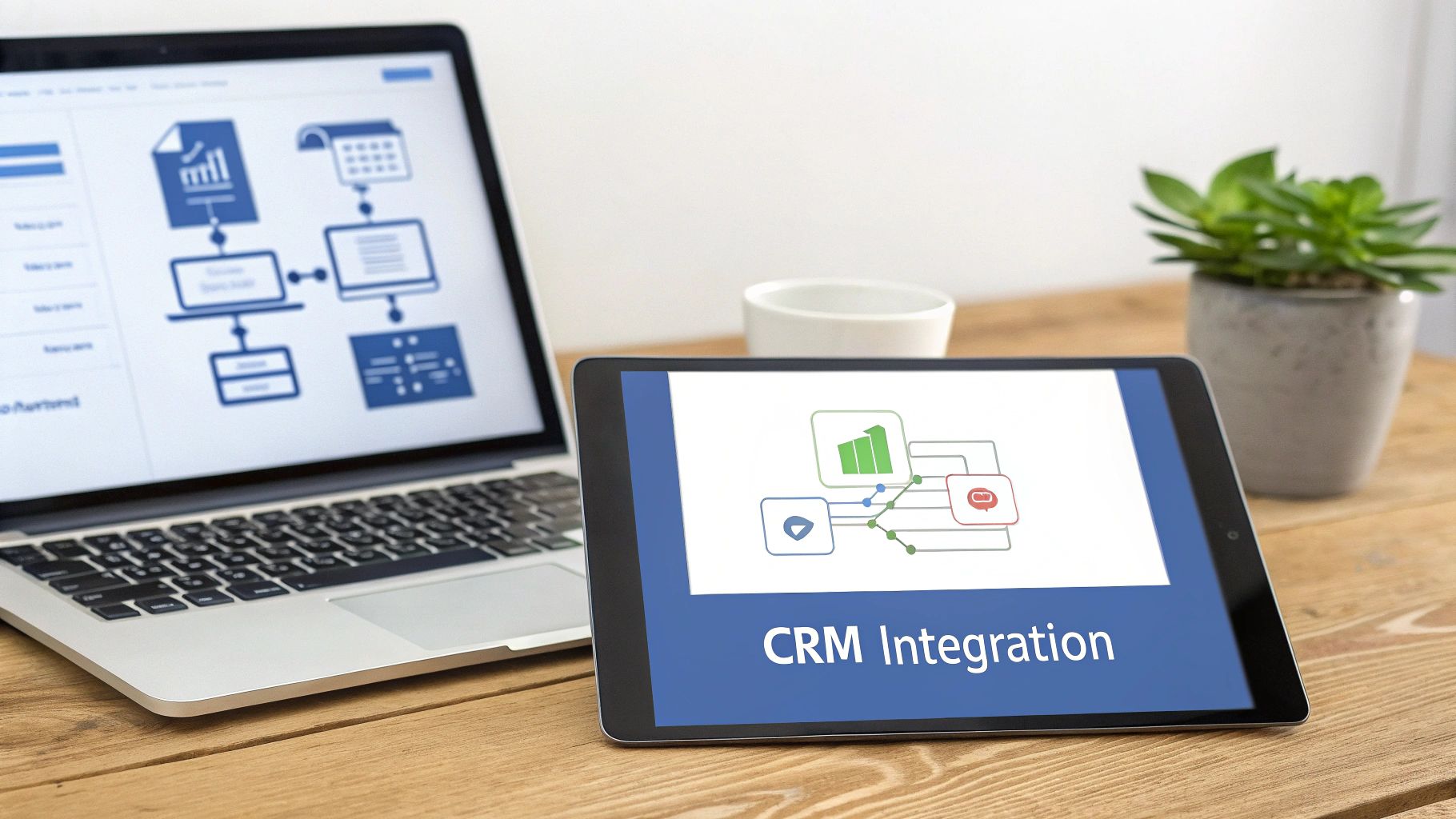
Effectively operationalizing scraped data is a multi-step process. It begins with the initial data extraction and concludes when a lead is automatically assigned to a sales sequence or a target account is enrolled in a nurture campaign. Mastering this data lifecycle is the difference between gaining a strategic advantage and creating more noise in your CRM.
The Data Lifecycle: From Scraper to CRM
Before any data from an instant data scraper enters your core CRM, it must undergo a rigorous preparation phase. Directly uploading a raw file using the Salesforce Data Loader or HubSpot’s import tool is a recipe for duplicate records, formatting issues, and a polluted database. A structured data pipeline is non-negotiable.
This process involves three critical steps:
- Cleaning and Normalization: This is the foundational step where you standardize formats. For example, ensure all state and province names use two-letter codes, job titles are consistent (“VP of Sales” vs. “Sales Vice President”), and extraneous HTML characters are removed.
- Validation and Verification: Next, confirm the data’s accuracy. This may involve using an email verification service to check the validity of scraped addresses or cross-referencing company names against a master data source to correct misspellings.
- Mapping and Enrichment: The final step before import is mapping each column from your source file to the corresponding field in Salesforce or HubSpot. This is also the ideal time to enrich the data, for example, by adding a specific lead source like “Webinar Speaker List Scrape” for clear attribution reporting.
Raw data is a liability; validated data is an asset. Establishing a mandatory pre-import staging area—whether a simple spreadsheet with validation rules or a dedicated staging object in your CRM—is the most critical step you can take to protect your data integrity.
Automating the Flow with Salesforce and HubSpot
Once your data is clean and validated, you can leverage the native automation tools within your CRM to act on it immediately. Both Salesforce Flow and HubSpot Workflows are designed to turn this newly acquired data into triggers for your GTM team.
For example, when a new list of enriched leads is imported into HubSpot, a workflow can be triggered to:
- Automatically assign leads to the appropriate sales representative based on territory rules.
- Enroll contacts into a targeted email nurture sequence tailored to their industry.
- Create a task for an SDR to send a personalized LinkedIn connection request.
In Salesforce, a Flow can be configured to monitor for new or updated Account records. If a field indicating a recent funding round is updated with scraped data, the Flow could instantly change the account’s priority, add it to a “High-Value Target” campaign, and notify the account executive. For technical guidance, detailed CRM integration documentation can outline the practical implementation steps.
Building Data Pipelines That Scale
For RevOps teams aiming to scale their data operations, middleware platforms are essential. Tools like Clay.com or Zapier serve as the connective tissue between your scraper and your CRM, enabling you to build robust, automated data pipelines.
These platforms can be configured to monitor a specific location, such as a Google Drive folder, for new CSV files. Upon detection, they can automatically execute cleaning and enrichment steps and then use the Salesforce or HubSpot API to push the perfected data into the correct objects and fields. This approach minimizes manual work, reduces the risk of human error, and ensures a consistent flow of high-quality data into your systems. Mastering these integration patterns is a core component of a successful CRM and marketing automation integration, enabling a truly data-driven GTM engine.
Choosing the Right Data Acquisition Method
An instant data scraper is a valuable asset, but it is just one component of a comprehensive data acquisition strategy. For RevOps leaders building a scalable go-to-market engine, the key is selecting the right method for each specific business need. Relying solely on scraping is like a carpenter using only a hammer—effective for some tasks but inefficient for others.
A robust data strategy balances the flexibility of DIY scraping with the reliability of established data providers. The optimal choice depends on your team’s resources, the specific data required, and your organization’s risk tolerance. Let’s evaluate the primary options to frame this decision.
Evaluating Your Options
When you need to introduce new data into your Salesforce or HubSpot instance, there are three primary paths. Each presents distinct trade-offs regarding cost, data quality, and operational effort.
- DIY with an Instant Data Scraper: This is the most flexible and cost-effective option for acquiring niche data sets that cannot be purchased from vendors. It is ideal for creating custom ABM lists or gathering competitive intelligence. However, the responsibility for data quality, cleanup, and legal compliance rests entirely with your team.
- Third-Party Data Providers (e.g., ZoomInfo): These services provide clean, structured, and compliant data at scale, significantly reducing your team’s workload and risk. The trade-off is the cost and lack of flexibility. You are limited to the data they offer, which may not cover the specific or emerging market segments you are targeting.
- Official APIs: Using a platform’s Application Programming Interface (API) is the most direct and reliable method for data acquisition. The data is structured, real-time, and its use is fully sanctioned by the provider. The primary challenges are technical; implementing an API connection typically requires developer resources, and many APIs have usage fees or rate limits.
The most effective approach is not to choose a single “best” method but to build a blended strategy. For example, use a scraper for a one-off competitive analysis, rely on ZoomInfo for core account data, and leverage an API for real-time social media signals.
A Comparison of Data Acquisition Methods
To facilitate an informed decision, it is useful to evaluate each method against key business objectives. This comparison clarifies which approach best aligns with your team’s goals and available resources. To maximize the effectiveness of scraping, it is important to understand best practices; this guide on proxies for web scraping data and best practices provides valuable insights for efficient and reliable data collection.
Here is a simple table to guide your strategic thinking.
| Method | Pros | Cons | Best For |
|---|---|---|---|
| Instant Data Scraper | Highly flexible, low upfront cost, great for niche data. | High manual effort, potential data quality issues, full compliance responsibility. | Building custom prospect lists, competitor research, and finding unique data points. |
| Third-Party Providers | High-quality structured data, low compliance risk, easy to scale. | Higher cost, less flexible, data can be generic. | Core lead and account enrichment, territory planning, and large-scale prospecting. |
| API Integration | Real-time and accurate data, fully compliant, very reliable. | Requires developer skills, can have usage costs, limited to one provider’s data. | Integrating critical data from platforms (like social media or financial services) into CRM workflows. |
Ultimately, selecting the right data acquisition method is a strategic decision that requires a clear assessment of your immediate needs and long-term goals. By understanding the pros and cons of each path, you can build a diversified and resilient data strategy that powers a more effective revenue engine.
Questions We Hear All the Time
If you’re in RevOps, you likely have practical questions about using an instant data scraper. Let’s address the most common inquiries to help you determine if this approach is right for your team.
Can I Hook a Scraper Directly Into Salesforce or HubSpot?
The short answer is no, and for good reason. A direct, out-of-the-box integration is rare and generally not advisable. Instant data scrapers are specialized tools designed for one purpose: extracting raw information from a website into a file, typically a CSV or JSON.
Integrating that data into Salesforce Sales Cloud or HubSpot requires an intermediary process. This is where RevOps teams engineer a data bridge using platforms that automate the flow from the raw file to a clean record in your CRM.
Here’s a practical overview of that process:
- Automation Platforms: Tools like Clay.com, Zapier, or Make are essential for this workflow. They can be configured to “watch” a specific location, such as a Google Drive folder, for new files generated by your scraper.
- Automated Workflows: When a new file is detected, these platforms initiate a pre-built workflow to automatically clean, format, and validate the data before it enters your CRM.
- Smart CRM Integration: Finally, these tools use the official Salesforce or HubSpot APIs to push the validated data into your system. This is a controlled process that creates or updates records according to pre-defined business rules, not a blind data dump.
Building this type of automated workflow is far more reliable and scalable than manual file uploads and ensures the integrity of your core database.
What’s the Difference Between Web Scraping and Just Buying Data?
The fundamental difference lies in who performs the work and assumes the risk. When you use an instant data scraper, your team manages the entire data acquisition lifecycle. This provides maximum flexibility but also entails full responsibility for quality and compliance.
Scraping is the ideal solution for acquiring custom, hard-to-find data from a specific source. In contrast, data providers are designed to deliver standardized, compliant B2B data at scale without the operational overhead.
Let’s break down the responsibilities.
When you use an instant data scraper, your team is responsible for:
- Source Identification: You must identify the websites that contain the required data.
- Scraper Configuration: You are responsible for configuring the tool to extract the precise data you need.
- Data Hygiene: All data cleaning, standardization, and validation falls under your purview.
- Compliance: You must ensure that your scraping activities adhere to all legal and ethical guidelines, including website Terms of Service.
With a third-party data provider like ZoomInfo, these responsibilities are handled for you. You gain access to a clean, structured, and compliant database via their platform or an API. You trade the control of scraping for convenience, guaranteed quality, and significantly reduced compliance risk.
How Do We Keep Scraped Data from Messing Up Our CRM?
Maintaining data quality is not a one-time task; it is an ongoing process. The risk of introducing inaccurate data into your CRM is one of the most significant challenges of scraping. Poor data quality can quickly erode the trust of your sales and marketing teams.
To protect your Salesforce or HubSpot instance, you need a robust data quality framework with three layers of defense.
1. Scrape from High-Quality Sources
Data quality begins at the source. Prioritize well-structured, authoritative websites. Data extracted from an official conference speaker list will be far more reliable than information scraped from an unverified online directory.
2. Build a Validation Checkpoint
Never allow raw scraped data to enter your production CRM environment. Every dataset must pass through a cleaning and validation stage. This includes:
- Deduplication before import to prevent record contamination.
- Standardizing formats for fields like job titles, states/provinces, and industry classifications.
- Using verification tools to confirm the accuracy of critical information, such as email addresses.
3. Use a Staging Area
This is your final and most critical line of defense. Before pushing data live, load the cleaned dataset into a temporary location—a staging object, a separate database, or even a spreadsheet. This allows a data steward to perform a final review before the information is integrated into your live Account, Contact, or Lead records. This simple step can prevent a minor error from becoming a major data integrity issue.
Ready to turn your raw data into a powerful, revenue-generating asset? MarTech Do specializes in designing and implementing the robust CRM workflows and data pipelines your B2B company needs. We turn data potential into measurable performance. Schedule a consultation today.