The customer lifetime value formula isn’t just another metric; it’s a strategic framework for shifting your focus from short-term acquisition to long-term, profitable customer relationships. For B2B organizations, mastering CLV is fundamental to building a scalable revenue engine.
Moving Beyond Single Deals to Sustainable Growth

In the B2B RevOps world, it’s easy to get caught up in the immediate goal of closing a deal. We celebrate quarterly targets and focus intently on the next signed contract. But this tunnel vision can obscure a critical truth: a customer’s real value isn’t captured in the initial sale. It’s realized over their entire lifecycle with your company.
This is where Customer Lifetime Value (CLV), sometimes called LTV, becomes an indispensable tool. It’s more than a number; it’s a lens that reframes your entire go-to-market strategy.
Why CLV Is a B2B Game-Changer
For professionals managing complex ecosystems like Salesforce or HubSpot, focusing on CLV provides a clear path to predictable, long-term growth. It compels you to look past acquisition and engineer a complete, high-value customer journey.
Here’s why it’s so vital for modern RevOps leaders:
- It Guides Smarter Investments: Knowing a customer’s potential lifetime value tells you precisely how much you can responsibly invest to acquire them. This replaces guesswork with a data-driven approach to your Customer Acquisition Cost (CAC).
- It Aligns Your Go-to-Market Teams: CLV is a powerful unifying metric. Marketing, sales, and customer success all have a direct impact on it, aligning every function toward a shared, strategic goal.
- It Uncovers Hidden Opportunities: Analyzing CLV by segment reveals your most profitable customer cohorts. This insight allows you to concentrate resources on acquiring and retaining similar high-value accounts.
Think of it this way: Chasing new leads without understanding CLV is like trying to fill a bucket riddled with holes. You’re constantly pouring resources in, but you’re not retaining the value you’ve already captured.
Ultimately, the customer lifetime value formula is your roadmap. It informs strategic decisions across the board, from marketing campaigns executed in Pardot (now Marketing Cloud Account Engagement) to product development priorities. It’s the thread that connects daily operations directly to lasting profitability.
Calculating Your Core Customer Lifetime Value
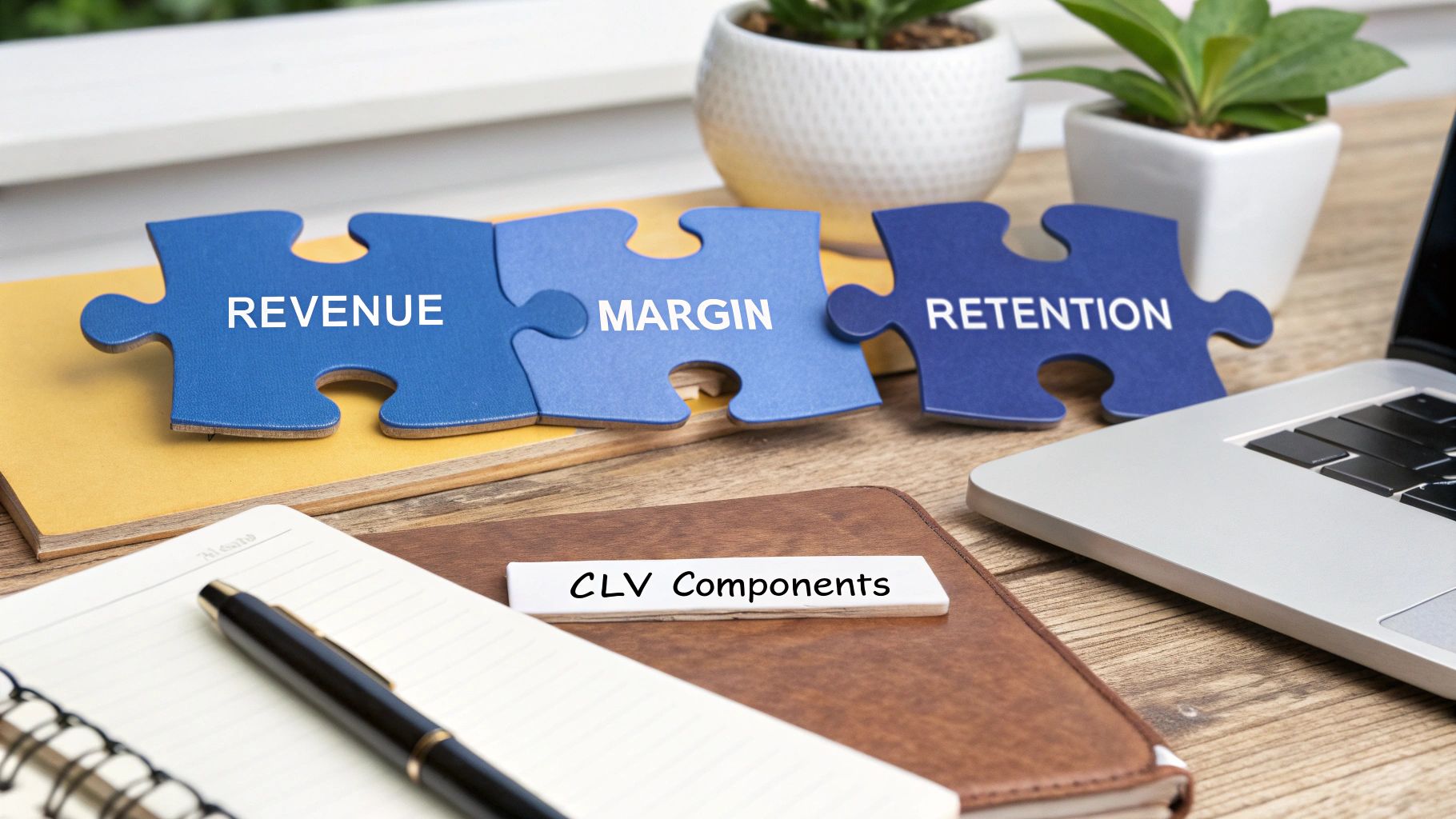
Before diving into complex predictive models, start with the fundamentals. Mastering the foundational customer lifetime value formula is the first step toward operationalizing this metric.
This simple calculation provides an immediate, practical snapshot of an average customer’s worth, turning an abstract concept into a tangible number for decision-making. For B2B companies, particularly those with recurring or subscription revenue models, this is the essential starting point.
The core formula is refreshingly straightforward, relying on three key metrics likely already tracked within your CRM.
Simple CLV Formula = Average Purchase Value x Average Purchase Frequency x Average Customer Lifespan
At its heart, this approach estimates the total revenue a customer is expected to generate throughout their relationship with your business. It serves as a powerful, high-level forecast.
Breaking Down The B2B Formula Components
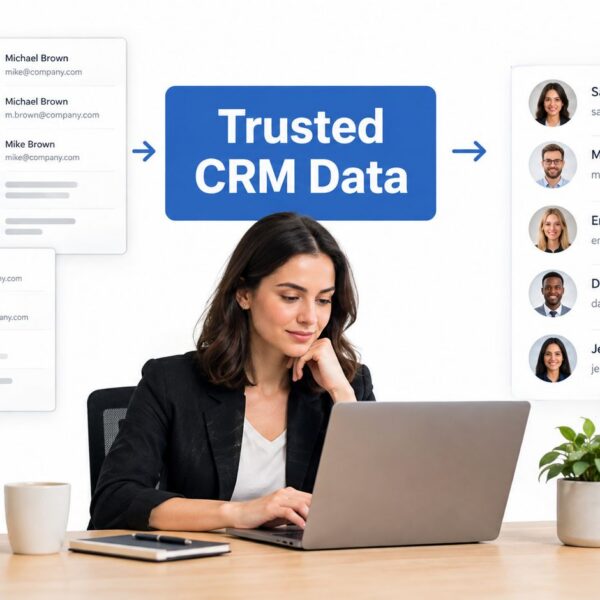
Let’s translate these variables into actionable data points for a B2B operations manager. A critical prerequisite: any calculation is only as reliable as its underlying data. Inaccurate or incomplete data will yield a misleading CLV. Therefore, learning how to improve data quality is a non-negotiable first step for any serious RevOps leader.
With a foundation of clean data, you can proceed to extract these numbers from your MarTech stack.
The table below breaks down each component of the simple CLV formula and provides examples of where to find the data in common CRMs like Salesforce or HubSpot.
Components of the Simple CLV Formula
| Metric | What It Means for Your Business | B2B Data Source Example (Salesforce/HubSpot) |
|---|---|---|
| Average Purchase Value (APV) | The average revenue from a single customer purchase. For a SaaS company, this is your average contract value (ACV). | Run a report on closed-won Opportunity or Deal objects. Calculate the average of the Amount field over a specific period. |
| Average Purchase Frequency (APF) | How often a customer buys from you within a defined period (typically one year). | For an annual SaaS subscription, this value is 1. For monthly, it’s 12. For project-based work, it’s the average number of contracts per account per year. |
| Average Customer Lifespan (ACL) | The average duration a customer remains active before they churn. This is the inverse of your customer churn rate. | First, calculate your customer churn rate. Then, Lifespan (in years) = 1 / Annual Churn Rate. |
By pulling these three metrics directly from your CRM, you are not performing a theoretical exercise; you are building a reliable, data-backed CLV calculation. This grounds high-level strategy in the operational data housed within Salesforce or HubSpot, which is precisely where strategic RevOps thrives.
To accurately determine your Average Customer Lifespan, a solid grasp of your retention metrics is essential. Learn how to master your https://martechdo.com/customer-retention-rate-calculation/ in our detailed guide.
The CLV to CAC Ratio: Your Profitability North Star

Calculating CLV is a significant step, but the metric realizes its full strategic value when paired with another key performance indicator: Customer Acquisition Cost (CAC). This is the total sales and marketing expenditure required to acquire a new customer.
The relationship between these two metrics—the CLV to CAC ratio—is your true north star for sustainable growth. It moves beyond isolated data points to answer the ultimate question for every RevOps leader: is our growth engine profitable?
Consider this: a high CLV is impressive, but it’s detrimental if acquiring each customer costs more than they are worth. Conversely, a low CAC is ineffective if those customers churn quickly, generating minimal value. The ratio provides the necessary context to make sound financial decisions.
What Is a Good CLV to CAC Ratio?
Before calculating your ratio, you must first master how to calculate customer acquisition cost (CAC) with precision. With accurate CLV and CAC figures, you can effectively gauge the health of your business model.
A common industry benchmark suggests a 3:1 ratio (CLV to CAC) is the ideal target for sustainable growth. In practical terms, for every $1 invested in acquiring a customer, you should expect a return of at least $3 in lifetime value. This balance ensures you are growing profitably.
A ratio below 1:1 indicates you are losing money on each new customer. A 1:1 ratio means you are breaking even on acquisition. The 3:1 target provides a healthy margin to cover operational costs and generate profit.
Tying CAC Back to Your MarTech Stack
To derive an accurate CAC, you must sum all sales and marketing expenses over a period and divide that total by the number of new customers acquired in that same timeframe. This data resides within your MarTech stack.
You can pull the necessary figures directly from your core systems:
- Marketing Automation (HubSpot, Pardot/MCAE): This is your source for campaign spend, advertising costs, and content creation expenses tied to lead generation.
- CRM (Salesforce, HubSpot): Here, you can account for sales team salaries, commissions, and technology costs associated with closing deals.
When you master your customer acquisition cost calculation, you create a direct link between your GTM team’s activities and the company’s financial health. It empowers you to justify marketing budgets, optimize channel performance, and build a growth strategy that drives sustainable profit.
Unlocking Predictive CLV Models for Your Tech Stack

You have mastered the basic CLV formulas, which provide a historical view. For a mature RevOps team, the next step is to evolve from analyzing what a customer has done to predicting what they will do.
This is where you transition from historical analysis to predictive modeling, transforming your tech stack from a system of record into a revenue-forecasting engine.
First, enhance your calculation by incorporating profitability. The Traditional CLV formula adds the critical layer of gross margin, providing a clearer view of a customer’s true impact on your bottom line.
Traditional CLV Formula
(Average Purchase Value x Average Purchase Frequency) x Gross Margin % x Average Customer Lifespan
This is a crucial adjustment. A high-revenue customer who is expensive to service is less valuable than they appear. Factoring in gross margin ensures you are optimizing for profit, not just revenue.
Moving From Historical Data to Predictive Insights
The true evolution in RevOps is Predictive CLV. This involves using statistical models and machine learning to forecast a customer’s future value with greater accuracy. The focus shifts from past transactions to anticipating future behavior based on the rich data you are already collecting.
This leap separates a good data operation from a great one. You begin leveraging algorithms that analyze transactional history, firmographics, and behavioral signals to build a more accurate forecast.
Predictive CLV is fueled by the behavioral data within your marketing automation and CRM platforms. Look beyond “closed-won” deals and analyze signals like:
- Product Usage: How frequently do they log in? Which features do they use most?
- Support Interactions: What is their ticket volume? How quickly are issues resolved?
- Marketing Engagement: Are they opening emails in Pardot or HubSpot? Attending webinars?
- Website Behavior: Which solution or resource pages do they visit repeatedly?
The Tech Stack for Predictive CLV
Predictive modeling requires a robust data infrastructure. While your CRM is the core, several other components are necessary to connect the dots.
- A Centralized Data Warehouse: This serves as your single source of truth, consolidating data from Salesforce, HubSpot, product analytics, and other systems.
- A Business Intelligence (BI) Tool: Platforms like Tableau or Power BI are needed to visualize data, build dashboards, and run statistical models.
- Clean, Integrated Data: The accuracy of your predictive model depends entirely on the quality of its input data. Seamless system integration is non-negotiable.
By layering these behavioral insights onto your transactional data, you can build a dynamic, forward-looking CLV model. This empowers your RevOps team to move from reactive reporting to proactive, data-driven strategy.
For more practical applications, see our guide on improving customer lifetime value.
Actionable Strategies to Increase Customer Lifetime Value
You have calculated your Customer Lifetime Value. Now, how do you increase it?
Improving CLV is not about guesswork; it requires executing targeted plays within your existing MarTech stack. Let’s transform CLV from a passive metric into an active catalyst for revenue growth.
Each of these strategies is a playbook designed for B2B teams running on platforms like Salesforce, Pardot (MCAE), and HubSpot. These are concrete actions to increase customer loyalty and value over time.
Master the Onboarding Experience with Automation
The first 90 days of a customer relationship are critical. A poor onboarding experience is the fastest way to jeopardize a new relationship and erode its potential CLV. Use your marketing automation platform to build a structured onboarding sequence that empowers new customers from day one.
- Pardot/HubSpot Workflow: Trigger a drip campaign as soon as a deal is marked “Closed-Won.” Begin with a welcome email, followed by a series of helpful communications, such as quick-start guides, relevant knowledge base articles, and invitations to new-customer webinars.
- Salesforce Integration: Log every email open and click as a task or activity on the Contact or Account record in Salesforce. This provides customer success managers (CSMs) with clear visibility into engagement, enabling them to identify customers who need proactive support.
A smooth, automated onboarding process ensures a consistent, high-quality experience for every customer, increasing the probability of long-term retention.
Pinpoint Upsell and Cross-Sell Opportunities in Your CRM
Your most profitable growth opportunities often lie within your existing customer base. Your CRM is a goldmine for identifying these expansion opportunities, but it requires a proactive approach.
By analyzing product usage, support ticket trends, and engagement data, you can predict a customer’s next logical purchase. This transforms your sales team from reactive order-takers into strategic advisors who deliver the right solution at the right time.
Build reports in Salesforce or HubSpot to flag accounts with high growth potential. For instance, create a dynamic list of customers who:
- Have reached 80% of their data limits or user licenses.
- Have not purchased a complementary product that similar customers own.
- Exhibit high product usage but lack premium features that could enhance their experience.
Then, configure automated tasks for your account managers to initiate outreach when a customer meets these criteria. This systematic process ensures you capitalize on expansion revenue opportunities.
Build a Powerful Customer Feedback Loop
To improve customer retention, you must understand what drives satisfaction and what causes churn. A continuous feedback loop is essential for boosting retention and, consequently, CLV.
Integrate a survey tool with your CRM to automate feedback requests at key moments, such as after a support case is closed or 60 days post-onboarding.
The real value is in the response. When negative feedback is received, use a Salesforce or HubSpot workflow to automatically create a high-priority task for the designated CSM. This proactive intervention allows you to address issues before they escalate, directly improving your average customer lifespan and CLV.
Putting CLV at the Heart of Your Revenue Operations
Calculating your customer lifetime value is an important first step, but its true power is realized when the metric is embedded into your company’s operational DNA. It should evolve from a dashboard metric into the central nervous system of your Revenue Operations.
CLV is not just a marketing KPI; it is a unifying goal that aligns marketing, sales, and customer success toward a common objective.
When CLV becomes your north star, departmental silos begin to break down. Marketing shifts from generating low-cost leads to attracting prospects with the highest long-term value potential. Sales focuses on closing deals with accounts that fit your ideal customer profile—the kind that lead to expansion revenue you can easily track in Salesforce or HubSpot.
Your CLV-Focused RevOps Checklist
This strategic shift requires deliberate leadership. As a RevOps leader, your role is to champion this customer-centric mindset, using CLV data to guide strategic decisions.
Here is a roadmap to get started:
- Standardize Your Reporting: Build shared CLV dashboards in your CRM or BI tool that are accessible to all go-to-market teams. Alignment occurs naturally when everyone is looking at the same data.
- Align Incentives: Adjust compensation plans to reward the acquisition of high-CLV accounts and the achievement of key retention and expansion targets by the customer success team.
- Integrate into Strategic Planning: Make CLV a core component of your quarterly business reviews (QBRs) and annual planning sessions.
When CLV becomes the common language spoken across your go-to-market teams, you transition from a reactive, deal-chasing organization to a proactive, value-driven growth engine. This is how RevOps solidifies its role as the strategic force behind sustainable, profitable growth.
Got Questions About CLV? We’ve Got Answers.
Even after understanding the formulas, translating CLV theory into practice can present challenges. When working within your Salesforce or HubSpot instance, practical questions often arise.
Here are answers to some of the most common questions from B2B RevOps leaders.
How Often Should We Actually Be Calculating CLV?
For most B2B organizations, a quarterly or semi-annual calculation cadence is optimal. This frequency is sufficient to identify significant trends within your customer base without creating an excessive reporting burden.
However, during periods of strategic change, such as a new product launch or market entry, consider shifting to a monthly calculation. This provides faster feedback on how major initiatives are impacting long-term customer value.
The key is to align your CLV reporting rhythm with your company’s established strategic planning cycles.
What Are the Biggest Mistakes People Make With the CLV Formula?
Two common errors significantly undermine the accuracy of CLV calculations: using raw revenue instead of gross margin, and failing to segment customers.
Using revenue inflates your CLV, creating a misleading picture that ignores the cost of delivering your product or service. Aggregating all customers into a single, company-wide CLV average masks the most valuable insights.
Your enterprise clients will have a dramatically different CLV compared to your SMB accounts. You must segment your analysis within your CRM to derive actionable intelligence.
Can I Calculate CLV Right Inside Salesforce or HubSpot?
Yes, for a basic, historical CLV, you can. Both CRM platforms contain the necessary core data, such as deal values, close dates, and customer start dates. You can build custom reports and dashboards to establish a solid foundational CLV metric.
However, for more advanced, predictive CLV modeling, you will likely need to integrate specialized tools. This involves connecting your CRM to a dedicated business intelligence (BI) platform like Tableau or Power BI. These tools are designed to handle complex statistical models and blend CRM data with other sources, significantly improving the accuracy of your forecasts.
At MarTech Do, we help B2B companies turn complex data into a clear RevOps strategy. If you need to optimize your CRM and marketing automation to drive profitable growth, let’s connect. Learn how we can help.