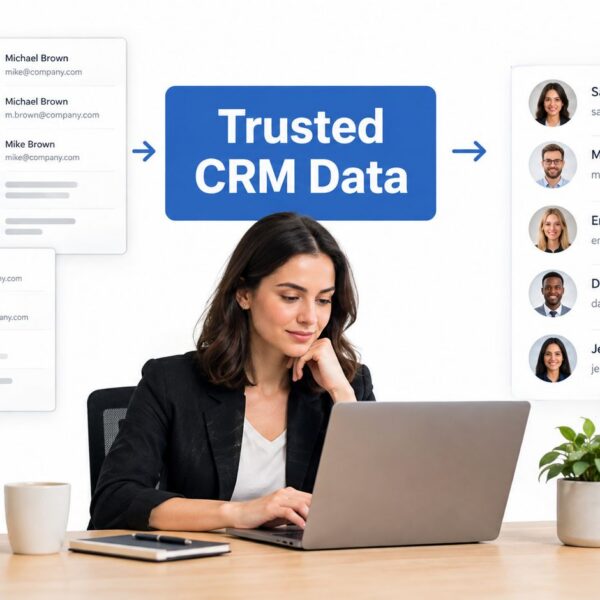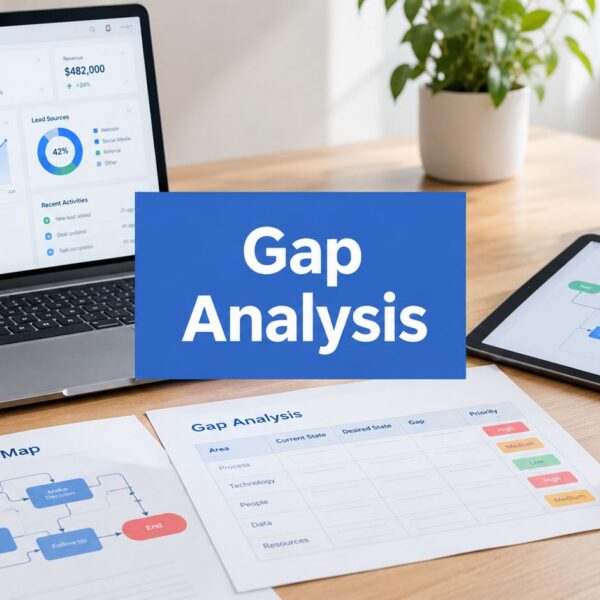
Growth stalls in a familiar way. Marketing says lead volume is healthy, sales says pipeline quality is weak, customer success says the wrong customers are being sold, and finance says the forecast keeps moving. Meanwhile, Salesforce is full of duplicate accounts, HubSpot and Account Engagement don’t agree on lifecycle stages, and nobody trusts attribution enough to make a serious budget decision.
That’s usually described as a process problem. It’s partly true, but it misses the underlying issue. Process breaks when nobody owns the full revenue system.
A chief revenue officer exists to fix exactly that. Not by acting as a super-sized sales leader, but by taking end-to-end ownership of how revenue is created, measured, and retained across marketing, sales, and customer success. In B2B SaaS, especially where Salesforce, HubSpot, Service Cloud, Revenue Cloud, and legacy marketing automation all need to work together, that leadership role matters more than the org chart suggests.
Most companies don’t need more dashboards first. They need one executive who can decide what the funnel is, how handoffs should work, which metrics matter, and what changes each team must make so the go-to-market engine performs as one system.
Introduction Why Revenue Is a Team Sport Without a Captain
A mid-market B2B SaaS company can look healthy on paper and still be underperforming. Demand gen keeps shipping campaigns. AEs keep pushing opportunities forward. Customer success keeps handling onboarding and renewals. Each team is busy, competent, and reporting progress. Yet growth feels harder every quarter.
The symptoms are obvious when you sit inside the system for even a week. Leads enter through multiple forms with inconsistent routing. MQL criteria in HubSpot don’t match qualification standards in Salesforce Sales Cloud. Sales reps create their own workarounds because the CRM doesn’t reflect how deals move. Customer success gets handed accounts with poor fit, thin implementation notes, or unrealistic expectations set in the sales cycle.
That friction compounds into a commercial problem. Forecasts become political. Attribution becomes an argument. Churn gets treated as a post-sale issue when the root cause started in acquisition. Teams optimise for their local target instead of the full customer lifecycle.
The pattern behind the pain
What looks like underperformance is often a missing operator at the top of the revenue function.
- Marketing chases volume: Campaigns generate names, but not enough qualified pipeline.
- Sales chases speed: Reps work opportunities that should have been disqualified earlier.
- Customer success absorbs the fallout: Onboarding teams inherit messy expectations and incomplete data.
- RevOps gets stuck in the middle: Analysts build dashboards for everyone, but nobody has authority to enforce one operating model.
Revenue breaks when teams share a target but not a system.
A good chief revenue officer brings that system together. They don’t just ask for tighter alignment. They define the lifecycle, the handoffs, the ownership rules, the forecast discipline, and the stack requirements that make alignment real.
Why this role matters more in a Salesforce and HubSpot environment
In companies using Salesforce, HubSpot, Account Engagement, Service Cloud, or Revenue Cloud, technical complexity turns leadership gaps into revenue leaks. A bad lifecycle definition doesn’t stay theoretical. It shows up as misrouted leads, duplicate records, broken scoring, poor renewals visibility, and unreliable reporting.
That’s why the CRO role has become so important in B2B SaaS. When revenue data, process design, and team incentives live across connected systems, someone has to own the architecture and the operating model behind it.
What Is a Chief Revenue Officer Really
A chief revenue officer is not just the person who owns the sales number. That’s the easiest way to misunderstand the role.
A CRO owns the full commercial engine. That includes new business, expansion, retention, and the operating model that links marketing, sales, and customer success. In practice, the role sits at the point where strategy, execution, and systems meet.

A VP of Sales usually focuses on pipeline coverage, rep performance, and closing. A CMO usually focuses on demand creation, positioning, and programme efficiency. A CRO has to care about both, and about what happens after the deal is signed.
What the CRO is not
The role gets watered down when companies rename a head of sales and call it transformation.
That doesn’t work if the same silos remain in place. If marketing still owns top-of-funnel definitions, sales still owns pipeline stages, customer success still owns renewals in a separate model, and RevOps is left negotiating between them, you don’t have a CRO. You have a title inflation problem.
A real CRO has authority to unify those decisions across functions.
Practical rule: If the person can’t change lifecycle definitions, compensation logic, forecasting rules, and CRM process across teams, they aren’t operating as a chief revenue officer.
Why the reporting line matters
The role only works when the organisation gives it enough authority. The critical structural point is that CROs report directly to the CEO, which creates independence from siloed departmental pressures and allows alignment of sales, marketing, and customer success around long-term revenue growth rather than narrow team targets, according to the CRO reporting structure outlined by GoFractional.
That reporting line changes behaviour. The CRO can act as the CEO’s revenue deputy, rather than as one more departmental leader protecting a function.
Here’s what that means in practice:
- Cross-functional power: The CRO can standardise qualification, handoff criteria, and pipeline definitions across teams.
- Cleaner trade-off decisions: Budget debates shift from “my channel versus yours” to “which motion improves revenue performance across the lifecycle”.
- Operational accountability: RevOps, sales ops, marketing ops, and customer success operations can work from one revenue model instead of parallel interpretations.
For B2B leadership teams, that is the definitive meaning. A chief revenue officer is the executive who owns the commercial system end to end, with the authority to make the system coherent.
Core CRO Responsibilities and Critical KPIs
The job becomes clearer when you stop thinking in titles and start thinking in operating responsibilities. A chief revenue officer owns the machinery of growth, not just the outcome line on a board slide.
In a modern B2B SaaS company, that means the CRO typically owns go-to-market process design, forecasting discipline, pipeline governance, revenue technology decisions, and cross-functional performance management. They aren’t expected to configure every workflow in Salesforce or rebuild every HubSpot automation themselves, but they are accountable for whether the system produces predictable revenue.

The operating mandate
The RevOps part of the CRO role is often underestimated. The CRO owns technology stack management, process refinement, and data governance across sales, marketing, and customer success. That includes CRM platform management in Salesforce and HubSpot, marketing automation integration, forecasting systems, and pipeline management. Under unified RevOps architecture led by a CRO, organisations show 23-40% improvement in sales cycle efficiency and 15-25% higher win rates, with core KPIs centred on Overall Revenue Growth, Customer Lifetime Value, and Net Revenue Retention, according to Shiny’s CRO role analysis.
That’s the strategic case. The practical case is even simpler. If the CRM lifecycle is broken, the CRO owns the fix. If lead scoring can’t support sales prioritisation, the CRO owns the decision. If forecasts are inconsistent because stages mean different things to different managers, the CRO owns standardisation.
What strong CRO ownership looks like
A capable CRO usually puts structure around five areas:
- Lifecycle design: Defining how a record moves from anonymous engagement to lead, opportunity, customer, renewal, and expansion.
- Forecasting discipline: Enforcing stage criteria, pipeline hygiene, close-date integrity, and inspection routines.
- Technology governance: Deciding how Salesforce, HubSpot, Account Engagement, Service Cloud, and adjacent tools should connect and what each system is responsible for.
- Commercial handoffs: Making sure marketing, sales, implementation, and customer success share clear entry and exit criteria.
- Data accountability: Creating one source of truth for revenue reporting.
The KPIs that actually matter
Some companies bury the CRO under dozens of reports. That usually signals weak prioritisation. The role works better when a small set of commercial metrics governs behaviour.
| KPI | Why it matters to the CRO |
|---|---|
| Overall Revenue Growth | Shows whether the combined GTM system is producing commercial results |
| Customer Lifetime Value | Tests whether acquisition quality and post-sale value creation are connected |
| Net Revenue Retention | Reveals whether customers stay, expand, or erode after the initial sale |
| Pipeline quality | Indicates whether opportunity creation is translating into credible forecast coverage |
| Forecast accuracy | Exposes whether stage definitions and inspection discipline are working |
The best CROs don’t measure more. They measure the few things that force the whole system to behave better.
In strong organisations, these metrics don’t sit in separate decks for separate departments. They tie back to one commercial narrative. That’s what makes the chief revenue officer different from a functional leader. The job is to make the revenue model executable, measurable, and repeatable.
Unifying Your GTM With a CRO-Led RevOps Strategy
A CRO-led RevOps strategy isn’t a reporting exercise. It’s an architectural one. The CRO decides how your revenue engine should behave, then uses process and platform design to make that behaviour consistent.
In a Salesforce and HubSpot environment, the first challenge is usually role clarity between systems. Salesforce Sales Cloud should hold core account, contact, opportunity, and forecast logic. HubSpot or Account Engagement should support campaign execution, nurture, scoring, and engagement signals. Service Cloud should carry implementation, support, and renewal visibility once the customer relationship matures. If those boundaries are fuzzy, teams duplicate work and reports stop making sense.

How the workflow should connect
A strong CRO starts with the lead lifecycle, not with dashboards.
A typical pattern looks like this:
- Marketing captures intent through HubSpot forms, webinars, paid campaigns, or outbound enrichment workflows.
- Qualification rules decide routing based on fit, behaviour, territory, and ownership logic.
- Sales works from Salesforce with clear acceptance criteria and stage definitions.
- Closed-won data triggers onboarding in Service Cloud or the post-sale system.
- Customer success feeds health and expansion signals back into the revenue model.
That flow sounds basic, but many organizations break it in the details. Lead status values don’t match opportunity rules. Sales creates new records instead of converting properly. Handoff notes are inconsistent. Renewal ownership sits outside the CRM. Enrichment runs without governance.
Where CROs create real leverage
The chief revenue officer creates value by turning disconnected tools into one operating system.
Examples include:
- Lead scoring that sales will trust: The CRO aligns behavioural and firmographic signals so scoring supports prioritisation, not vanity.
- Closed-loop attribution: Campaign engagement from HubSpot or Account Engagement connects to pipeline and revenue in Salesforce.
- Customer transition design: The moment a deal closes, implementation and customer success inherit the right data, stakeholders, and commitments.
- Stack rationalisation: The CRO decides when to keep legacy Pardot logic, when to move workflows, and when to integrate tools such as Clay for enrichment and outbound research.
A useful model for post-sale alignment is a documented handoff and adoption process. If your customer team is distributed, a practical remote customer success playbook can help pressure-test whether onboarding and account ownership are defined clearly enough to scale.
For leadership teams formalising this work, a GTM operating model usually needs more than a few disconnected fixes. A structured go-to-market strategy framework helps translate revenue goals into lifecycle stages, ownership rules, channel design, and measurement standards.
Systems don’t create alignment on their own. Leaders do, then they configure systems to enforce it.
When Your B2B Company Is Ready for a CRO
Not every B2B company needs a chief revenue officer immediately. Early-stage teams can often get by with a strong founder, a capable head of sales, and disciplined operators. The problem starts when growth complexity outruns functional leadership.
The signal isn’t just revenue size. It’s organisational strain.
If your board keeps hearing the same argument about lead quality, win rates, churn, and forecast credibility, you’re already paying for the absence of revenue leadership. If your systems can’t tell a coherent story from first touch to renewal, you’re relying on departmental interpretation instead of commercial management.
Signals that the role has become necessary
The need for a CRO usually shows up in patterns like these:
- Pipeline exists, but confidence doesn’t: Sales can produce a number, but finance and the CEO don’t trust the assumptions behind it.
- Marketing and sales use different definitions: MQL, SQL, accepted lead, and opportunity creation mean different things depending on who’s presenting.
- Customer success is reactive: Expansion and retention are discussed after renewal risk appears, not designed into the lifecycle earlier.
- Your stack has grown faster than your operating model: Salesforce, HubSpot, Account Engagement, and point tools all exist, but governance is weak.
- Attribution can’t support investment decisions: Campaign reporting is available, but not decision-grade.
Why this matters in Canadian mid-market B2B SaaS
The regional evidence is useful here because it points to a maturity gap, not just a hiring trend. A 2025 SaaS North survey of 300+ Canadian mid-market B2B firms found that only 42% use standardised RevOps KPIs under CRO oversight, leading to 28% lower go-to-market efficiency compared to US peers. The same source notes that 35% of Canadian B2B stacks show significant attribution gaps, reinforcing the need for CRO-led system audits, according to Allen Austin’s CRO market overview.
That matters because many leadership teams still think the answer is another hire inside one function. Another marketer won’t fix lifecycle governance. Another sales manager won’t clean attribution logic. Another CS leader won’t solve upstream qualification problems.
If three departments are contributing to the problem, one department won’t solve it alone.
The right time to hire a chief revenue officer is when revenue has become a shared responsibility but still lacks a single accountable owner.
How to Hire a Chief Revenue Officer
Hiring a chief revenue officer is not like hiring a stronger VP of Sales. The evaluation criteria are wider, and the mistakes are more expensive.
In California’s tech market, total compensation for CROs averages $426,507 annually, and venture-backed startup base salaries often reach $400K-$600K plus significant equity, according to PayScale-based compensation benchmarks summarised by Prospeo. That pricing tells you how the market values the role. It also tells you not to improvise the hiring process.
What to look for first
The best candidates usually combine four capabilities.
- Commercial breadth: They understand demand generation, sales execution, retention, and expansion as one model.
- Operational depth: They can talk credibly about forecasting, stage governance, compensation design, territory logic, and handoffs.
- Systems fluency: They understand how Salesforce, HubSpot, Account Engagement, and reporting architecture shape behaviour.
- Executive judgement: They can make trade-offs between speed, control, cost, and scalability.
If a candidate speaks only in sales language, they’re too narrow. If they speak only in strategic abstractions, they probably won’t improve operations. You want someone who can discuss pipeline inspection in the same conversation as lifecycle architecture and post-sale ownership.
The hiring sequence that works
A disciplined process usually includes:
- Define the mandate before writing the role. Is this person fixing new logo acquisition, retention, RevOps governance, or all three?
- Audit your current revenue model. If you can’t describe the current gaps clearly, you won’t assess candidates well.
- Test systems understanding early. Ask how they would handle Salesforce governance, HubSpot lifecycle design, and attribution credibility.
- Use scenario interviews. Present a broken funnel, messy CRM, or weak forecast. Ask what they would change in the first months.
- Check for CEO-level communication. The role depends on influencing peers, not just directing a function.
If you need a baseline before drafting responsibilities, a practical revenue operations job description can help separate CRO-level ownership from manager-level RevOps work.
Key Interview Questions for a B2B SaaS CRO
| Question Category | Sample Question | What to Listen For |
|---|---|---|
| Revenue strategy | How would you align acquisition, retention, and expansion under one operating model? | A lifecycle view, not just a pipeline answer |
| Forecasting | What makes a forecast trustworthy in Salesforce? | Clear stage criteria, inspection rhythm, manager accountability |
| Marketing and sales alignment | How would you redesign lead qualification between HubSpot and Salesforce? | Practical lifecycle logic and shared definitions |
| Customer success integration | When should renewal and expansion data enter the main revenue forecast? | Comfort with post-sale metrics and ownership design |
| Tech stack governance | How do you decide what belongs in Salesforce versus HubSpot or Account Engagement? | System boundaries, data ownership, and process clarity |
| Change management | How do you handle resistance from department heads losing local control? | Executive maturity and cross-functional leadership |
The strongest hires aren’t just polished. They can diagnose your revenue engine in real terms and explain what they’d standardise, what they’d leave alone, and where the tech stack is amplifying bad process.
The Future CRO AI-Powered and GTM-Engineered
A lot of CRO discussion still sounds like a polished version of old-school sales leadership. That view is already outdated.
The role is shifting toward GTM engineering, where the chief revenue officer doesn’t just manage teams but also shapes how data, automation, enrichment, and AI improve commercial execution. In practice, that means being comfortable with APIs, workflow design, enrichment logic, and predictive models across Salesforce and HubSpot.

Where AI is helping, and where teams still struggle
The promising use cases are practical. Better forecasting. Smarter lead prioritisation. Faster enrichment. Cleaner segmentation. More consistent account research for outbound teams.
The challenge is integration and governance. According to the verified Canadian trend data, post-2025 federal AI regulations saw CROs in leading firms achieve 25% faster forecasting via HubSpot-Salesforce APIs combined with AI, but many still struggle to integrate legacy MarTech, including Pardot, with tools like Clay for lead enrichment, as noted in this discussion of AI and RevOps integration challenges.
That tracks with what operators see on the ground. AI can improve the quality of decisions, but only when the underlying CRM structure is reliable enough to support it. If account hierarchies are messy, lifecycle stages are inconsistent, and enrichment rules are uncontrolled, AI tends to scale confusion.
What the next-generation CRO needs
The next version of the role looks different from the classic revenue executive.
- System judgement: Knowing when to automate and when to simplify first.
- Data discipline: Protecting CRM hygiene before adding more intelligence layers.
- Tool fluency: Understanding how enrichment, scoring, routing, and forecasting tools affect rep behaviour.
- Commercial engineering mindset: Treating GTM as a designed system, not a set of departmental activities.
A useful place to start if you’re thinking this way is a more deliberate GTM engineering approach, especially in organisations trying to connect legacy automation with modern enrichment and AI-enabled workflows.
The future CRO won’t win by adding more software. They’ll win by making the stack produce better decisions.
If your Salesforce or HubSpot environment is making revenue harder to manage, MarTech Do helps B2B teams audit the stack, fix lifecycle gaps, improve attribution, and build a RevOps operating model that sales, marketing, and customer success can effectively run.