You can usually tell when a B2B SaaS revenue engine has hit its limit.
Marketing says lead volume is healthy, but sales says the handoff is weak. Salesforce reports don’t line up with HubSpot dashboards. Lifecycle stages mean one thing to demand gen and something else to sales leadership. The team spends more time arguing over definitions, sync behaviour, and attribution than fixing the funnel.
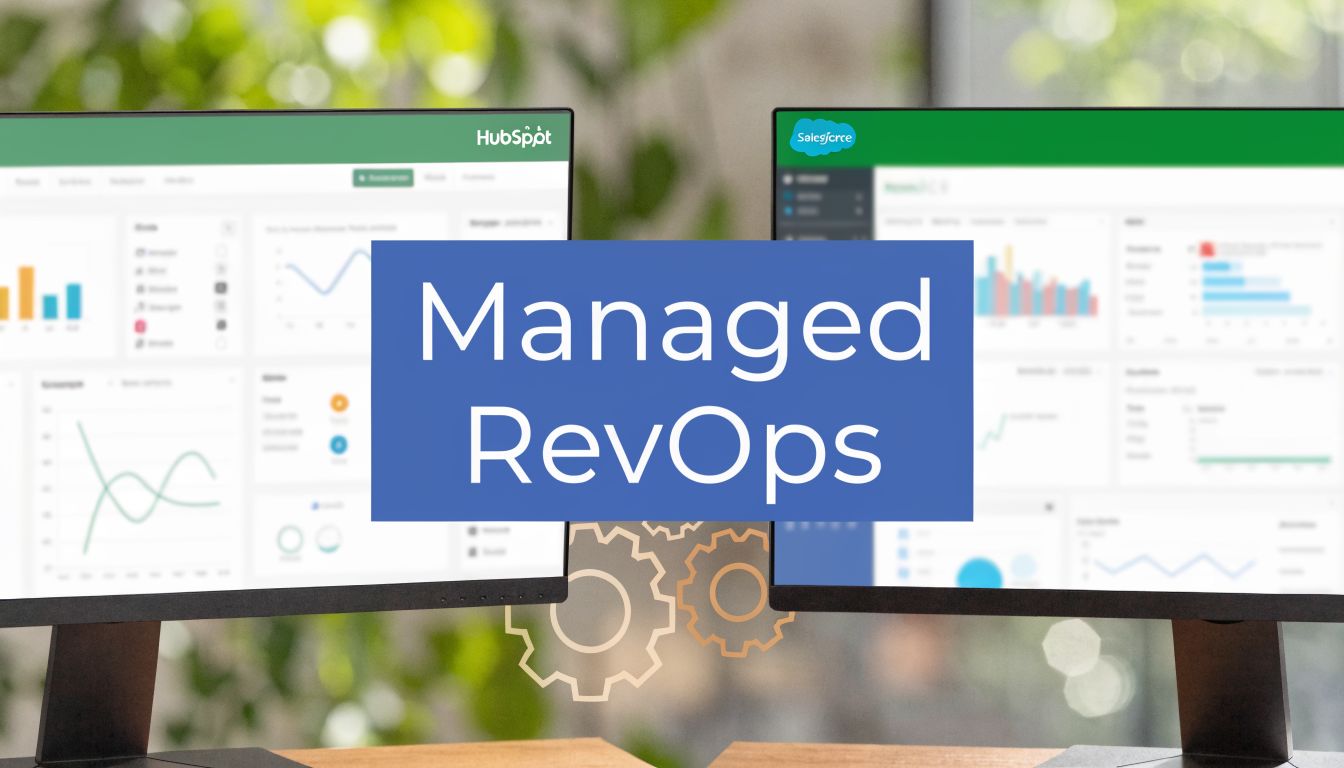
That’s the point where many ops leaders start looking at managed revops for hubspot and salesforce teams. Not because they want another agency in the mix, but because the internal stack has become too important, too connected, and too easy to break through piecemeal fixes. The work stops being “admin support” and becomes revenue infrastructure.
A strong managed RevOps partner doesn’t just tidy fields or rebuild a report. They audit the system, define ownership, fix architecture, and make sure the commercial team can trust what they’re looking at.
The RevOps Breaking Point in B2B SaaS
The pattern is familiar in mid-sized SaaS companies. HubSpot runs forms, lead scoring, nurture paths, and campaign reporting. Salesforce runs opportunities, forecasting, account ownership, and board-level pipeline views. Both systems matter. Neither tells the full story on its own.
The trouble starts in the gaps between them.
A lead fills out a form in HubSpot, hits an MQL threshold, and gets pushed into Salesforce. Then routing fails, or the lifecycle mapping is inconsistent, or a rep updates a record that later gets overwritten by another workflow. A few weeks later, leadership asks a simple question about campaign contribution to pipeline. Marketing and sales bring different numbers to the same meeting.
What the breaking point looks like
By the time teams ask for outside RevOps help, they’re usually dealing with several issues at once:
- Sales distrusts inbound data because records arrive incomplete, duplicated, or poorly routed.
- Marketing can’t prove contribution because attribution stops at lead creation or breaks when opportunity data lives elsewhere.
- Ops teams are buried in manual fixes like field clean-up, workflow exceptions, and report reconciliation.
- Leadership lacks confidence in forecasting because CRM stages, ownership rules, and conversion definitions aren’t consistently enforced.
Clean reporting is usually the last thing to fail. Data ownership and process discipline fail first.
Managed RevOps functions as a strategic lever, not a support function. In the Canadian B2B SaaS sector, companies implementing managed Revenue Operations achieved 25% higher customer acquisition efficiency than non-RevOps peers, and managed services reduced average lead response times from 42 hours to 11 hours, according to Arovy’s RevOps statistics summary.
Why in-house fixes stall
Internal teams often know something is wrong. What they usually don’t have is the spare capacity to stop, audit the full system, and redesign the operating model without disrupting pipeline.
A marketing ops manager can patch a sync issue. A sales ops lead can rebuild a dashboard. A Salesforce admin can adjust validation logic. But when HubSpot workflows, lifecycle definitions, routing rules, attribution fields, and forecasting requirements are all connected, isolated fixes tend to create new problems.
Managed RevOps works when the provider treats the stack as one revenue system. That means process design, platform architecture, reporting logic, and operating cadence all get handled together.
What Managed RevOps Actually Delivers
Managed RevOps is not the same as hiring a contractor to clean up lists or tune one automation. It’s also not the same as hiring a single full-time ops lead and expecting that one person to cover Salesforce architecture, HubSpot automation, attribution, reporting, training, and governance.
It’s a structured operating model for the revenue engine.

Audit before action
The first deliverable should be a proper systems audit. That includes lead flow, field usage, lifecycle definitions, automation overlap, reporting logic, routing, and user behaviour. Without that baseline, implementation work becomes guesswork.
A good audit answers practical questions:
- Where does the lead handoff fail
- Which fields are critical but unreliable
- What automations conflict across platforms
- Which reports are being used for executive decisions despite weak underlying data
This is also where experienced teams find hidden data debt. Old workflows, duplicate properties, inconsistent stage rules, and legacy exceptions often explain why the stack feels unstable.
Strategy that maps to commercial reality
The second deliverable is a roadmap tied to the actual go-to-market motion. Not a generic “alignment” workshop. The roadmap should define lifecycle ownership, scoring inputs, handoff criteria, attribution design, and the reporting layer required by marketing, sales, and leadership.
For teams refining outbound and inbound motion together, adjacent resources on optimizing sales and marketing outreach can also help clarify where RevOps design needs to support enablement, not just systems administration.
Operational test: If the roadmap can’t explain how a raw lead becomes closed-won, and who owns each transition, it isn’t complete.
Hands-on implementation
Managed RevOps demonstrates its value. Strategy only matters if someone can build it inside HubSpot, Salesforce, and the surrounding stack.
Typical implementation work includes:
- Lifecycle and funnel architecture inside both platforms.
- Automation rebuilds to remove overlap and reduce brittle workflow chains.
- Field and object mapping across HubSpot, Salesforce, and connected tools.
- Dashboard and reporting rebuilds so commercial teams work from one set of definitions.
Ongoing optimisation
The strongest engagements don’t end at launch. Teams need governance, issue triage, backlog prioritisation, and regular performance reviews. Markets change, headcount changes, and GTM motions change. RevOps has to keep up.
That’s the difference between outsourced labour and a managed function. One closes tickets. The other improves how revenue teams operate.
Platform-Specific Needs for HubSpot and Salesforce Stacks
A common mid-market SaaS scenario looks like this. Marketing trusts HubSpot. Sales trusts Salesforce. Finance trusts neither report because lead status, pipeline stage, and attribution logic no longer match across systems.
HubSpot and Salesforce can work well together, but only if each platform has a defined job and the sync is built around that decision. The native connector does not solve architecture, ownership, or compliance on its own.

Where HubSpot usually leads
HubSpot usually performs best upstream. It handles form capture, nurture flows, campaign response, web conversion tracking, and early lifecycle progression with less administrative overhead than Salesforce.
That speed helps lean teams launch quickly. It also creates risk. Once teams pile on custom properties, scoring rules, routing logic, enrichment tools, and consent workflows, HubSpot can turn into a second CRM without the controls needed to govern it.
I see the same failure pattern often. Marketing builds process inside HubSpot because it is faster. Sales later asks Salesforce to override those rules because forecast accuracy matters more than marketing convenience. Now both systems are trying to manage the same customer record.
Where Salesforce usually leads
Salesforce is better suited for opportunity management, account structure, quote-adjacent process control, territory logic, and board-level pipeline reporting. It is also less forgiving when architecture is sloppy.
Validation rules can stop sync. Old Process Builders can conflict with Flow automation. Custom objects can make reporting harder if nobody defines how they relate to core revenue stages. In regulated environments, poor field governance creates another problem. Consent status, legal basis, and contact preferences can drift between systems, which becomes a real issue for North American SaaS teams managing CCPA obligations.
The sync design that separates useful data from expensive noise
Bi-directional sync fails when teams map fields before they decide field ownership. The right approach starts with business rules, then system rules.
A workable model usually looks like this:
- HubSpot-owned fields for engagement history, form conversion context, marketing subscription status, and early funnel qualification
- Salesforce-owned fields for opportunity stage, amount, close date, account hierarchy, and rep-managed pipeline data
- Shared fields only when both teams agree on definitions, update logic, and the system of record
If both platforms can overwrite the same high-value field, reporting confidence drops fast. Reps stop trusting dashboards. Marketing disputes attribution. Leadership gets two pipeline numbers and neither survives scrutiny.
For teams designing that ownership model, this guide to HubSpot Salesforce integration architecture is a useful reference because it treats the connection as an operating model decision, not a setup task.
What in-house teams usually miss
Internal teams often start with the connector, a field map, and a few urgent sync fixes. That feels efficient. It usually creates a backlog of harder problems three months later.
The gaps are predictable:
- Automation is reviewed tool by tool instead of process by process
- Lifecycle stages are copied across systems even when the definitions serve different teams
- Attribution fields are synced without checking how campaign membership, contact roles, and opportunity influence should interact
- Consent data is passed between systems without testing deletion requests, subscription updates, and source-of-consent history
This is one reason managed RevOps can outperform a smart internal admin team. The job is not just to configure HubSpot or Salesforce well. The job is to decide what should happen in each platform, what should never sync, and where governance has to sit once new tools are added.
That matters even more when AI tooling enters the stack. An AI automation agency can help teams automate enrichment, routing, and support workflows, but those gains disappear if the CRM and marketing automation layer still have conflicting ownership rules.
Good architecture protects revenue. It also protects reporting quality, rep adoption, and compliance. Mid-sized SaaS companies usually hit the breaking point when they try to solve all three with ad hoc admin work. Managed RevOps gives them a Head of Operations level view before the stack becomes harder, and more expensive, to fix.
How to Evaluate and Choose a RevOps Partner
Most revenue operations agencies sound similar until you ask them detailed questions. Everyone says they align teams, improve reporting, and streamline systems. The useful differences show up when you press on architecture, process, compliance, and delivery.
If you’re choosing a partner, evaluate them the way you’d evaluate a strategic systems hire. Look at how they think, not just what they sell.
The questions that expose depth
Start with platform depth. Ask how they handle HubSpot lifecycle management when Salesforce owns pipeline. Ask how they audit automation overlap. Ask what they do before enabling two-way sync on shared fields.
Then ask about go-to-market design. A real RevOps partner should be comfortable discussing routing logic, scoring models, attribution structure, and enrichment workflows with tools such as Clay, ZoomInfo, and your current CRM stack.
If they answer every question with a tooling list, keep looking.
Compliance is not a side issue
For California-based teams, consent data and lifecycle syncing can’t be treated as a later clean-up task. Post-2025 CCPA amendments have led to significant fines for CA B2B firms due to poor data syncing, and a key evaluation question for any managed RevOps provider is their playbook for maintaining CCPA-compliant consent tracking across both HubSpot and Salesforce, because standard workflows often fail this test, according to this Salesforce AppExchange listing reference.
That matters even if your current issue feels operational rather than legal. Consent handling, lifecycle transitions, and field mapping are connected. A provider who treats compliance as someone else’s problem may also be careless with system design.
Ask for the provider’s exact approach to consent field mapping, deletion workflows, and auditability across both platforms.
Managed RevOps Partner Evaluation Scorecard
| Evaluation Criteria | What to Look For | Your Rating (1-5) |
|---|---|---|
| Platform expertise | Clear experience with both HubSpot and Salesforce, including sync architecture and reporting design | |
| Audit methodology | A defined discovery process covering data, automation, lifecycle stages, and reporting dependencies | |
| GTM engineering capability | Ability to support enrichment, routing, segmentation, and workflow design across the full funnel | |
| Compliance readiness | A concrete playbook for consent tracking, field governance, and data handling across systems | |
| Delivery model | Named owners, sprint cadence, prioritisation method, and documented communication process | |
| Change management | Training, documentation, stakeholder alignment, and post-launch support | |
| Business orientation | Focus on pipeline visibility, handoff quality, forecasting, and revenue outcomes rather than tickets closed |
Look for signal outside the pitch
Sometimes it helps to compare how adjacent service firms frame automation and systems work. For example, an AI automation agency may approach process orchestration from a different angle, which can sharpen your view of whether a RevOps firm understands operational design versus surface-level automation.
If you’re benchmarking specialist providers, reviewing a dedicated revenue operations agency can help you see whether the engagement model is built around ongoing revenue performance or one-off implementation work.
The right partner should make your internal team more effective, not more dependent. That usually shows up in documentation quality, decision clarity, and how confidently they discuss trade-offs.
The Managed RevOps Engagement Process
The engagement usually starts after a breaking point. Forecast numbers do not match across HubSpot and Salesforce. Sales is questioning lead quality. Marketing cannot defend spend because attribution is fragmented. Legal wants clear answers on consent capture and data handling, and no one is confident in the audit trail.
A managed RevOps partner should bring order fast.

Discovery and audit
The first phase is a working audit of how revenue operations function today, not how the org chart says they function. That means reviewing CRM architecture, lifecycle logic, routing rules, automation history, reporting dependencies, data quality, and consent fields across systems. For North American SaaS teams, CCPA implications should be part of this review from day one, especially if customer and prospect data is moving between tools without clear field governance.
The useful audits go beyond admin settings. They look at what reps update, which reports finance trusts, where marketers are still exporting CSVs, and which handoffs rely on Slack messages because the system cannot be trusted.
Roadmap and sprint planning
After the audit, the partner should turn issues into a sequence that reflects business risk and implementation reality. Some fixes belong in week one because they affect pipeline visibility or lead response time. Others should wait because changing them too early creates rework across scoring, routing, or reporting.
Common early sprint priorities include:
- Field and sync governance for revenue-critical objects
- Lifecycle and stage definitions that finance, sales, and marketing all use the same way
- Routing and assignment logic to reduce lag and ownership confusion
- Reporting rebuilds for pipeline creation, conversion, and forecast inspection
- Consent and data handling controls to support CCPA compliance and cleaner downstream reporting
This planning stage is also where experienced operators save teams from expensive internal mistakes. In-house teams often try to fix attribution before standardising campaign naming, or rebuild dashboards before resolving stage drift and duplicate records. That usually creates a cleaner-looking reporting layer on top of bad operational logic.
Implementation that produces visible business output
Execution should produce business output your leadership team can see. A good sprint does not stop at “workflow built” or “fields mapped.” It changes how decisions get made.
A common example is attribution mapping tied to revenue reporting. HubSpot source data, campaign responses, and sales activity need to flow into a model that leadership can use to evaluate spend, pipeline contribution, and conversion quality. If that work is done well, marketing can defend budget with evidence instead of channel anecdotes, and finance gets a cleaner basis for planning. Teams building that case often benefit from a practical framework for measuring marketing ROI.
The same standard applies to compliance work. If consent capture is inconsistent, the partner should not just patch forms. They should define field ownership, retention logic, sync behavior, and exception handling so your team is not revisiting the same issue every quarter.
Good implementation removes ambiguity from pipeline reviews, budget decisions, and compliance checks.
Ongoing support after launch
Post-launch support separates a strategic RevOps partner from a project shop. Mid-sized SaaS companies usually need continued backlog management, reporting changes, governance reviews, user training, and help resolving new requests from sales, marketing, success, and finance without breaking what was already fixed.
The handover has to be explicit. Your team should know which decisions are permanent, what still needs validation, how requests are prioritised, and where documentation lives. If the partner cannot show that clearly, you are buying dependency.
For teams that want stronger internal measurement after launch, Querio’s guide on performance indicators is a useful reference point. It helps teams separate operating metrics that drive action from dashboards that only make the system look busy.
Connecting RevOps Activities to Measurable ROI
RevOps work only gets budget when leadership can connect system improvements to commercial outcomes. “Better alignment” won’t carry the case on its own. You need a line from operational change to revenue impact.
That starts with the cost of delay.
When lead routing breaks, reps follow up late. When attribution is weak, demand gen budgets get allocated on partial evidence. When forecasting fields aren’t governed, leadership spends planning cycles debating data quality instead of making decisions.
Which metrics matter most
The most useful ROI framework for managed RevOps focuses on a short list of metrics:
- Pipeline growth
- Lead response speed
- SQL to closed-won conversion quality
- Customer acquisition cost
- Forecast reliability
- Time spent on manual reconciliation
Those indicators are close enough to day-to-day execution that teams can influence them, but important enough that finance and leadership care.
For teams building an internal measurement framework, this practical overview of performance indicators is a solid companion resource. It helps separate operational metrics that inform action from vanity metrics that only decorate dashboards.
Why outsourced RevOps can outperform hiring first
For CA-based SMBs, managed RevOps services deliver 3.2x faster ROI, reaching return under 6 months compared with 18+ months for hiring in-house, and clients attributed a 27% increase in pipeline growth directly to outsourced integration and optimisation work, according to RevBlack’s marketplace listing.
That doesn’t mean outsourcing is always the right answer. It does mean the common objection, “we should just hire someone,” needs closer scrutiny. A single hire often inherits a broken system, unclear ownership, and too many urgent requests to redesign the foundation properly.
Build the case using business friction
A realistic business case doesn’t need heroic assumptions. It should answer four questions:
- What revenue-critical processes are currently unreliable
- What manual effort is being spent to compensate
- Which commercial decisions are weaker because data can’t be trusted
- How quickly can a managed partner reduce that drag
If you’re building this internally, a guide on measuring marketing ROI can help connect attribution, pipeline reporting, and investment decisions into one story finance can support.
The strongest RevOps business cases are rarely about software hygiene. They’re about improving the speed and quality of revenue execution.
Your Next Steps and Common RevOps Questions
If your team is running both HubSpot and Salesforce, the biggest risk usually isn’t missing a feature. It’s allowing the stack to evolve without a clear operating model. That’s how teams end up with broken handoffs, unreliable reporting, and a pipeline story nobody fully trusts.
Managed RevOps is worth considering when the commercial system has become too cross-functional for ad hoc fixes. The right partner should improve architecture, decision quality, and execution speed without turning your team into permanent dependants.
Common questions
How much time will our team need to commit
Expect meaningful involvement from a small group of stakeholders, especially early on. RevOps, sales ops, marketing ops, and a sales or marketing leader usually need to clarify goals, review process decisions, and validate changes. The point is not to pull your team into every build step. It’s to make sure the new model reflects how the business operates.
What system access will a provider need
A serious partner will need the right level of access to HubSpot, Salesforce, reporting layers, and any connected tools that affect routing, enrichment, or attribution. Access should be scoped, documented, and tied to a defined workplan. If a provider asks for broad access before they can explain their audit process, that’s a warning sign.
What happens after the initial project
That depends on your internal maturity. Some teams only need a clean rebuild and handover. Others need ongoing support for governance, reporting evolution, backlog execution, and training. The right model should be explicit from the start so you know whether you’re buying a project, a managed service, or a hybrid of both.
The best engagements leave your systems stronger and your team clearer on how to run them.
When is outsourcing better than hiring
Outsourcing is usually the better first move when the challenge spans architecture, process, reporting, and change management at the same time. A single internal hire can be excellent, but they still need time, context, and support. If the business needs progress quickly, a managed team often creates momentum faster.
What should we ask on the first discovery call
Ask how the provider audits sync risk, how they define field ownership, how they handle consent data, and how they turn reporting problems into implementation priorities. You’re not just buying technical execution. You’re choosing the operating logic for your revenue engine.
If your team needs a partner that can audit the stack, fix HubSpot and Salesforce architecture, and build a cleaner revenue operating model, MarTech Do is built for that work. Book a discovery call to review your current setup, pressure-test the handoff between marketing and sales, and identify the fastest path to a more reliable GTM system.