

In B2B sales and marketing, a lead is more than just a name in a CRM. It's an individual or organization that has expressed interest in your company's product or service, making them a potential customer. Think of it as the initial signal in your go-to-market (GTM) strategy—a critical starting point that your revenue engine must process, qualify, and convert into an opportunity.
Defining a Modern B2B Sales Lead

To build a high-performance revenue engine, it's crucial to understand what is lead generation in sales. In today's B2B landscape, a lead is the raw material that fuels your entire sales funnel. They've demonstrated initial buying intent, perhaps by downloading a whitepaper, registering for a webinar, or requesting a demo.
But "lead" is a broad term. In a well-architected marketing and sales operation, this initial spark is just the beginning. It's the unrefined ore that your RevOps processes must qualify, nurture, and shape into a tangible sales opportunity.
Beyond a Simple Contact Record
A lead is fundamentally different from a contact. A contact is simply a record in your CRM—it could be a partner, a vendor, or a past connection. A lead, however, has taken a specific action that signals potential commercial interest.
This distinction is mission-critical for teams operating within platforms like HubSpot or Salesforce. Treating every new record as a sales lead creates noise, drains sales resources, and renders pipeline forecasts inaccurate. The objective is not data collection; it's the identification of genuine buying signals.
These signals include:
- Submitting a form to download gated content like an ebook.
- Registering for a webinar on a relevant business challenge.
- Requesting a demo or pricing information from your website.
- Starting a free trial of your software.
Each action is an explicit hand-raise, converting a passive contact into an active lead who has initiated a dialogue with your brand. The next operational step is to determine if that dialogue warrants a sales engagement. For a deeper look at this process, see our guide on the Marketing Qualified Lead.
Mapping the Lead Lifecycle from First Touch to Conversion

A lead doesn't just appear—it moves through a defined lifecycle. For marketing and sales operations professionals, mapping this journey is the blueprint for a predictable revenue engine. A poorly defined lifecycle causes leads to stall, disappear into CRM black holes, or receive the wrong message at the wrong time.
Think of the lead lifecycle as a relay race where the lead is the baton. A sloppy handoff between marketing and sales kills momentum. A well-engineered lifecycle, built on clear, automated rules within your CRM like Salesforce or HubSpot, ensures every handoff is seamless and precise. This journey is the operational core of your GTM strategy, designed to convert initial interest into a closed-won deal.
The Initial Stage: Lead Generation
This is the starting point. A Lead (often called a raw or new lead) is any individual who has provided contact information, typically in exchange for content or access. They have shown initial interest, but their fit and intent are still unverified.
Common triggers include:
- Downloading a top-of-funnel whitepaper.
- Subscribing to a company newsletter.
- Registering for an industry webinar.
When this occurs, a new record is created in your CRM, capturing the initial touchpoint and source. The immediate operational goal is automated data enrichment. GTM engineering tools like Clay.com or ZoomInfo append critical firmographic data—such as company size, industry, and location—before any manual review.
The Marketing Qualification Stage: MQL
Once a lead is enriched and exhibits specific buying signals, it progresses to a Marketing Qualified Lead (MQL). This is a critical milestone governed by marketing automation rules within platforms like Marketing Cloud Account Engagement (MCAE) or HubSpot.
An MQL is not just interested; they are interested and they align with your Ideal Customer Profile (ICP). This status change is typically triggered by a combination of demographic fit and engagement behavior. For example, a Director of Revenue Operations at a 500-employee technology company (ICP fit) who visits your pricing page (intent signal) is a textbook MQL.
Key Takeaway: The MQL stage is marketing's formal declaration that a lead is ready for sales engagement. It's a data-backed commitment that the lead is worth a salesperson's valuable time—the most critical handoff in the funnel.
This is where top companies find their best prospects. For instance, 80% of B2B leads are sourced from LinkedIn, while leads from SEO close at a 14.6% rate. A robust MQL process ensures these high-value leads are systematically fast-tracked. You can learn more about how California's top firms generate leads and apply similar strategies.
The Sales Handoff Stages: SAL and SQL
When an MQL is passed to the sales team, the baton exchange begins. The first step is acceptance. A Sales Accepted Lead (SAL) is an MQL that a sales development representative (SDR) or account executive (AE) has reviewed and formally accepted for outreach. This is a vital checkpoint; a high MQL rejection rate signals a critical misalignment between marketing and sales.
From there, the SDR's objective is to connect and qualify. If they establish contact and confirm the lead has a genuine need, the necessary budget, and the authority to decide, the lead becomes a Sales Qualified Lead (SQL). This is the moment a lead transitions from a marketing-vetted prospect into a tangible sales pursuit.
The Final Stage: Opportunity to Customer
Once a lead is promoted to SQL, an AE typically takes ownership to develop it into an Opportunity. In Salesforce, this is an Opportunity object; in HubSpot, it's a Deal. This represents a formal entry in the sales pipeline, complete with an estimated deal value, a projected close date, and a sales stage. This is where active selling—demos, proposals, and negotiations—begins.
The journey concludes when the Opportunity is marked "Closed-Won," and the lead officially becomes a customer. This entire lifecycle must be meticulously tracked within your CRM to create a single source of truth for forecasting, performance analysis, and revenue attribution.
Choosing the Right Lead Qualification Framework
Once marketing transfers a lead to sales, the focus shifts from nurturing interest to validating a genuine business opportunity. A lead qualification framework is mission-critical for this process. It provides a structured playbook for your sales team to systematically separate high-potential opportunities from unqualified noise.
Without a consistent framework, qualification becomes subjective. Reps rely on gut instinct, leading to inaccurate forecasts, wasted hours on dead-end leads, and the classic conflict between marketing and sales over lead quality. A standardized framework aligns both teams on a single definition of a "good lead" and ensures every rep asks the right questions.
This operational discipline enables a proactive sales motion, focusing your team's energy on deals they can win. For a deeper dive, review our complete breakdown of what is lead qualification and how to implement it.
BANT: The Classic Starting Point
BANT is one of the most established and straightforward frameworks. It's a simple acronym that helps sales reps quickly assess a lead's viability against four core criteria:
- Budget: Does the organization have allocated funds for a solution?
- Authority: Is this contact a decision-maker or a key influencer?
- Need: Is there a tangible business pain that your solution addresses?
- Timeline: When do they intend to make a purchasing decision?
BANT serves as an excellent initial filter. It is easy for new reps to adopt and can be quickly configured with custom fields in Salesforce or HubSpot. However, its rigidity can sometimes prematurely disqualify promising leads who haven't yet formalized a budget or timeline.
CHAMP: A Modern, Customer-Centric Alternative
As B2B buying journeys grow more complex, modern frameworks like CHAMP have emerged. CHAMP reorients the conversation around the lead's problems, creating a consultative rather than interrogative dynamic.
CHAMP is structured as follows:
- Challenges: What specific business pains or roadblocks are they facing?
- Authority: Who is involved in the decision-making process?
- Money: What is the financial impact of their challenges, and what budget is available?
- Prioritisation: How urgent is solving this problem for the organization?
This framework is ideal for consultative sales teams, as it helps reps build trust by demonstrating a genuine interest in the customer's challenges before discussing pricing.
RevOps Insight: The most effective framework is one that your team consistently uses. Whichever you select, embed it directly into your CRM. Map BANT or CHAMP criteria to specific fields on Lead and Contact records. Then, implement validation rules or guided selling flows to ensure reps capture this data before converting a lead to an opportunity.
MEDDIC: For Complex Enterprise Sales
For high-value, complex B2B sales cycles involving multiple stakeholders, a more rigorous methodology is required. MEDDIC provides a strategic framework for navigating enterprise-level deals.
Its core components are:
- Metrics: What are the quantifiable business outcomes the prospect expects? (e.g., increase revenue by 15%, reduce costs by 20%).
- Economic Buyer: Who has ultimate P&L responsibility and can authorize the purchase?
- Decision Criteria: What are the specific technical, financial, and vendor requirements they will use for evaluation?
- Decision Process: How will they reach a final decision? Map every step, stakeholder, and approval required.
- Identify Pain: What is the acute business pain compelling them to act now?
- Champion: Who is your internal advocate? This individual believes in your solution and will sell on your behalf internally.
MEDDIC is the gold standard for enterprise sales organizations. It enforces the discipline needed to build an airtight business case, identify internal champions, and navigate complex procurement processes, leading to improved forecast accuracy and higher win rates on strategic accounts.
Putting It All Together: Automated Lead Scoring and Routing in Your CRM

With your lead stages and qualification framework defined, the next step is to operationalize this strategy within your CRM. This is where best-in-class RevOps teams excel: by building an intelligent, automated system that identifies high-intent leads and routes them to the correct salesperson in minutes.
Manual lead management is a recipe for revenue leakage. Reps cherry-pick leads, follow-up is inconsistent, and valuable MQLs decay in a queue. By implementing automated scoring and routing in Salesforce or HubSpot, you replace guesswork with data-driven precision, empowering your sales team to focus on high-value conversations.
Designing a Smart Lead Scoring Model
Lead scoring is a system that assigns a numerical value to each lead based on their profile and behavior, objectively ranking their sales-readiness. The primary goal is to answer one question: "How prepared is this person for a sales conversation?"
A robust model integrates multiple data types:
-
Demographic and Firmographic Data (Fit): This measures alignment with your Ideal Customer Profile (ICP). Points are assigned for attributes like job title, company size, industry, or geography. A "VP of Sales" at a "500-person technology firm" will score significantly higher than an "Intern" at a "10-person agency."
-
Behavioral Data (Intent): This tracks engagement with your brand. High-intent actions—such as visiting your pricing page or requesting a demo—receive a high point value. Passive activities, like reading a single blog post, receive fewer points.
The total score reflects a combination of who they are and what they do. A score threshold—for example, 100 points—is defined to automatically trigger a status change to MQL and initiate the handoff to sales. For a comprehensive guide, see our article on what is lead scoring and how to construct a model.
Implementing Automated Lead Routing
Once a lead meets the MQL threshold, speed is critical. Automated lead routing is the system that instantly assigns that new MQL to the appropriate owner. Data shows that a delay of just 30 minutes in follow-up can drastically reduce the likelihood of connecting with a lead.
Within HubSpot or Salesforce, assignment rules can be configured based on nearly any CRM field.
RevOps Best Practice: Design routing logic that is simple to manage yet sophisticated enough to be effective. Overly complex rules are prone to breaking and can create black holes where leads vanish. Start with core rules and iterate.
Common routing strategies include:
- Territory-Based Routing: The classic model, assigning leads based on geographic location (country, state/province, or postal code).
- Attribute-Based Routing: Route leads to specialized teams based on attributes like company size or industry. For example, assign companies with over 1,000 employees to the enterprise team.
- Round Robin: Distribute leads evenly among a team of SDRs to ensure balanced workloads and fair opportunity allocation.
Optimizing these workflows is essential for improving your speed-to-lead metric. Given that 63% of leads take over three months to convert, intelligent automation is non-negotiable. Furthermore, effective automation can drive a 451% increase in qualified leads. A well-architected scoring and routing system is the central nervous system of your GTM strategy, ensuring your best leads receive immediate attention and driving pipeline efficiency.
Fine-Tuning Your Lead Management Engine
Your CRM is the operational hub of your GTM strategy, where the lead lifecycle, qualification frameworks, and routing logic converge. If this engine is hindered by poor data quality or inefficient processes, your strategy will fail. Optimizing your CRM—whether it's Salesforce or HubSpot—is a direct investment in revenue growth.
A dysfunctional lead management system creates friction across the organization. Sales teams complain about poor-quality data, marketing struggles with attribution, and high-potential MQLs are lost. These are not minor issues; they are costly operational failures that stall growth.
Taming the Data Beast with CRM Hygiene
Poor data quality is the silent killer of lead management. Duplicates, outdated information, and inconsistent field values poison everything from personalization to routing. Maintaining a clean CRM is not a one-time project; it requires continuous, disciplined governance.
Establish clear data governance policies, defining user permissions for creating and modifying records. Use native CRM tools—like validation rules and picklists in Salesforce and HubSpot—to enforce standardized data entry. Regular system audits, like those conducted by MarTech Do, are essential for identifying and resolving data issues before they escalate.
Focus your data hygiene efforts on:
- Deduplication Rules: Aggressively merge duplicate leads, contacts, and accounts to maintain a single source of truth.
- Data Enrichment Workflows: Integrate tools like Clay.com or ZoomInfo to automatically append and update firmographic data, ensuring records remain current without manual effort.
- Required Fields: Make critical fields required at key lifecycle stages to prevent incomplete records from stalling in the funnel.
Nailing the Lead-to-Contact Conversion
The conversion of a qualified lead into an account, contact, and opportunity is a critical transition point within the CRM. In Salesforce, this is the native lead conversion process. If this process is manual and slow, it creates friction, delays sales cycles, and risks data loss from improper field mapping.
Automate this transition. Configure Salesforce to automatically map custom lead fields to the corresponding fields on the newly created Account, Contact, and Opportunity records. This ensures all marketing-gathered context—lead source, engagement history, and scoring data—is seamlessly transferred to the sales team.
In HubSpot, the mechanics differ, as a single contact can be associated with multiple deals. However, the principle remains the same: ensure data integrity and a clear, documented handoff process. The goal is to provide the account executive with a complete 360-degree view of the prospect's journey.
Building Airtight System Handoffs
Finally, your CRM must enforce your service-level agreements (SLAs) between marketing and sales. Build automated alerts and reports to monitor lead progression. For instance, a workflow can notify a sales manager if a new MQL remains unassigned for more than four hours.
This creates accountability and provides a real-time dashboard for identifying bottlenecks. An alarming 79% of marketing leads never convert without proper follow-up. We also know that well-timed content can increase sales opportunities by 20%, but this is only possible with a rapid, system-enforced handoff. Building these guardrails transforms your CRM from a passive database into a strategic tool that drives performance. To learn more about current best practices, explore reports on how top US companies approach lead generation.
Measuring Your Lead Management Performance
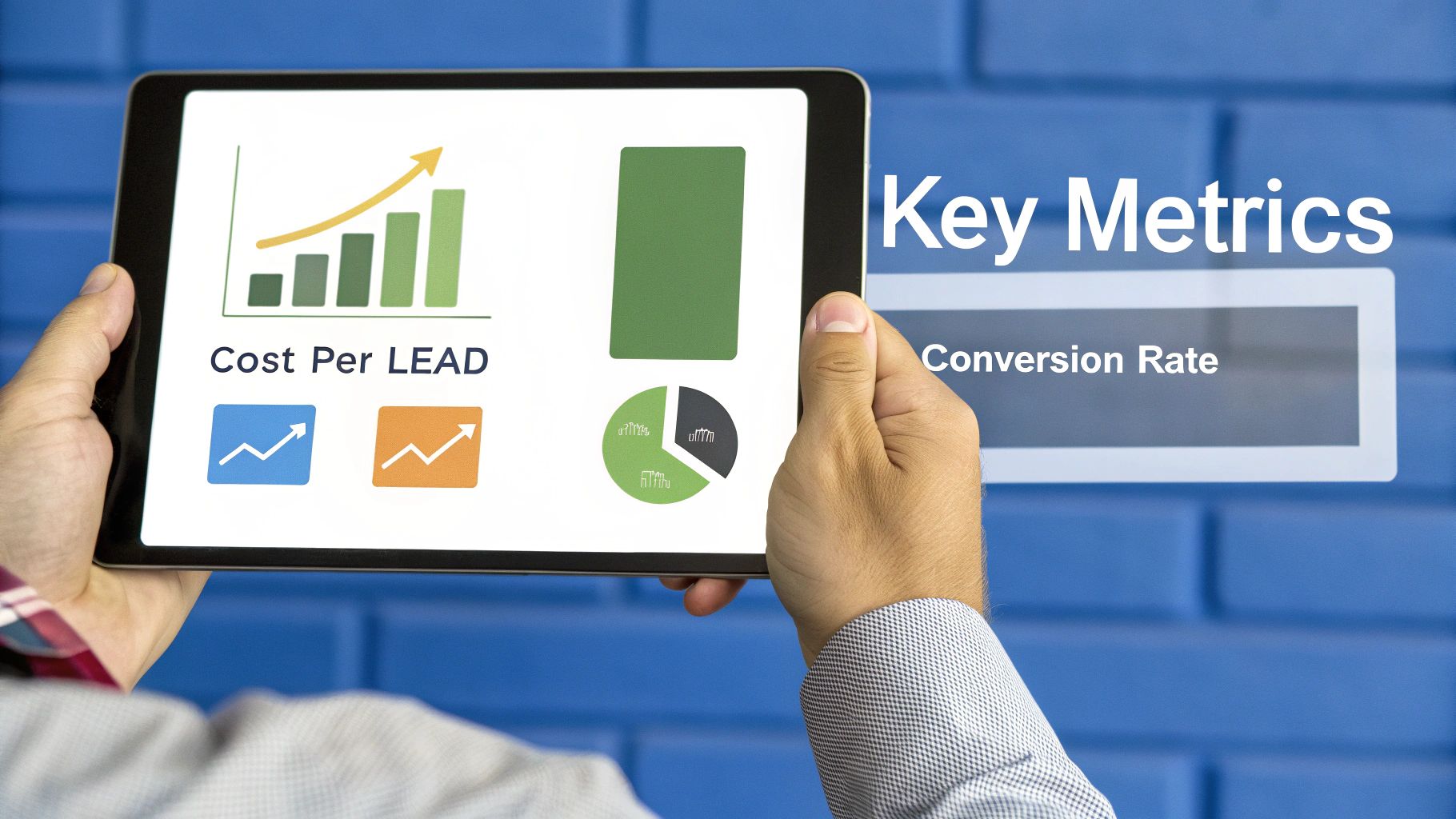
In Revenue Operations, the axiom "if you can't measure it, you can't improve it" is paramount. A sophisticated lead management process is only valuable if it produces measurable results. To demonstrate its ROI, you must track the right key performance indicators (KPIs).
Tracking these metrics transforms your CRM from a simple database into a strategic command center. Dashboards built in Salesforce or HubSpot provide a real-time view of what's working, where bottlenecks exist, and how your efforts are impacting revenue. These KPIs are the vital signs of your sales funnel.
Essential Lead Management KPIs
A holistic view requires measuring cost, conversion rates, and velocity. Each metric tells a part of the story, from initial acquisition cost to the speed at which a lead becomes a customer.
A foundational metric is the Cost Per Lead (CPL). It measures the efficiency of your marketing spend.
- Formula: Total Marketing Campaign Cost / Total New Leads Acquired
- What It Reveals: CPL quantifies how much you are paying to acquire a single lead from a specific channel. A rising CPL can indicate that an ad campaign is underperforming or targeting is misaligned, providing a clear signal to re-evaluate budget allocation.
Tracking Conversion and Velocity
Beyond acquisition cost, the true measure of success is how effectively you convert leads into revenue. Conversion and velocity metrics analyze the efficiency of the marketing-to-sales handoff and the overall sales process.
A well-structured lead management process built within Salesforce or HubSpot doesn't just organise data—it actively accelerates revenue. By automating follow-up and ensuring no high-intent lead is left behind, you create a more predictable and efficient sales engine.
Key metrics for your dashboard include:
- MQL-to-SQL Conversion Rate: This KPI is a primary indicator of lead quality and sales/marketing alignment. It measures the percentage of leads marketing deems "qualified" that sales accepts and qualifies. A low rate signals a disconnect in the definition of a sales-ready lead.
- Lead Velocity Rate (LVR): LVR measures the month-over-month growth of your qualified leads. A consistently increasing LVR is a strong predictor of future revenue growth.
- Sales Cycle Length: This metric tracks the average time from a lead's first touchpoint to a closed-won deal. A decreasing sales cycle length indicates that your qualification and nurturing processes are becoming more effective.
Monitoring these KPIs is non-negotiable. Nurtured leads produce a 20% increase in sales opportunities compared to non-nurtured leads. By closely watching these metrics, you can continuously optimize your processes and ensure every dollar of investment and hour of effort delivers maximum return.
Frequently Asked Questions About Sales Leads
We are frequently asked to clarify core concepts around leads. Here are common questions from RevOps, marketing, and sales professionals, with direct, actionable answers.
What's the Real Difference Between a Lead and a Prospect?
Think of it as a progression: a lead is an individual who has shown initial interest by taking an action, like downloading content. They are on your radar, but their fit and intent are unverified.
A prospect is a lead who has been qualified. You have vetted them against your Ideal Customer Profile (ICP) and confirmed they have a potential need. They are typically qualified using a framework like BANT or MEDDIC and have moved into an active sales conversation. The MQL-to-SQL transition usually marks this distinction.
How Often Should We Revisit Our Lead Scoring Model?
Your lead scoring model should be audited at least quarterly. Markets evolve, products change, and buyer behavior shifts. A "set it and forget it" approach will lead to a stale model that misidentifies high-intent signals. Regular reviews ensure your scoring remains aligned with current GTM objectives and accurately flags the best leads for sales.
An outdated lead scoring model is worse than no model at all. It provides a false sense of security, directing sales efforts toward low-potential leads while your best opportunities go cold.
What Exactly Is Lead Nurturing, and Why Bother?
Lead nurturing is the strategic process of building relationships with leads who are not yet ready to buy. It involves delivering relevant, valuable content over time, typically through marketing automation platforms like Marketing Cloud Account Engagement (Pardot) or HubSpot.
It is critical because most B2B leads do not convert immediately. Nurturing keeps your brand top-of-mind, educates prospects, and guides them through their buying journey until they are ready for a sales conversation. It is an essential strategy for maximizing the ROI of your lead generation efforts.
Is your lead management process leaking revenue? At MarTech Do, we conduct comprehensive system audits and optimise your Salesforce or HubSpot instance to build a seamless, data-driven lead lifecycle that accelerates growth. Learn how we can help you build a high-performance GTM engine.