
Lead qualification is not a marketing buzzword; it’s the strategic process of determining which prospects are worth your sales team’s time. For any B2B company, it’s the essential operational filter that separates high-potential opportunities from market noise, ensuring marketing efforts and sales capacity are perfectly aligned.
An effective qualification framework stops your sales reps from wasting hours on dead-end conversations. Instead, you direct their energy toward the opportunities most likely to convert into revenue, building a predictable and scalable go-to-market engine.
Defining Your Revenue Engine

Picture your sales pipeline as a high-performance engine. Lead generation provides the fuel. But if that fuel is contaminated with low-quality prospects, the entire engine clogs up and sputters to a halt.
Lead qualification is the critical fuel filter. It’s the system that methodically separates high-octane opportunities from the low-quality leads that would otherwise grind your revenue operations to a standstill.
If you operate on platforms like Salesforce, HubSpot, or Pardot (Marketing Cloud Account Engagement), this isn’t an abstract concept—it’s an operational imperative. Without a robust qualification process, marketing and sales teams work in silos, leading to friction, wasted budget, and missed quotas. For many B2B organizations, the first point of contact is a dedicated call center for lead generation, which makes a solid qualification step immediately afterward even more crucial.
The Strategic Importance of Qualification
A well-architected qualification process brings the clarity needed to build a predictable and scalable go-to-market strategy. It marks the shift from frantically chasing every inbound name to executing a focused, data-driven approach to closing deals. The operational benefits are significant:
- Improved Sales Efficiency: Sales teams can spend up to 67% of their time on non-revenue-generating activities, including pursuing leads that were never a good fit. A strong qualification filter ensures they engage only with prospects who have real buying potential.
- Enhanced Marketing and Sales Alignment: This is where you establish a clear, unified definition of a “good lead.” It’s a shared understanding, often codified in a Service Level Agreement (SLA), that ends the timeless complaint of marketing sending “junk leads” to sales.
- Higher Conversion Rates: When you focus energy on prospects who match your Ideal Customer Profile (ICP) and demonstrate clear buying intent, you will close more deals. It’s a direct correlation.
The goal is not just to generate more leads; it’s to find the right leads. Qualification turns a high volume of raw interest into a clean, manageable pipeline of high-value opportunities. It’s the foundation for any sustainable growth strategy.
To execute this, you must understand the different stages of the lead journey. A prospect showing initial interest is a Marketing Qualified Lead (MQL). To refine your process, you can explore our in-depth guide on the marketing qualified lead definition. Once vetted further and deemed ready for a direct sales conversation, they become a Sales Qualified Lead (SQL). This fundamental process sets your entire revenue team up for success.
Understanding the Core Qualification Frameworks

To build a repeatable and scalable lead qualification process, you need a blueprint. Frameworks provide that structure, creating a shared language between marketing and sales so everyone knows precisely what a “good lead” looks like. These are not abstract theories; they are battle-tested methods for cutting through pipeline noise.
Think of these frameworks as lenses for evaluating your leads. Each helps you zero in on specific attributes to determine if you are looking at a genuine opportunity or a distraction. Selecting the right framework depends on your business model, sales cycle complexity, and your ideal customer’s buying process.
Choosing the Right Qualification Methodology
For most B2B organizations, three frameworks have become standard. Each has distinct strengths and is designed for different sales environments.
- BANT (Budget, Authority, Need, Timeline): The classic framework, valued for its simplicity and directness. BANT is ideal for more transactional sales cycles where you need to quickly confirm if a lead has the basic means and motive to purchase.
- CHAMP (Challenges, Authority, Money, Prioritization): A more modern, customer-centric approach. CHAMP starts with the prospect’s challenges, making it a natural fit for consultative selling where you position your product as the solution to a specific business pain point.
- MEDDIC (Metrics, Economic Buyer, Decision Criteria, Decision Process, Identify Pain, Champion): This is the heavyweight framework for complex enterprise deals. MEDDIC is incredibly thorough, forcing your team to uncover the granular details of how a large organization makes decisions—from the ROI metrics justifying the purchase to identifying an internal champion who will advocate for your solution.
The best framework is the one your team will consistently use. It is better to start simple, ensure it aligns with your sales motion, and add complexity only when necessary. The goal is operational consistency, not theoretical perfection.
Differentiating MQLs, SQLs, and PQLs
Beyond high-level frameworks, effective qualification requires crystal-clear definitions for each stage a lead passes through. These definitions serve as the official handoff points between teams, eliminating friction and ensuring everyone is aligned within your CRM or marketing automation platform.
The three core stages to define are:
- Marketing Qualified Lead (MQL): An individual who has shown interest through marketing efforts (e.g., downloaded an ebook, attended a webinar) and fits your Ideal Customer Profile. They have raised their hand but are not yet ready for a sales conversation.
- Sales Qualified Lead (SQL): An MQL that the sales team has reviewed and accepted. They have confirmed the lead meets a predefined set of criteria—often based on a framework like BANT—and is worth a salesperson’s direct engagement.
- Product Qualified Lead (PQL): A prospect who has used your product (typically via a free trial or freemium model) and whose in-app actions signal purchase intent. Their product usage demonstrates they understand its value.
The rise of SaaS has made the PQL an incredibly powerful buying signal. Data shows that 46.4% of B2B professionals now view PQLs as their most valuable lead type, surpassing SQLs (37.5%) and MQLs (16.1%). This trend highlights a fundamental shift toward qualifying prospects based on what they do with your product, not just the content they consume.
Building a Lead Scoring Model That Works
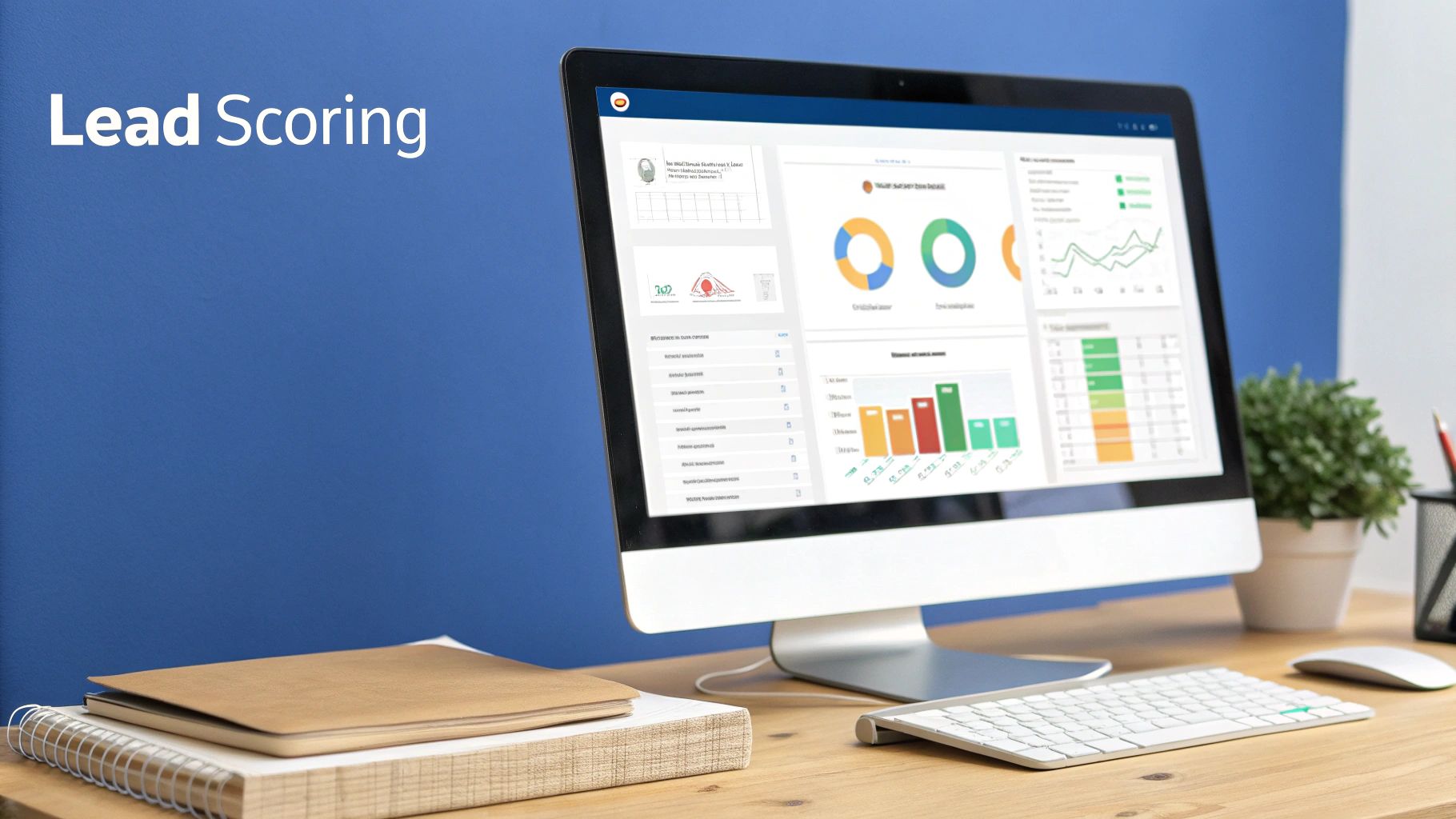
Now, let’s get tactical. A lead scoring model is the operational engine you build inside your marketing automation platform—whether you use HubSpot, Pardot (MCAE), or another system—to automate qualification at scale.
Think of it as a credit score for your prospects. Certain attributes and behaviors indicate a higher likelihood to buy, so we assign points to them. This data-driven system automatically surfaces the hottest leads, allowing your sales team to engage them at the peak of their interest.
Assigning Points to Explicit and Implicit Data
A robust scoring model balances two types of information to create a complete picture of a lead. Both are essential for accuracy.
First, there is explicit data. This is information a lead provides directly—the firmographic and demographic details that show if they match your Ideal Customer Profile (ICP). We assign points for high-value attributes that indicate a strong fit.
Then, there is implicit data. This is purely behavioral. What is the lead doing? How are they engaging with your website, content, and emails? These actions reveal their interest and intent, providing clues about their stage in the buying journey. For a deeper look at building these systems, explore our guide on lead scoring best practices.
Crafting Your Scoring Rules
The real value emerges when you define your rules. This requires a collaborative session with your sales team to determine what truly constitutes a high-quality lead. Once you achieve consensus, you translate it into a point system within your marketing automation platform.
Here are a few real-world examples to get you started:
- Explicit (Fit) Scoring Examples:
- Job Title: VP or C-Suite (+15 points), Director (+10), Manager (+5)
- Industry: Target Industry (e.g., B2B SaaS) (+10 points)
- Company Size: 500-5,000 Employees (+10 points)
- Location: North America (+5 points)
- Implicit (Intent) Scoring Examples:
- High-Value Actions: Requested a Demo (+25 points), Visited Pricing Page (+15)
- Content Engagement: Downloaded a Case Study (+10), Attended a Webinar (+10)
- Basic Engagement: Opened an Email (+1), Visited Blog Post (+2)
A lead scoring model is never “set it and forget it.” Plan to review and refine your rules at least quarterly. Analyze the data with your sales team and ask: Are our high-scoring leads converting? If not, it’s time to recalibrate.
With your rules established, the final piece is setting the MQL threshold. This is the total score a lead must reach to be automatically routed to sales. For example, you might decide that any lead reaching 100 points is officially sales-ready. This trigger creates a clean, automated handoff, enabling reps to connect with the best leads at precisely the right moment.
Using Lead Nurturing to Guide Prospects
Lead qualification is rarely a single event; it’s a journey. A prospect who shows initial interest may not be ready for a sales conversation today. This is where strategic lead nurturing becomes the workhorse of a modern qualification process.
Think of lead nurturing as your pipeline’s guide. It takes promising-but-not-ready leads and moves them forward. Instead of letting them go cold, you can use automated workflows in platforms like HubSpot or Marketing Cloud Account Engagement (MCAE) to deliver value, build trust, and keep your brand top of mind.
Designing Nurturing Workflows
The most effective nurturing sequences are not one-size-fits-all. They are tailored to the lead’s profile and behavior, serving the right content at the right time to advance them toward sales-readiness. This is not about sending more emails; it’s about being relevant and helpful.
Here’s a practical workflow example:
- Trigger: A lead downloads a top-of-funnel guide.
- Step 1: Two days later, an automated email sends them a case study relevant to their industry, demonstrating how a peer company solved a likely problem.
- Step 2: One week later, they receive an invitation to an upcoming webinar that explores the topic in greater depth.
This sequence accomplishes two goals simultaneously: it educates the prospect and gathers more behavioral data, which in turn refines their lead score. As they continue to engage, their score increases, moving them closer to the MQL threshold. For more advanced strategies, consult our complete guide on lead nurturing best practices.
The Impact of Consistent Engagement
Consistent, valuable engagement does more than just “warm up” leads. It positions your company as a trusted authority and educates your audience. When they finally speak with sales, the conversation is more informed, productive, and focused on solutions.
The data confirms this impact.
Lead nurturing, a core component of a sophisticated qualification strategy, generates 20% more sales opportunities compared to non-nurtured leads. Furthermore, nurtured leads can shorten the sales cycle by 23% and tend to result in purchases that are 47% larger.
Despite these clear advantages, an estimated 65% of marketers have not implemented a formal lead nurturing program. This represents a significant opportunity for strategic RevOps teams to gain a competitive edge. You can discover more insights about these sales statistics to build your business case. By developing these automated pathways, you create a system that consistently guides prospects toward qualification, ensuring no high-potential lead is left behind.
Supercharging Qualification with AI and Automation

Manual lead qualification is time-consuming and prone to human error. Modern technology—specifically AI and automation—provides the tools to make the entire process faster, more accurate, and highly scalable.
Instead of relying solely on static, manually defined rules, these technologies analyze vast datasets to identify patterns that a human analyst would miss. This transforms qualification from a reactive task into a proactive, intelligent system. AI can predict which leads are most likely to close and prioritize them for sales, fundamentally changing how your team approaches their pipeline. It’s about working smarter, not harder.
Predictive Lead Scoring
Traditional lead scoring is an excellent foundation, but it is built on rules that you must define and maintain. Predictive lead scoring is the next evolution. It uses machine learning to analyze the historical data in your CRM, examining every won and lost opportunity to identify common characteristics.
The AI model essentially learns the “DNA” of your best customers—the subtle attributes and behavioral signals that correlate with success. It then creates a dynamic model to score new leads based on how closely they match that winning profile. This method is not only more accurate but also adapts as your business evolves, keeping your team focused on the highest-potential leads.
Automation at the Front Lines
In B2B sales, speed is a critical advantage. Automation enables you to qualify leads instantly and ensure no opportunity is missed.
- Intelligent Chatbots: Modern chatbots are far more than FAQ bots. They can engage website visitors 24/7, ask targeted qualifying questions (e.g., company size, industry), and book demos directly on your sales reps’ calendars.
- Automated Data Enrichment: When a new lead submits a form, data enrichment tools like Clearbit or ZoomInfo can be triggered automatically. Integrated with your CRM, these platforms append missing firmographic and demographic details, providing your team with a complete profile without manual research.
AI-driven technologies now enable predictive lead scoring, automated follow-ups, and smart prioritization, empowering sales teams to enhance accuracy while saving valuable time. A striking 78% of sales representatives report that AI frees them to concentrate on high-value selling tasks, while personalization in lead qualification can drive engagement rates up by 80%.
Advanced AI answering services offer another layer of efficiency. They can automate initial interactions, capture key information, and route prospects to the appropriate team member. This not only reduces response times but also ensures every inbound inquiry is triaged correctly, freeing up your team for the complex, strategic conversations that close deals.
Got Questions? We’ve Got Answers.
Even the most experienced RevOps leaders encounter challenges when refining lead qualification processes. Below are some of the most common questions we hear, along with straightforward answers to help you navigate common roadblocks.
How Often Should We Review Our Lead Scoring Rules?
Treat your lead scoring model as a dynamic component of your go-to-market strategy—not a one-time setup. Markets shift, customer needs evolve, and your products change. Static scoring rules quickly become obsolete.
As a best practice, convene your sales and marketing leaders to review your lead scoring rules at least quarterly. This meeting should be a deep dive into your conversion data, analyzing MQL-to-SQL rates and, most importantly, SQL-to-close rates.
Do not wait for the quarterly review if significant business changes occur. Re-evaluate your model immediately if you:
- Launch a new product or major feature.
- Enter a new market or vertical.
- Make a significant change to your go-to-market strategy.
The indicators of a broken model are typically clear. Are high-scoring leads failing to convert? Your criteria may be misaligned. Conversely, are sales reps finding high-quality opportunities among low-scoring leads? That’s a signal that your model is missing key buying intent signals and needs recalibration.
What Is the Biggest Mistake Companies Make?
The single biggest mistake is a lack of alignment between sales and marketing. This classic disconnect almost always manifests as a poorly defined MQL or a handoff process riddled with friction.
When marketing provides leads that sales deems low-quality, a toxic cycle begins. Trust erodes, marketing budgets are wasted, and sales reps become demoralized chasing unqualified prospects. Marketing blames sales for not following up, while sales blames marketing for providing poor leads.
The solution is to create a robust Service Level Agreement (SLA). This document is a pact where sales and marketing collaboratively define the exact demographic, firmographic, and behavioral criteria for a sales-ready lead. An SLA ensures everyone is operating from the same playbook, transforming your pipeline from a source of conflict into a well-oiled revenue machine.
How Does Account-Based Marketing Change Lead Qualification?
Account-Based Marketing (ABM) doesn’t just adjust lead qualification—it inverts the model. In a traditional volume-based approach, you qualify individual leads. With ABM, you qualify entire accounts.
This fundamentally changes the process. Instead of focusing on an individual’s lead score, you assess the collective engagement from the entire buying committee at a target account. You are no longer searching for a single MQL; you are identifying a Marketing Qualified Account (MQA).
An MQA is an account where multiple key stakeholders demonstrate coordinated interest. For example, the CTO downloads a technical whitepaper, and a week later, a director of operations from the same company attends your webinar. Neither action alone might be sufficient, but together, they signal strong buying intent at the account level.
To execute ABM effectively, your MarTech stack must track activity at the account level. Your CRM and marketing automation platforms must be configured to aggregate these signals and flag when an entire account is “hot” enough to warrant direct sales outreach.
Ready to build a lead qualification and RevOps engine that drives predictable growth? The experts at MarTech Do specialize in auditing and implementing systems in Salesforce, HubSpot, and Pardot to align your teams and accelerate revenue. Schedule a consultation with us today.