A lead arrives from a Canadian technology company, but Salesforce routes it to a rep covering a different region. A second rep is already working the same account, while a third territory has no visible pipeline because several accounts have never been assigned. Marketing sees campaign responses, sales sees ownership disputes, and leadership receives a forecast that looks complete only because the underlying coverage rules are unclear.
This is the situation many B2B teams face when territory design lives in spreadsheets, individual knowledge, or informal agreements. Territory management is not just the act of dividing a market between salespeople. It's a RevOps system for deciding who can work which accounts, how ownership changes, what marketing and customer success can see, and how leaders measure coverage and expected revenue.
Introduction Why Territory Design Breaks Revenue Execution
A territory model can look tidy on an organisation chart and still fail in the CRM. A province, industry, or account list may have an assigned owner, yet inbound leads can bypass that owner, duplicate records can create competing assignments, and opportunities can remain attached to former employees. The result is operational friction that appears in several places at once: slower lead follow-up, unclear account responsibility, inconsistent handoffs, and unreliable reporting.
The problem usually isn't that a sales leader chose the wrong boundary. It's that the business never translated the boundary into data fields, assignment logic, permissions, lifecycle rules, and reporting. A rep may understand that they cover Southern Ontario, but Salesforce or HubSpot needs a precise rule for an account with multiple offices, an incomplete address, a distributor relationship, or a customer that buys through more than one route to market.
Salesforce describes territory management as a formal framework for organising accounts, opportunities, and users into logical groupings based on geography, industry, product line, or customer segment. Its model supports hierarchies such as US, West, California, along with assignment rules that determine whether an account belongs in a child territory such as California. The platform also allows teams to test a territory model before deployment and, after activation, automatically assign accounts while surfacing reports for territory accounts, unassigned accounts, and expected revenue by territory. Salesforce's territory data model shows why the capability belongs in RevOps rather than in a private spreadsheet.
Operating principle: A territory is only real when the CRM can apply it consistently, explain the result, and report what remains uncovered.
This guide treats territory management as a system design choice. It covers the common models, Canadian FSA geography, Salesforce and HubSpot trade-offs, data governance, routing, automation, and the reporting practices that keep the model usable after launch.
What Territory Management Really Means in RevOps
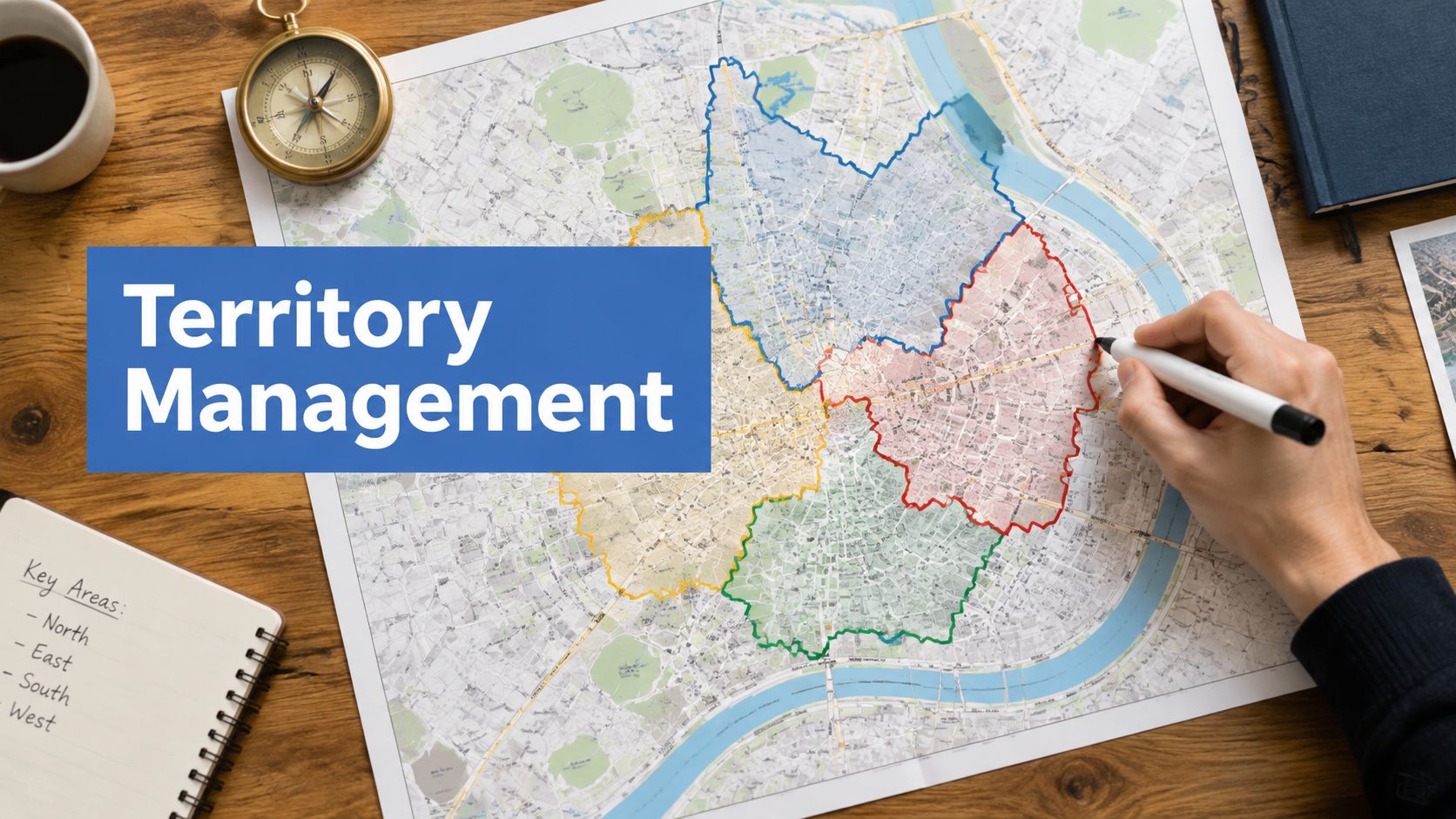
Start with a simple analogy. A service company might divide a city into zones so each technician knows which addresses they serve. The zone isn't merely a shape on a map. It determines dispatching, workload, accountability, customer communication, and management reporting.
Sales territories work the same way, but the objects are commercial. A territory can determine which rep receives a lead, which user sees an account, who owns an opportunity, how a customer is handed to service, and where revenue appears in a forecast.
In practical terms, territory management is a governed framework for organising accounts, opportunities, and users into logical groupings. The grouping may use:
- Geography, such as province, region, postal area, or FSA.
- Industry, such as manufacturing, healthcare, or financial services.
- Product line, where specialist sellers support different offers.
- Customer segment, such as commercial, mid-market, or enterprise.
- A hybrid, where geography is combined with account attributes or named-account rules.
The model becomes operational through three connected components. The hierarchy gives leaders a structured view, such as country, region, province, and local territory. Assignment rules translate CRM data into a territory decision. Governance defines who can change rules, how exceptions are handled, and how the team monitors records that don't match.
Design and management are different jobs
Territory design is the planning work. You choose the boundaries, segments, hierarchy, ownership model, and rules. Territory management is the ongoing operating discipline. You maintain assignments, handle personnel changes, investigate gaps, review workload, and update the model as the go-to-market motion changes.
That distinction matters because a model can be logically sound on launch day and inaccurate later. New accounts arrive, addresses change, reps move roles, distributors expand coverage, and marketing creates records with incomplete firmographic data. Without monitoring, the original design becomes a source of stale ownership.
Salesforce's documentation describes territory types, parent-child hierarchies, and assignment rules as core components of its modern model. Its guidance also makes an important governance point: an account enters a child territory only when a specific rule matches that territory. Salesforce's territory management guidance therefore supports a practical conclusion: unmatched data isn't a minor exception. It's a coverage and reporting risk.
A RevOps team should be able to answer four questions for every account:
- Which territory does this account belong to?
- Which rule assigned it there?
- Who owns the current sales action?
- What happens when the data or business relationship changes?
If the answer depends on asking a manager, searching a spreadsheet, or reading an old Slack message, the organisation has account allocation, not a reliable territory management system.
Core Territory Models and When to Use Each
No single model fits every B2B sales motion. Geography is intuitive, but it can be a poor choice when product expertise, account complexity, or channel relationships matter more than physical location. The right approach balances coverage, workload, expertise, customer experience, and reporting clarity.
| Model | Best For | Strengths | Watch Outs |
|---|---|---|---|
| Geographic | Field sales, regional buying patterns, and location-dependent service | Clear ownership, easier routing, and straightforward regional reporting | Province-level boundaries may be too broad, while detailed postal areas can create maintenance work |
| Industry vertical | Specialised products, regulations, or buyer roles | Builds seller expertise and supports relevant messaging | Accounts in the same region may have different owners, creating coordination needs |
| Account-based and named account | Strategic enterprise selling and complex buying groups | Matches senior coverage to account value and buying complexity | Parent-child account structures and workload need careful governance |
| Hybrid | Mixed direct, distributor, OEM, and enterprise motions | Combines geographic accountability with segmentation or named-account overlays | Overlap becomes likely unless precedence and exception rules are explicit |
Geographic models
A geographic model assigns responsibility by location. In Canada, that could mean province, metro area, region, or Forward Sortation Area, the first three characters of a Canadian postal code. Salesforce Territory Planning uses Canada's FSA as a country-specific boundary type, and its planning concepts allow administrators to assign units using fields such as billing postal code and billing country. Salesforce's boundary documentation makes FSA-based design a practical option when province-level coverage is too coarse.
Industry and account models
Industry territories make sense when buyers need specialised knowledge. Account-based models work when a small set of strategic customers requires coordinated executive, sales, service, and partner coverage. Named-account rules should be explicit, especially for parent companies with offices across regions.
Hybrid models
A hybrid model might assign most Canadian accounts by FSA, reserve strategic national accounts as named accounts, and give distributor relationships a channel overlay. Oracle's territory-planning guidance describes postal-code and province-level attributes as possible geographic inputs and distinguishes between one winning territory for service-style models and multiple winning territories for sales models. Oracle's geographic territory guidance is useful when deciding whether one owner should control an account or several teams should participate.
Selection rule: Choose the model that reflects how customers buy, not the structure that looks easiest to draw.
How Territory Management Powers GTM Alignment and RevOps
Territory management connects the commercial teams through a shared ownership layer. Marketing can route qualified demand to the correct sales team, sales can work accounts without ownership disputes, and customer success can see the account context needed for a clean handoff. The benefit comes from consistent rules, not from the territory label itself.
A marketing operations team may capture a lead through Account Engagement, Salesforce forms, or HubSpot Marketing Hub. The routing process then needs reliable country, province, FSA, industry, segment, and account-match data. Sales operations uses that result to assign an owner, apply an SLA, and place the record into the correct queue or workflow. Customer success needs a related account and opportunity structure so the post-sale handoff doesn't erase the original coverage context.
For a broader operating framework, teams can use this guide to aligning sales and marketing when documenting shared lifecycle stages, handoffs, and ownership expectations.

Salesforce and HubSpot solve different parts of the problem
Salesforce Sales Cloud offers a formal territory framework with territory types, hierarchies, assignment rules, account access, model testing, activation, and territory-level reporting. That structure suits larger organisations with multiple sales roles, complex permissions, and a need to model scenarios before changing production ownership.
HubSpot Sales and Marketing Hubs can support territory operations through owner properties, teams, workflows, custom properties, lists, and routing logic. The implementation can be more lightweight, but RevOps teams must design the data model and precedence rules carefully. A property labelled “Territory” isn't enough if workflows can overwrite ownership, if account matching is incomplete, or if users can edit the value without governance.
The GTM engineering layer
Clay can enrich account records with firmographic and geographic attributes before a routing workflow applies ownership. A team might use Clay to prepare data for a Salesforce or HubSpot process, but enrichment doesn't replace CRM governance. It should feed documented fields and controlled rules, with a clear audit trail for updates.
Territory accuracy affects forecasting because leaders group pipeline by ownership and region. It also affects pipeline hygiene, since an account without a valid territory can bypass the intended follow-up process. That makes territory management a RevOps governance problem, with marketing operations, sales operations, customer success, and systems administrators sharing responsibility.
Building a Scalable Territory System From Data to Reporting
A durable territory system starts with the records that drive assignment. Before drawing boundaries, audit the fields your rules will use. Review account country, province, billing postal code, industry, segment, parent account, owner, lifecycle stage, channel, and account status. In Canada, postal data must accommodate civic addresses, rural routes, and postal boxes. Canada Post's postal-code lookup service confirms that Canadian postal codes are entered by address, rural route, or postal box number.
Use data governance best practices to define field ownership, validation standards, duplicate handling, and change controls before automation goes live.
Build the rule hierarchy
Write the decision order in plain language first. For example:
- Named accounts take precedence when an approved strategic-account list matches.
- Channel accounts follow the distributor or OEM ownership rule.
- FSA geography assigns standard Canadian accounts.
- Province or national queues catch records that lack sufficient detail.
- Unassigned review captures anything that matches no rule.
The exact sequence depends on the business, but the principle is constant. A record should have one explainable path to its assignment, or a deliberate multi-owner design where the sales motion requires it.
Salesforce Territory Planning supports FSA boundaries for Canada, while Salesforce administrators can use address-level fields such as billing postal code and billing country. The platform also warns that planning postal-code assignment may be derived from latitude and longitude coordinates rather than matching the postal code stored on the account record exactly. Salesforce's assignment-rule considerations mean that geocoding quality belongs in the implementation plan. Test records where the address field and mapped location disagree.
Configure the CRM and automate carefully
In Salesforce, decide whether the formal Territory Management model should control account access, opportunity participation, forecasts, and reporting. Test the model before activation, then validate assignment results with a controlled sample. In HubSpot, define the equivalent properties, teams, owner rules, workflows, and exception queues. Keep routing logic documented outside the workflow editor so administrators can review the model without tracing every branch manually.
Automation should handle repeatable events, such as new account creation, address changes, owner departures, territory changes, and account merges. It shouldn't overwrite a named-account exception or remove an existing opportunity owner without a documented policy.
Report on coverage, not just revenue
Create dashboards that show:
- Assigned accounts, grouped by territory and segment.
- Unassigned accounts, with the reason no rule matched.
- Ownership changes, including the triggering field or workflow.
- Pipeline by territory, separated by stage and owner.
- Expected revenue by territory, using the CRM's established forecast logic.
- Coverage balance, reviewed through opportunity, account, and workload context rather than account count alone.
For Canadian operations, validate whether the postal-code value, geocoded location, and assigned FSA agree. A clean report should make exceptions visible, not hide them inside an “other” category.
Territory Management in Action With Salesforce and HubSpot Examples
Consider a Canadian B2B company launching regional coverage. The standard accounts use FSA-based rules, while a national enterprise account is handled through a named-account exception. Salesforce can represent the broader hierarchy, test the model before activation, assign matching accounts, and report on assigned, unassigned, and expected-revenue views. The operations team then reviews address exceptions before routing new demand.

A HubSpot team could implement the same business policy with an FSA property, a named-account flag, owner assignment workflows, and an exception queue. HubSpot's simpler configuration can work well for a focused sales motion, but the RevOps owner must establish precedence. Otherwise, a later workflow may replace the named-account owner when the address changes.
An industry-based example looks different. A company selling specialised manufacturing software might route by industry and account segment rather than location. A prospect in one Canadian province could belong to the same specialist team as a similar prospect elsewhere, while customer success maintains a separate regional service structure. That model supports expertise, but the team needs explicit rules for sales-to-service handoff and cross-territory collaboration.
A hybrid enterprise model adds another layer. Named accounts receive strategic ownership, standard accounts follow geography, and distributor-led accounts use a channel rule. The system should answer which rule won and why, rather than only displaying the latest owner value.
For teams refining Salesforce lead routing, Salesforce lead assignment rules provide a useful related implementation reference. The key operational test is simple: create representative records, confirm the expected assignment, inspect access and reporting, and then test exceptions such as incomplete postal data, multiple locations, and reassignment after a personnel change.
Rollout Checklist Pitfalls to Avoid and Next Steps
A territory rollout works best when the team treats it as a controlled systems change rather than a boundary announcement. Use this sequence:
- Validate the data: Check addresses, FSAs, province values, industry, segments, parent accounts, and existing owners.
- Align stakeholders: Get sales, marketing, customer success, finance, and systems owners to approve definitions and exceptions.
- Document precedence: State which rule wins when named accounts, channels, geography, and industry overlap.
- Test before activation: Use representative records, edge cases, duplicates, incomplete addresses, and cross-border accounts.
- Activate with ownership controls: Confirm permissions, routing workflows, notifications, and opportunity behaviour.
- Monitor continuously: Review unassigned accounts, ownership changes, coverage gaps, pipeline, and expected revenue by territory.
Common failures include overlapping rules, poor address data, treating province as sufficiently granular for every motion, and ignoring unassigned accounts after launch. Salesforce's territory guidance makes the matching principle clear. An account enters a child territory only when its data matches the relevant rule, so missing or inaccurate fields can create silent coverage gaps.
Canadian teams also need to decide whether a postal value or geocoded location is the authoritative input. Rural and postal-box formats can require validation, and a mapped location may not exactly match the stored postal code. That decision should appear in the data dictionary and the audit process.
Territory management should evolve with the go-to-market model. A RevOps review can assess whether the hierarchy still reflects regional and channel coverage, whether routing rules still match the sales process, and whether reporting gives leaders a trustworthy view of account coverage and revenue. MarTech Do offers RevOps audits, Salesforce and HubSpot implementation, data remediation, lead-routing design, integrations, reporting, and team enablement for B2B organisations building this operating layer. Visit MarTech Do to discuss a territory audit or implementation plan grounded in your CRM data, ownership rules, and Canadian coverage requirements.