What is lead scoring? In B2B marketing and sales, it’s a foundational methodology for prioritizing sales efforts and maximizing revenue operations efficiency.
Think of it as a qualification system for potential customers. It’s a method sales and marketing teams use to rank prospects, differentiating who’s just browsing from who is genuinely ready for a sales conversation.
For B2B companies, this isn’t just a nice-to-have. It’s a core component of an optimized go-to-market strategy, enabling teams to pinpoint the right leads at the right time.
What Is Lead Scoring and Why It Matters Now
At its core, lead scoring is a system for focusing your sales team’s energy where it generates the most impact. Instead of treating every inbound contact equally, you assign points based on explicit data (who they are—job title, company size, industry) and implicit data (what they do—visit your pricing page, download a whitepaper, request a demo).
This systematic process transforms raw data from platforms like Salesforce or HubSpot into a clear, prioritized action plan for your sales representatives.
Let’s apply this to a practical scenario. Imagine two contacts engage with your website today.
One is a student who downloads a blog post for a research paper. The other is a VP of Operations from one of your target accounts. She reviews your pricing, watches a full product demo, and downloads a detailed case study.
Without lead scoring, they are both just “website visitors.” But with it? The VP of Operations is identified immediately as a high-value, sales-ready lead who requires immediate follow-up.
This systematic approach builds a solid bridge between marketing and sales, optimizing your entire revenue operation. It prevents your sales team from wasting valuable hours on unqualified leads and allows them to focus exclusively on prospects with the highest probability of converting.
Closing the Gap Between Marketing and Sales
The primary benefit of a well-implemented lead scoring program is alignment.
Marketing’s objective is often to generate a high volume of leads. Sales, conversely, requires high-quality opportunities that are worth their time. This classic disconnect creates friction: sales complains about poor lead quality, and marketing feels its efforts are undervalued.
Lead scoring serves as the operational agreement. It compels both teams to collaborate on a clear, data-driven definition of a “good lead.”
Once a lead reaches a pre-determined score—the agreed-upon threshold—they officially become a Marketing Qualified Lead (MQL). This designation signals that they are sufficiently nurtured and ready for a sales conversation. We have a complete guide that explores the specifics of what defines a Marketing Qualified Lead for those who want to dive deeper.
This clear handoff process yields significant results:
- Marketing can demonstrate its direct contribution to the sales pipeline with quantifiable data.
- Sales receives a predictable stream of vetted leads, which enhances efficiency and morale.
- Leadership gains a much clearer view of the sales funnel, leading to more accurate revenue forecasting.
By standardizing how leads are evaluated, sales and marketing teams can finally speak the same language. This shared understanding is the foundation of a high-functioning revenue engine, eliminating guesswork and replacing it with a predictable, data-backed process.
To maximize the benefits, integrate your scoring model into your wider GTM strategy. For example, weaving it into the process of building an automated lead generation system is a game-changer. It allows you to qualify prospects automatically, ensuring only the most qualified leads are routed to a sales rep’s queue.
This combination of intelligent scoring and strategic automation is what separates high-growth B2B companies from the competition.
Lead Scoring At a Glance Key Concepts Explained
To help you understand the core mechanics, here’s a breakdown of the fundamental components of lead scoring. This table provides a quick reference for the concepts we’ll build on throughout this guide.
| Concept | Description | Example for a B2B SaaS Company |
|---|---|---|
| Explicit Data | Information the lead directly provides about themselves. It informs their fit. | Job Title (“VP of Marketing”), Company Size (500-1,000 employees), Industry (“Technology”). |
| Implicit Data | Information gathered by tracking a lead’s behavior. It indicates their interest level. | Visited the pricing page, downloaded a case study, attended a webinar. |
| Negative Scoring | Subtracting points for actions or attributes that indicate a poor fit or lack of interest. | A student email address (-10 points), visiting the careers page (-5 points), inactivity for 30 days (-15 points). |
| Score Threshold | The specific point total a lead must reach to be considered “sales-ready” or an MQL. | A lead is passed to the sales team once they reach a score of 100. |
| Lead Decay | Gradually reducing a lead’s score over time if they show no engagement. | A lead loses 5 points every 30 days they don’t interact with your website or emails. |
This table outlines the building blocks. Now, let’s explore how to assemble them into a scoring model tailored to your business needs.
The Four Pillars of an Effective Scoring Model
To build a lead scoring model that delivers reliable results, you must evaluate leads from multiple dimensions. It’s not enough to just track an ebook download. A robust framework rests on four key pillars.
Think of it as assembling a complete profile of your ideal customer. Each pillar provides a different set of data points, and only when combined do you see the full picture of a lead’s potential.
These pillars are Fit, Behavior, Content Engagement, and Intent Data. Let’s break them down.

Pillar 1: Fit
First, does this lead match our customer profile? That is the central question of Fit. It measures how closely a prospect aligns with your Ideal Customer Profile (ICP).
You’re analyzing firmographic and demographic data—the objective facts. This includes their job title, company size, industry, or geographic location.
A VP of Marketing at a 500-person technology company is a much better fit for most B2B SaaS firms than a marketing intern at a small startup. A strong fit score acts as your first filter, ensuring your sales team only engages with accounts that can realistically become customers.
If you haven’t clearly defined your ICP, that is the essential starting point. Refer to our guide on how to create buyer personas to establish that foundation.
Pillar 2: Behavior
So, the lead profile fits. But are they actively interested? That’s where Behavior comes in.
This pillar tracks the actions a lead takes across your digital properties. Did they visit your website? How frequently? Did they open your last email campaign? Did they submit a “Contact Us” form? These digital footprints create a narrative of their engagement level.
A lead who visited your pricing page three times this week is demonstrating significantly more buying intent than someone who glanced at a blog post a month ago. These behavioral signals are invaluable and form the core of scoring models within marketing automation platforms like HubSpot or Salesforce Pardot.
Pillar 3: Content Engagement
Not all behavior is created equal. This subtle but critical distinction brings us to Content Engagement. This pillar goes a step deeper than simply tracking actions; it assigns value based on the quality of those interactions.
For example, a contact who downloads a detailed, bottom-of-funnel case study is far more invested than someone who reads a top-of-funnel blog post. You might assign 5x more points for the case study download.
Content engagement helps you separate serious researchers from casual browsers. It adds a layer of nuance by focusing on the depth of their interest, not just the frequency of their clicks.
Pillar 4: Intent Data
Finally, we have Intent Data. This is a powerful strategic asset. It provides insight into what your prospects are doing outside your owned digital channels.
This data is sourced from third-party providers and tracks buying signals across the web, revealing which companies are actively researching solutions like yours. They might be reading competitor reviews, browsing B2B software forums, or consuming content around a specific problem you solve.
“Intent Data uncovers buying signals from outside your own channels, completing the prospect profile.”
A surge in intent signals can instantly elevate a lead’s priority, flagging them as a hot prospect who is likely ready for a sales conversation now.
Pulling It All Together
The true power of this methodology is realized when you blend all four pillars. A lead who is a great Fit, exhibits consistent Behavior on your site, engages deeply with your Content, and is flagged by Intent Data is the definition of a sales-ready lead.
Here’s a summary table for quick reference:
| Pillar | What It Measures | B2B Example |
|---|---|---|
| Fit | Alignment with ICP | VP job title at 500-employee company |
| Behavior | Frequency and recency of actions | 3 visits to pricing page |
| Content Engagement | Depth of interactions | Downloaded case study |
| Intent Data | External research signals | Viewed competitive comparisons |
This multi-layered approach transforms a disorganized list of leads into a neatly prioritized queue for your sales team, ensuring they focus their efforts on opportunities most likely to close.
How to Build Your First Lead Scoring Model
Building your first lead scoring model may seem like a significant undertaking, but it is a series of logical, manageable steps. This is where expertise in marketing and sales operations becomes critical.
The objective is to move from a theoretical concept to a functional, automated system within your CRM or marketing automation platform. This is not a solo mission—it requires strong collaboration, data analysis, and a clear understanding of what an ideal lead looks like for your business. Let’s walk through the five stages of launching a successful program.
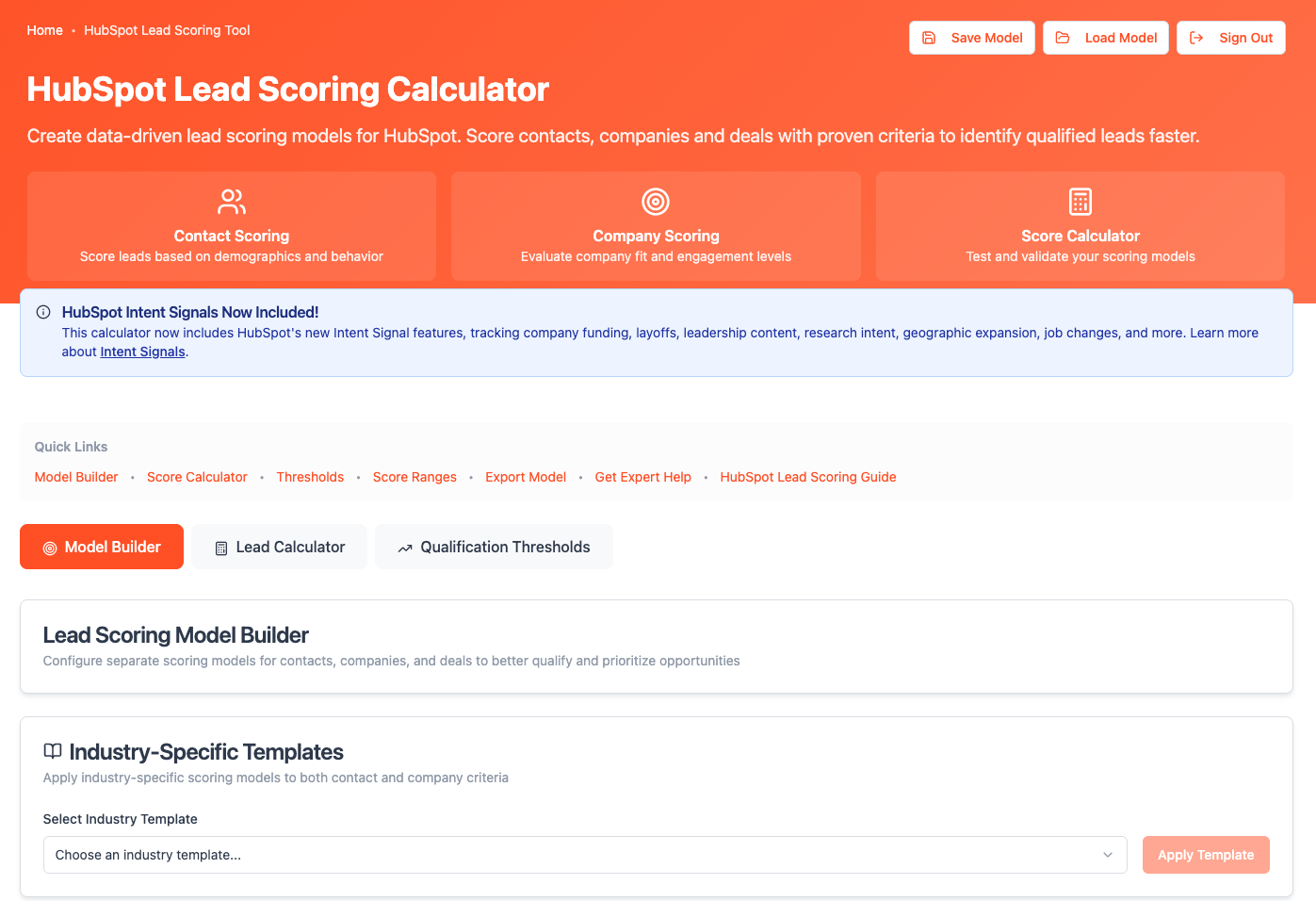
The screenshot above from the Lead Score Builder app, designed for HubSpot, illustrates this in practice. You are assigning positive or negative points to different attributes and actions. This interface is where your strategic decisions become the automated rules your system uses to qualify leads.
Stage 1: Align Sales and Marketing
Before assigning a single point, facilitate a conversation between your sales and marketing teams. A lead scoring model developed by marketing in isolation is destined to fail. The initial goal is to achieve consensus on two critical concepts.
First, you must define your Ideal Customer Profile (ICP) together. This is not a persona, but a detailed description of the company that is a perfect match for your solution. Analyze your best customers to identify common attributes.
- Industry: Which verticals derive the most value from your solution?
- Company Size: Is there an optimal range for employee count or annual revenue?
- Geography: Are you targeting specific countries, states, or regions?
- Technology Stack: Do they need to use specific technologies for your product to be compatible?
Next, define what a Sales-Qualified Lead (SQL) means to your organization. This is the precise point at which a lead is considered ready for a sales conversation. Finalizing this definition preempts the common “marketing is sending us junk leads” argument.
Stage 2: Identify Key Scoring Attributes
With your ICP and SQL definitions established, you can identify the data points that indicate a strong fit and active interest. This involves creating a comprehensive list of all explicit (fit) and implicit (behavioral) attributes you can track in your marketing automation platform or CRM, such as Salesforce or Pardot (MCAE).
Explicit (Fit) Attributes:
- Job Title (e.g., VP, Director, Manager)
- Department (e.g., Marketing, Sales, IT)
- Company Size
- Industry
Implicit (Behavioral) Attributes:
- Website page views (especially high-value pages like pricing or case studies)
- Content downloads (e.g., whitepapers, ebooks)
- Webinar registrations and attendance
- Email opens and clicks
- Demo requests or “Contact Us” form submissions
The key is to select attributes with a proven correlation to closed deals. Analyze your historical data. What actions did your best customers take immediately before purchasing? Those are the signals you want to score.
Stage 3: Assign Point Values
Now you can assign a numeric value to each attribute. Most B2B companies operate on a 0-100 point scale. The logic is simple: high-value actions and ideal traits receive more points. This step is both an art and a science, requiring input from sales and marketing.
For instance, a lead who requests a demo is signaling much stronger intent than someone who simply opens an email. Therefore, the demo request should be worth significantly more points. Similarly, a C-level executive from a target industry is a more valuable prospect than an intern from a non-target vertical.
Don’t forget negative scoring. You must subtract points for actions that indicate a poor fit or lack of interest.
- Visiting the careers page (-10 points)
- Using a freemail provider like Gmail (-5 points)
- Long periods of inactivity (-15 points after 90 days)
Stage 4: Set the SQL Threshold
The SQL threshold is the definitive score. It’s the number a lead must reach before being automatically routed to the sales team. Setting this threshold correctly is crucial.
Set it too low, and you will flood the sales team with unqualified leads, eroding their trust in the system. Set it too high, and you will starve them of opportunities, allowing qualified prospects to go cold.
A data-driven approach is to analyze the scores of leads who have become customers in the past. If you find that most of your closed-won deals had scores between 75 and 100, setting your initial threshold at 75 is a logical starting point.
Stage 5: Implement and Automate
The final stage involves building this model within your technology stack. Whether you use HubSpot, Salesforce, or Pardot (MCAE), the core task is the same: create automation rules that add or subtract points based on your defined criteria.
Set up workflows that automatically update a lead’s status to “SQL” the moment they cross your threshold. This status change should trigger an instant notification to the appropriate sales rep and create a task in the CRM for immediate follow-up. This automation is what transforms lead scoring from an idea into a scalable, efficient engine that drives revenue.
From Manual Rules to AI-Powered Scoring
Lead scoring methodology has evolved. The field has bifurcated into two distinct approaches: traditional, rule-based systems and modern, AI-driven predictive models. For any RevOps or Marketing Ops leader, understanding the difference is essential for strategic planning.
The original method, traditional lead scoring, is an entirely manual process. Your team convenes to debate which actions and attributes are important and assigns a point value to each. A case study download might be worth +15 points, while a visit to the careers page is -10. This system is straightforward to implement in platforms like HubSpot or Pardot (MCAE) and provides a clear, controllable framework.
However, this control is also its greatest limitation. The system is rigid. It is based entirely on your team’s assumptions about buying intent, which are often educated guesses. It cannot adapt autonomously and frequently misses the subtle, interconnected behaviors that truly signal a lead’s readiness to buy.

The Rise of Predictive Scoring
This is where AI-powered scoring fundamentally changes the approach. Instead of relying on a human-defined rulebook, it uses machine learning algorithms to analyze your historical sales data. It examines every closed-won and closed-lost opportunity in your CRM to identify the actual attributes and behaviors that your best customers have in common.
The AI builds a dynamic model that learns and improves over time. It uncovers hidden correlations that a human team would never detect. For instance, it might discover that leads from a specific industry who view a particular trio of web pages in a single session are 80% more likely to become customers.
Predictive scoring isn’t about simple “if-then” rules. It’s about calculating the probability of conversion by analyzing thousands of data points simultaneously. This provides a much more accurate, nuanced picture of lead quality that remains current.
This modern approach offers significant advantages over manual methods.
- Adaptability: The model continuously learns from new data, becoming more accurate as your business and the market evolve.
- Precision: AI can process dozens of variables at once, delivering a level of detail unattainable with manual rules.
- Efficiency: It automates the most labor-intensive part of lead scoring—building and refining the model—freeing up your operations teams to focus on strategy.
How AI Uncovers Hidden Buying Signals
The real value of AI lies in its ability to find patterns in the noise. A manual system might award points for attending a webinar. An AI model, in contrast, analyzes the webinar topic, the attendee’s job title, their past engagement, and recent intent signals to understand the true significance of that single action.
Historically, lead scoring focused on basic demographic and firmographic data. Today, the most effective systems are AI-driven and incorporate real-time buyer intent, piecing together complex behavioral patterns and engagement metrics. To explore this evolution further, you can find valuable expert insights on lead scoring trends that demonstrate how AI has transformed the discipline.
Ultimately, this means the system can differentiate between a high-potential prospect attending a product deep-dive and a low-potential contact at a general industry event, scoring them appropriately. For today’s RevOps leaders, leveraging this technology is no longer a “nice-to-have.” It’s a strategic imperative for optimizing lead prioritization and maximizing sales team efficiency.
How to Measure and Optimize Your Scoring Program
Launching your lead scoring model is a significant milestone, but it is the beginning, not the end. A successful scoring program is a dynamic system that requires continuous monitoring and optimization to maintain its effectiveness. For professionals in RevOps or Operations, this is where the real work begins—and where you prove the model’s long-term value.
Your model is like a high-performance engine; it cannot be set and forgotten. It requires regular tune-ups to perform optimally. If neglected, the model will gradually become misaligned as your market, product, and ICP evolve.
Key Metrics to Track Program Performance
How do you determine if your lead scoring is effective? By tracking the right metrics. These numbers provide a feedback loop, indicating what is working and what needs adjustment. The objective is to focus on data that directly connects your scoring efforts to pipeline and revenue.
Begin by closely monitoring these essential KPIs:
- MQL-to-SQL Conversion Rate: This is your north star metric. It measures the percentage of marketing-qualified leads that are accepted by sales. A low rate indicates a significant misalignment between teams.
- SQL-to-Opportunity Conversion Rate: Of the leads sales accepts, how many convert into tangible pipeline opportunities? This metric validates the quality of leads your model identifies as “hot.”
- Sales Cycle Length: Are high-scoring leads closing faster than low-scoring ones? They should be. An effective model surfaces leads that move through the sales funnel more quickly.
- Win Rate by Score: This is the ultimate test. Analyze the win rates for deals that originated as high-scoring leads. They should consistently close at a higher rate than deals from lower-scored leads.
Establishing a Sales Feedback Loop
Data tells you what is happening, but your sales team provides the why. A structured feedback loop is non-negotiable for refining your model. Your sales reps are on the front lines, and their qualitative insights are invaluable.
Your CRM must be the single source of truth for this feedback. Implement a simple, mandatory field for reps to select a “Disqualification Reason” whenever they reject an MQL. This transforms anecdotal feedback into actionable data.
You will begin to see patterns. Common reasons might include “Not the decision-maker,” “Timing isn’t right,” or “No budget.” If you identify a trend—such as 25% of rejected MQLs being tagged as “Wrong industry”—you have a clear signal to adjust the firmographic point values in your model. This feedback loop ensures your scoring criteria reflect real-world sales outcomes. For more hands-on advice, explore our detailed guide on lead scoring best practices.
Diagnosing and Fixing Common Issues
As you monitor performance, you will identify problems. This is normal. The key is to correctly diagnose the root cause and adjust your scoring rules accordingly.
Here are a couple of common scenarios you might encounter:
- High-scoring leads aren’t closing: This classic issue usually means your behavioral scores are over-weighted. A lead might appear qualified because they downloaded every ebook, but they lack purchasing authority. The fix? Increase the weight of firmographic and demographic data, such as job title and company size.
- Sales is closing low-scoring leads: This indicates your model is missing a key buying signal. It’s time to investigate. Analyze those closed-won deals to identify what those leads did that your model failed to value. You may need to add new rules for visits to a specific product page or an interaction you previously overlooked.
The goal is continuous improvement. To further sharpen your program, review these lead scoring best practices. By regularly reviewing data, gathering sales feedback, and refining your rules, you can transform your lead scoring program from a static tool into a dynamic asset that drives predictable revenue.
Common Lead Scoring Mistakes to Avoid
Implementing a lead scoring program is a major achievement for any RevOps function. However, even the most well-designed plans can be derailed by common pitfalls. Getting this wrong can erode sales team trust, create pipeline inefficiencies, and undermine your operational efforts.
Fortunately, these mistakes are avoidable. By understanding them in advance, you can build a scoring system that is robust, accurate, and effective from day one. Let’s examine the most common errors B2B teams make and how to prevent them.
Overly Complex Models
It is easy to assume that more rules and greater complexity lead to higher accuracy. In reality, the opposite is often true. If your model is so intricate that no one on the sales or marketing team can explain it, it is ineffective. Sales reps will not trust a score they cannot understand.
The Fix: Start simple. Identify the 5-10 most impactful firmographic and behavioral signals that you know correlate with closed-won deals. You can add complexity later as you gather more data and feedback. Clarity and team buy-in are always more valuable than complexity.
Failing to Incorporate Negative Scoring
Understanding who isn’t a good fit is just as important as identifying who is. Without negative scoring, you risk inflating lead scores with activities that appear positive but are meaningless. A student visiting your careers page or an intern from a non-target industry should not score the same as a director downloading a key case study.
When you fail to account for these red flags, you generate false positives—leads that appear hot but are unqualified. This is the quickest way to make your sales team ignore every MQL you generate.
By subtracting points for disqualifying actions or attributes, you build a quality filter directly into your model. It’s a simple technique that prevents unqualified leads from wasting your sales team’s time.
Ignoring Score Decay
A lead’s interest is not permanent; it has a shelf life. A prospect who was highly engaged three months ago but has been inactive since is no longer a hot lead. A significant mistake is allowing scores to accumulate indefinitely, which creates a backlog of stale leads who are not ready to buy.
This is where score decay is essential—it is the gradual reduction of a score over time when a lead becomes inactive. It keeps your system focused on current activity, ensuring sales is always working with leads who are demonstrating fresh interest. In fact, nearly three-quarters of companies track engagement frequency for this reason. To learn more, you can discover the latest lead scoring statistics and trends.
Got Questions About Lead Scoring? We’ve Got Answers.
Even with a solid plan, questions inevitably arise during the implementation of a lead scoring system. Let’s address some of the most common inquiries from B2B teams to provide clarity.
What’s the Difference Between Lead Scoring and Lead Grading?
This is arguably the most critical distinction to understand. The terms are often used interchangeably, but they serve two different functions.
Lead scoring focuses on a lead’s behavior. It measures their level of interest based on their actions. Did they visit your pricing page? Download a case study? Request a demo? These actions accumulate points and indicate their engagement level.
Lead grading, in contrast, is about fit. It evaluates who the lead is—their demographic and firmographic data—to determine if they match your Ideal Customer Profile (ICP). This includes attributes like job title, industry, and company size. It tells you if this is the type of customer you want to acquire. A comprehensive RevOps strategy requires both.
Think of it this way: Grading tells you if you should talk to them. Scoring tells you if they want to talk to you right now.
The ideal prospect is a Grade ‘A’ lead with a high score. That is your signal for immediate sales engagement.
How Often Should We Update Our Lead Scoring Model?
Your lead scoring model is not a set-it-and-forget-it system. It requires regular maintenance to ensure its continued accuracy. As a rule of thumb, conduct a performance review every quarter and a comprehensive audit at least once a year.
However, certain events necessitate a more immediate review. You should revisit your model if:
- Your Strategy Changes: If you launch a new product, enter a new market, or redefine your ICP, your existing scoring rules are obsolete.
- Performance Declines: Is your MQL-to-SQL conversion rate suddenly dropping? This is a major red flag that your model is no longer identifying the right signals for sales-readiness.
- Sales Provides Negative Feedback: If your sales team consistently reports that the “hot” leads you’re providing are actually cold, take their feedback seriously. It’s time to re-evaluate and adjust your point values.
Can Small Businesses Really Benefit from Lead Scoring?
Yes, absolutely. In fact, one could argue that small businesses need it more than larger enterprises.
When operating with a lean sales team, every minute of their day is valuable. You cannot afford to have them pursuing unqualified leads. Lead scoring is an efficiency tool that drives focus, ensuring your reps spend their limited time on opportunities with the highest probability of closing.
This is not just about saving time; it’s about preventing burnout and maximizing the return on your resources. You do not need a large operations team to implement it. Most marketing automation platforms, like HubSpot, have built-in scoring features that are relatively easy to configure. It’s a game-changing capability that helps smaller teams compete effectively.
Implementing an effective lead scoring model is a critical step, but it’s just one component of building a high-performance revenue engine. At MarTech Do, we specialize in auditing and optimizing the technology and processes that align marketing and sales.
If you’re ready to transform your MarTech stack into a true driver of growth, let’s have a conversation. Learn more about our RevOps solutions.