
For a RevOps leader, an outsourced sales solution functions like the cloud computing of your sales department. It’s an on-demand service that provides access to specialized talent, technology, and scalability without the heavy upfront investment of hiring. This is more than just contracting a few external reps; it’s a strategic lever for accelerating pipeline growth and achieving predictable revenue. These solutions tackle core challenges head-on, from the high cost of talent acquisition to the constant pressure for measurable GTM results.
What Are Outsourced Sales Solutions
Outsourced sales is a strategic decision where a company partners with an external agency to manage specific—or all—sales functions. This modern approach is a world away from the traditional call center model. A strategic partner acts as a true extension of your go-to-market (GTM) team, contributing seasoned skills, proven processes, and its own technology stack to drive revenue.
For B2B companies operating within platforms like Salesforce Sales Cloud, Account Engagement (fka Pardot), or HubSpot, this isn’t about replacing your core team. It’s about augmenting their capabilities. The right partner injects expertise precisely where it’s needed most, whether that’s filling the top of the funnel with high-quality leads or setting qualified appointments for your account executives.

Why RevOps Leaders Are Turning to Outsourcing
The shift toward this model is gaining significant momentum. By 2025, it’s expected that 68% of B2B companies will leverage some form of sales outsourcing, a notable increase from 55% in 2023. This trend is driven by clear financial and operational advantages. Companies can reduce sales-related costs by 20-40% and achieve results up to 43% better than in-house teams alone for critical functions like lead generation.
This strategic pivot directly addresses several major pain points for marketing operations, sales operations, and RevOps leaders:
- Accelerated Speed-to-Market: Onboarding an external team is significantly faster than the lengthy cycle of recruiting, hiring, and training an in-house sales development representative (SDR) or inside sales team.
- Cost Efficiency: This model converts fixed headcount costs—salaries, benefits, and training—into a variable, performance-based expense, providing greater budgetary flexibility and control.
- Access to Specialized Talent: You gain immediate access to professionals who are experts in their craft, from cold calling and email sequencing to navigating complex B2B prospecting.
- Technology and Process Stack: Top-tier partners come with their own optimized tech stack, which can include GTM engineering tools like ZoomInfo or Clay.com, and proven playbooks that integrate directly with your existing CRM.
A Strategic GTM Engineering Decision
To fully appreciate the value, you must look beyond the cost savings and view this as a critical component of the insourcing vs. outsourcing debate. The decision is about agility and focus. Outsourcing frees up your internal team to execute their highest-value tasks: closing deals and nurturing key accounts, while the external partner systematically builds a healthy pipeline.
For a Revenue Operations leader, outsourcing is an exercise in resource allocation. It allows you to direct your most valuable assets—your experienced account executives—toward revenue-closing activities, while a specialized partner efficiently builds the pipeline they need to succeed.
This approach is a cornerstone of modern GTM engineering. It empowers businesses to scale sales efforts up or down in response to market dynamics without the long-term commitment of full-time hires. For companies targeting rapid growth, an outsourced sales solution can be the key to penetrating new market segments and achieving revenue targets faster and more predictably. To understand how this fits into a broader strategy, read our complete guide on inside sales.
Comparing Outsourced Sales Engagement Models
Selecting the right partner for an outsourced sales solution is a major decision, but it’s only half the battle. The other, equally critical part, is choosing the right engagement model. To be clear: not all outsourced sales services are created equal. The model you select will directly impact your go-to-market strategy, your budget, and the depth of integration with your tech stack.
For RevOps managers tasked with building a predictable revenue engine, this choice is non-negotiable.
Consider it like hiring a contractor for a home renovation. You wouldn’t hire a master carpenter just to paint a wall, nor would you ask a painter to frame a new extension. The right expertise—and the right agreement—depends entirely on the job at hand. We will examine the three primary models to help you align your goals with the optimal operational setup.

H3: Lead Generation as a Service (LGaaS)
First is Lead Generation as a Service, or LGaaS. This is your top-of-funnel specialist, laser-focused on one objective: volume. The purpose here is to cast a wide—but intelligent—net to find and deliver a steady stream of marketing-qualified leads (MQLs) that match your Ideal Customer Profile (ICP).
This model is ideal for companies that have a robust internal team ready to nurture and close deals but lack the bandwidth for high-volume prospecting. If the top of your sales funnel is looking sparse, LGaaS is a rapid and effective way to replenish it.
- Primary Goal: Generate a high volume of qualified leads (MQLs).
- Ideal Use Case: Businesses with strong lead nurturing processes in place that need to quickly expand their pipeline.
- Typical Cost Structure: Pay-per-lead, pay-per-meeting, or a monthly retainer for a set volume of leads.
- CRM/MarTech Integration: Requires clear lead routing rules within your CRM, like Salesforce or HubSpot, to ensure a seamless handoff to your internal team.
H3: Sales Development as a Service (SDRaaS)
Moving further down the funnel, we have Sales Development as a Service (SDRaaS). This model is focused on converting MQLs into qualified, booked appointments for your closers. These outsourced Sales Development Representatives (SDRs) function as a direct extension of your team. They handle the rigorous work of outreach, follow-up, and qualification to place meetings on your Account Executives’ (AEs) calendars.
SDRaaS is a strategic choice for businesses that need to improve their lead-to-meeting conversion rates or want to free up their AEs from time-consuming prospecting. An SDRaaS partner will integrate more deeply into your marketing and sales operations, often working directly within your CRM to manage outreach cadences and track all activities.
An SDRaaS partnership is about more than just booking meetings; it’s about building predictable pipeline velocity. The right partner becomes a critical component of your revenue engine, ensuring your closers spend their time on what they do best—closing deals.
H3: Full-Cycle Sales Outsourcing
Finally, we have the most comprehensive option: Full-Cycle Sales Outsourcing. This model entails handing over the entire sales process for a specific initiative, from the initial touchpoint all the way to a signed contract. Companies typically deploy this model for major strategic initiatives, like entering a new market, launching a new product line, or pursuing a customer segment where the in-house team lacks expertise.
Because of its strategic importance, this model requires the deepest level of integration and trust. Your partner effectively becomes your sales team for that initiative. This demands complete alignment on your brand voice, sales methodology, and the key performance indicators (KPIs) you track in your CRM.
The market reflects this diversity, with specialized providers offering varied engagement models. For instance, some firms focus on B2B appointment setting with project minimums starting around $5,000+. On the other end of the spectrum, larger enterprises might engage firms with project minimums of $100,000+. This flexibility allows companies of all sizes to test outsourcing strategies before committing to larger investments across their sales operations. You can explore more about these providers to see the full range of outsourced sales companies and their models.
To clarify the choice, let’s break down how these three models compare across key operational areas.
Comparison of Outsourced Sales Engagement Models
| Model | Primary Goal | Ideal for | Typical Cost Structure | CRM/MarTech Integration Level |
|---|---|---|---|---|
| LGaaS | Generating MQLs at scale | Companies needing to fill the top of the funnel | Pay-per-lead or pay-per-meeting | Low (Simple lead handoff) |
| SDRaaS | Booking qualified sales appointments | Businesses aiming to improve lead conversion and free up AEs | Retainer + performance bonus | Medium (Partner works within your CRM/sales tools) |
| Full-Cycle | Owning the entire sales process to close deals | New market entry, product launches, or targeting new segments | Revenue-share or high retainer + commission | High (Deep integration with your entire tech stack) |
Ultimately, the best model is the one that directly addresses your most pressing sales bottleneck. By identifying where you need the most support—whether at the top, middle, or end of your funnel—you can select a partner and engagement model that will act as a true force multiplier for your revenue team.
The Strategic Upside for Revenue Operations
As a Revenue Operations leader, you’re not just looking for generic benefits. The tangible value of an outsourced sales solution is measured by its direct impact on the revenue engine. From a RevOps perspective, every decision must connect to core KPIs like pipeline velocity, customer acquisition cost (CAC), and sales cycle length. This isn’t just about delegating tasks; it’s a strategic move to optimize those critical metrics.
Consider the speed it provides. If you aim to penetrate a new market or pursue a new vertical, the traditional path is long and costly—hiring, onboarding, and training an in-house team from scratch. With the right partner, you can deploy a trained, ready-to-go team in weeks, not months. That significantly reduces your time-to-revenue and can provide an invaluable competitive advantage.
Furthermore, it completely reframes your cost structure. What was once a fixed, heavy overhead (salaries, benefits, tools) becomes a flexible, variable expense. That level of financial agility is a game-changer for any RevOps strategy.
Plug Into Specialized Talent and Technology
Outsourcing instantly injects specialized expertise directly into your go-to-market motion. You’re not just hiring reps; you’re gaining access to professionals who live and breathe prospecting, bringing their own proven playbooks and tech stacks. These partners often come equipped with advanced tools like ZoomInfo for data enrichment or Clay.com for sophisticated automation, saving you the expense and complexity of licensing and managing these platforms internally.
This pre-built operational framework allows your team to focus on their core competencies. Instead of being bogged down in top-of-funnel activities, your internal account executives can dedicate their energy to the high-value conversations that close deals. That focus is central to any strategy for improving overall sales productivity.
For RevOps, the true advantage is predictability. An experienced outsourced partner brings a battle-tested process for generating pipeline, allowing you to forecast with greater confidence and build a more resilient revenue model.
The growth in this space tells the story. The global market for outsourced sales services reached $2.71 billion in 2024 and is projected to hit $4.21 billion by 2034. For B2B companies, the figures are even more impressive, standing at $105.39 billion in 2024 with projections to nearly double by 2033. North America leads the way, accounting for 42% of global spending, largely because a competitive labor market has made efficient scaling a top priority.
A Real-World RevOps Scenario
Let’s make this tangible. Imagine a mid-market B2B tech company preparing to launch a new product. Their internal sales team is already at full capacity managing the pipeline for existing products within their Salesforce Sales Cloud instance. Building a dedicated in-house SDR team for the new launch would have delayed their timeline by at least six months.
Instead, they partnered with an outsourced SDR team that had deep industry expertise. Here’s a summary of the outcome:
- Rapid Onboarding: The partner’s team was fully trained on the new product’s value proposition and ideal customer profile in just three weeks.
- Seamless CRM Integration: They were provisioned with dedicated user profiles in Salesforce. The RevOps team configured lead routing rules and dashboards to provide the internal team with complete, real-time visibility.
- Targeted Outreach: Using their own data tools, the outsourced team built a hyper-targeted list and launched a multi-channel outreach campaign.
- Transparent Handoffs: As qualified meetings were booked, they were passed seamlessly to the in-house Account Executives directly in Salesforce, complete with all logged activities and notes for full context.
The result was significant. In the first quarter post-launch, the company tripled its sales-qualified meetings for the new product, surpassing initial projections. This is a perfect example of how outsourced sales isn’t just about cost-cutting—it’s a powerful lever for achieving strategic goals with speed and precision.
Integrating Outsourced Teams with Your MarTech Stack
Successfully implementing an outsourced sales solution depends on more than just a strong contract. The true success—or failure—lies in the technological integration. For any RevOps leader, this is where strategy meets execution.
An external team operating in a data silo is not just ineffective; it’s a liability. It creates data gaps, disjointed handoffs, and operational friction. However, when the integration is executed correctly, that same team becomes a seamless, transparent extension of your revenue engine.
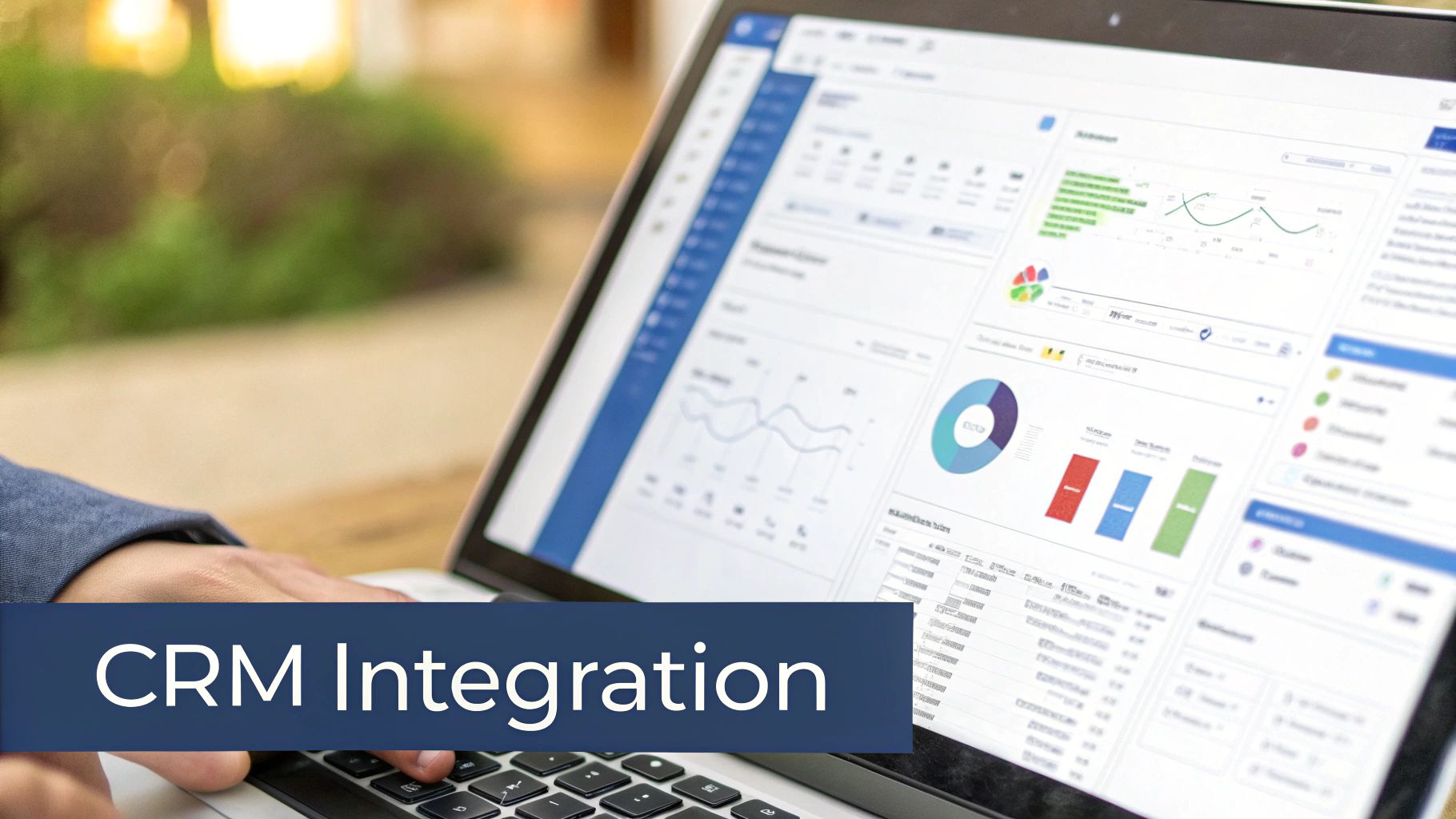
Your MarTech stack, particularly your CRM like Salesforce Sales Cloud or HubSpot, is the central nervous system of your entire go-to-market strategy. Your outsourced partner must be directly integrated into it. This is not about simply providing a login; it’s about architecting a shared digital infrastructure where data flows cleanly and performance is transparent to all stakeholders.
Laying the Technical Groundwork in Your CRM
Before your partner sends their first email, you must prepare your CRM. This foundational work prevents data chaos and establishes clear rules of engagement from day one. Bypassing this step is a common mistake that leads to duplicate records, misattributed leads, and significant cleanup for your ops team.
First, create dedicated user profiles and permission sets. This is a non-negotiable step for security and governance. Your partner requires sufficient access to create and update records, but they should not have unrestricted access to your entire company’s data.
Next, define and automate your lead and contact ownership rules. In Salesforce, this involves setting up assignment rules to automatically route new leads to the correct person or queue. In HubSpot, you can use workflows to assign ownership based on specific triggers. Automation eliminates manual work and ensures every lead is actioned promptly.
Aligning on Process and Definitions
Technology alone is not enough. You and your partner must be fully aligned on your processes and, equally important, your terminology. Your definition of a Marketing Qualified Lead (MQL) or a Sales Qualified Lead (SQL) must be identical to theirs. This shared language is the foundation of a successful partnership.
A system audit conducted before you onboard a partner is the single best investment you can make. It shines a light on hidden data issues, process gaps, and integration flaws that could completely derail the partnership before it even gets started.
Document these definitions in a shared playbook and then build them directly into your systems. For example, use specific lead statuses in Salesforce or lifecycle stages in HubSpot to objectively track a prospect’s journey. This ensures that when a partner marks a lead as “Sales Qualified,” it meets the exact criteria your internal team expects, facilitating a smooth handoff. To learn more about connecting different systems, read this guide on what platform integration really means.
Creating Transparency with Shared Dashboards
Once the team is active, visibility is paramount. You shouldn’t have to wait for a weekly check-in call to understand performance. The most effective way to achieve this is through shared dashboards built directly within your CRM.
Set up dedicated dashboards in Salesforce Sales Cloud or HubSpot that track the key performance indicators (KPIs) agreed upon in your Service Level Agreement (SLA).
Essential KPIs to track on a shared dashboard:
- Activities: Dials, emails sent, and social media touches per rep.
- Conversion Rates: MQL-to-SQL conversion, and the SQL-to-meeting booked rate.
- Pipeline Generated: The dollar value of the opportunities being created by the outsourced team.
- Data Hygiene Score: A metric to track the completeness and accuracy of the records they manage.
This level of transparency ensures accountability and enables real-time course corrections. If you notice activity levels declining or conversion rates falling, you can address the issue with your partner immediately—not weeks later when it has already impacted your pipeline. This data-driven approach transforms your outsourced sales team from a black box into a fully integrated and measurable component of your revenue machine.
Finding the Right Partner and Dodging Common Pitfalls
Selecting an outsourced sales partner is a critical decision. The right choice can supercharge your growth. The wrong one can derail your go-to-market strategy, waste budget, and create significant operational headaches. This process isn’t about finding a vendor; it’s about identifying a true extension of your team.
The evaluation process must go beyond a flashy sales pitch. You need to look for concrete evidence of their expertise, a genuine cultural fit, and the technical proficiency to support their claims. A poor partnership doesn’t just burn cash—it can damage your brand and disrupt your entire revenue operation.
Begin with a structured and thorough evaluation. The first filter should always be industry experience. A team that excels at selling SaaS subscriptions may be completely lost navigating the long, complex sales cycles of industrial equipment. Request case studies with verifiable metrics, and always ask to speak with their current or former clients.

The RevOps Leader’s Vetting Checklist
As a RevOps leader, your perspective is different. You’re not just evaluating sales performance; you’re assessing their ability to integrate seamlessly. Will this partner enhance your tech stack and workflows, or will they create friction?
Here’s what to focus on:
- MarTech and CRM Fluency: Do they possess genuine expertise in your CRM? Whether you use Salesforce Sales Cloud or HubSpot, ask them to demonstrate how they would manage leads, log activities, and build reports within your system.
- Onboarding That Clicks: How do they plan to immerse their team in your brand, value proposition, and ideal customer profile? Look for a well-documented, comprehensive training plan. It’s a strong indicator of their professionalism.
- Reporting Rhythm and Transparency: A good partner operates with full transparency. They should be able to deliver clear, consistent reports on the metrics that matter and be prepared for a regular cadence of strategic meetings.
- Data Security and Compliance: This is non-negotiable. You need to understand exactly how they will handle your sensitive data. Ensure they have robust protocols in place and are compliant with regulations like GDPR or PIPEDA.
Sidestepping the Most Common Partnership Traps
Even with the most rigorous vetting process, outsourcing carries inherent risks. The key is to anticipate them and build safeguards into your agreement from day one.
Think of your Service Level Agreement (SLA) as the operational blueprint for the relationship, not just a legal document. It’s where you turn strategic goals into measurable promises, making sure everyone is 100% aligned on what success actually looks like.
Let’s address the biggest risks head-on.
Risk 1: Brand Dilution
An external team that fails to master your brand’s voice can cause real damage to your market perception.
- How to Avoid It: Equip them with a comprehensive sales playbook. It must include everything: messaging guides, examples of your brand voice, and scripts for handling objections. Require them to pass a certification on it before they engage with any prospects.
Risk 2: The “Black Box” Problem (Poor Communication)
It is dangerously easy to lose visibility into performance and pipeline health when the team is not in your office.
- How to Avoid It: Mandate direct integration with your CRM. Shared dashboards tracking mutually agreed-upon KPIs are essential. Establish weekly tactical check-ins and monthly strategic reviews to analyze data and refine your approach.
Risk 3: Data Security Leaks
Granting external access to your CRM introduces potential security vulnerabilities.
- How to Avoid It: Apply the principle of least privilege. Create custom user profiles in your CRM with permissions restricted to only what is absolutely necessary. Your contract must also include iron-clad data protection clauses and NDAs to legally protect your assets.
Frequently Asked Questions About Outsourced Sales
When considering an outsourced sales partner, many questions arise. It’s a significant decision for any RevOps or sales leader, and obtaining clear answers is essential for moving forward with confidence. We will address the three most common concerns: cost, control, and brand integrity.
Resolving these details upfront is key to finding a partner that feels like a true extension of your team, integrating seamlessly into your existing tech stack, whether that’s Salesforce Sales Cloud or HubSpot.
How Much Do Outsourced Sales Solutions Typically Cost?
This is often the first question, but there is no single answer. The cost depends heavily on the engagement model you choose, as each is designed to deliver different outcomes.
The key is to look beyond the initial quote and compare it to the fully-loaded cost of hiring an in-house team. When you factor in salary, benefits, recruiting fees, training time, and software licenses for internal staff, the financial comparison often looks very different.
Here’s a brief overview of common pricing structures:
- Lead Generation as a Service (LGaaS): This is the most direct model. You typically pay per lead or per booked meeting, resulting in a predictable, output-based cost.
- Sales Development as a Service (SDRaaS): This usually involves a monthly retainer for a dedicated SDR team. Often, performance bonuses are tied to key metrics, such as the number of qualified meetings set.
- Full-Cycle Sales Outsourcing: As the most comprehensive option, this model typically combines a larger monthly retainer with a commission percentage on closed deals, creating a shared-risk, shared-reward partnership.
Will an Outsourced Team Understand Our Unique Brand and Product?
This is a critical—and entirely valid—concern. Can an external team truly understand your product and represent your brand with the same conviction as your own employees? The best partners can, because they operate as a genuine extension of your go-to-market team, not just a vendor.
A top-tier partner’s training program should look almost identical to your own internal onboarding. It has to go way beyond just learning product features. Their team needs to be immersed in your company culture, your brand’s voice, your core value proposition, and exactly who your ideal customer is.
When vetting potential partners, press them on their training process. Request a detailed walkthrough of their onboarding timeline and curriculum. Ask for examples of sales playbooks or training materials they have developed for clients in a similar industry. This will help you distinguish partners who are truly committed to becoming brand ambassadors from those who merely claim to be.
How Do We Maintain Control and Visibility Over an External Team?
Handing over a sales function can feel like a loss of control, but it doesn’t have to be. With the right framework, you can actually gain more visibility. The key is not micromanagement; it’s establishing control through robust processes and integrated technology.
This is where your CRM, such as Salesforce Sales Cloud or HubSpot, becomes your single source of truth. By providing the outsourced team with direct access to your system via specific user profiles and permissions, you gain a real-time view into every call, email, and activity. Nothing is hidden.
Clear, mutually agreed-upon Service Level Agreements (SLAs) are the foundation of this relationship. These SLAs should define everything from daily activity volume to the specific criteria for a qualified lead. Combine this with a regular meeting cadence—such as weekly tactical check-ins and monthly strategic reviews—and shared dashboards tracking KPIs.
This structure keeps everyone aligned with your goals and provides the transparency needed to manage the partnership effectively. For more answers on related sales topics, you can explore these general sales FAQs. Instead of a “black box,” the partnership becomes a measurable, predictable part of your revenue engine.
Ready to see how a perfectly integrated sales partner can accelerate your pipeline without sacrificing control? At MarTech Do, we specialize in aligning outsourced teams with your existing Salesforce and HubSpot stacks to drive predictable revenue. Let’s talk about building a strategy that works for you.