
In B2B marketing operations, not all leads are equal. Distinguishing high-potential prospects from time-wasters can drive significant revenue gains. Yet many RevOps and marketing teams struggle to filter out noise, leaving sales with unqualified leads. The solution is a robust, data-driven lead scoring model that aligns marketing and sales and powers your RevOps, marketing operations, and CRM strategy.
A strategic lead scoring system does more than assign points—it refines your go-to-market approach and maximizes ROI. It converts a volume of Marketing Qualified Leads (MQLs) into a focused set of Sales Qualified Leads (SQLs). With precise scoring, your team invests time in prospects with the highest probability of conversion.
This listicle presents seven actionable lead scoring best practices for Marketing Cloud Account Engagement (formerly Pardot/MCAE) and HubSpot. You’ll learn to define your Ideal Customer Profile (ICP), automate scoring rules, and ensure your sales team seizes the right opportunities.
1. Define Clear Ideal Customer Profile (ICP) and Buyer Personas
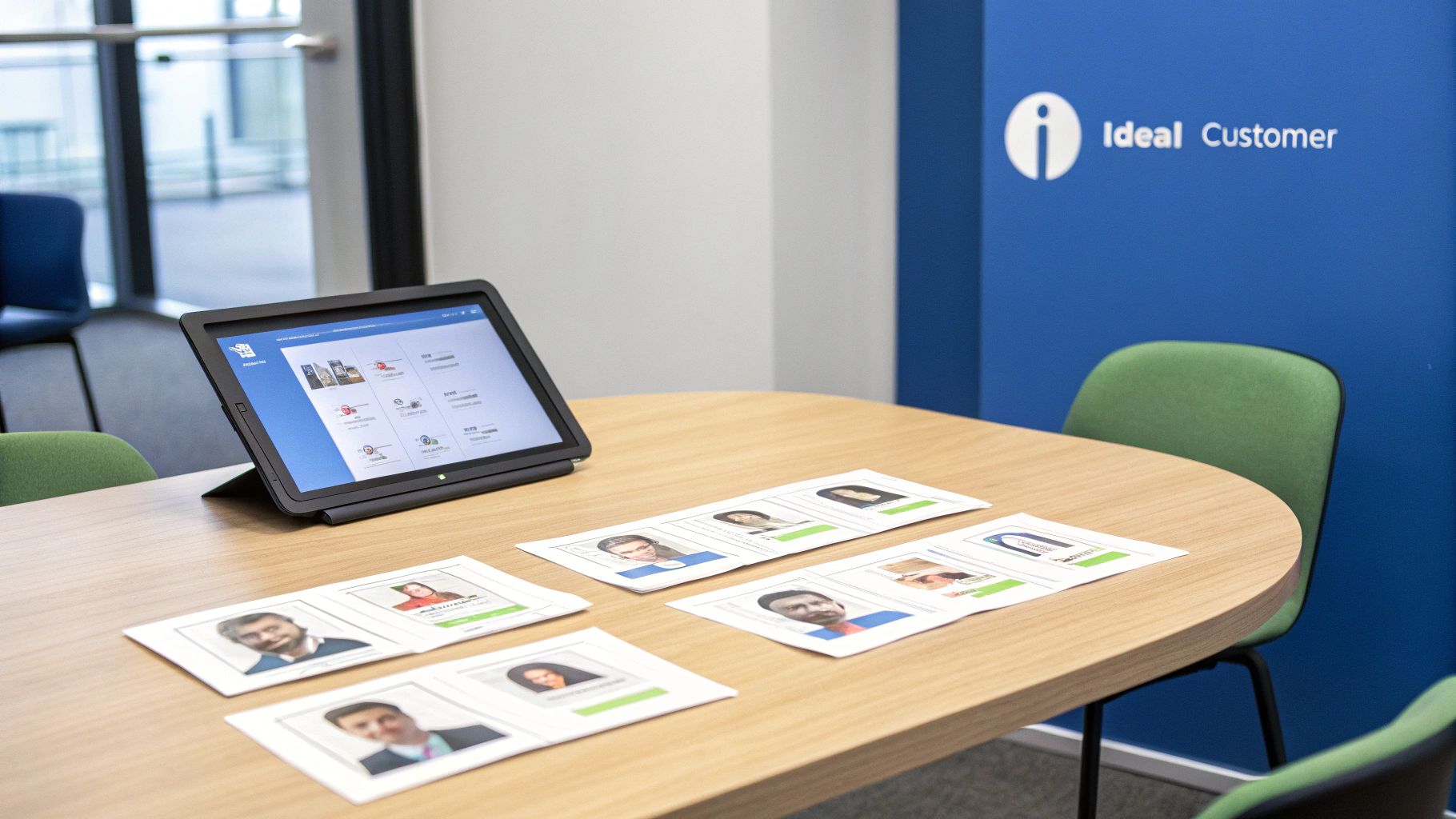
A successful lead scoring model starts with a clear Ideal Customer Profile (ICP) and buyer personas. Your ICP is the firmographic and technographic blueprint of your perfect-fit company. Personas represent the key decision-makers you’re targeting. Without this foundation, your scoring logic rests on assumptions, not data, misaligning sales and marketing.
Why It’s a Foundational Best Practice
An ICP acts as the North Star for your go-to-market strategy and directs your scoring model. For example, if your ICP is a SaaS company with 200–1,000 employees using Salesforce as their CRM, assign a significant point boost to leads that match. This ensures sales focuses on high-value accounts, improving efficiency and deal velocity.
“Your lead scoring model is only as accurate as your understanding of your ideal customer. Garbage in, garbage out. If your ICP is vague, your MQLs will be too.”
How to Implement ICP and Personas in Your Scoring Model
Actionable Implementation Steps:
- Data Analysis: Pull a report from your CRM (e.g., Salesforce) of your top 20% of customers by revenue or lifetime value. Identify common industries, company sizes, annual revenues, locations, and technology stacks.
- Qualitative Interviews: Talk with your sales team and top customers. Discover their buying process, pain points, and decision triggers. Use these insights for persona-driven scoring.
- Create Scoring Tiers: In HubSpot, define custom properties for “ICP Tier” (Tier 1, 2, 3) and map point values automatically based on fit.
- Utilize Negative Personas: Define personas for poor-fit leads (e.g., students, competitors, non-target industries) and assign negative points in MCAE to deprioritize them.
2. Implement Behavioral Scoring Based on Engagement Activities
Firmographic data tells you who a lead is; behavioral scoring reveals how interested they are. Assign points for actions like page visits, form submissions, and content downloads. This real-time insight layers intent data over fit, surfacing leads ready for sales conversations.

Why It’s a Foundational Best Practice
Behavioral scoring bridges marketing engagement and sales readiness. A lead that matches your ICP and visits your pricing page or requests a demo is far more valuable than one who only downloads a blog post. Prioritizing high-intent actions boosts connection and conversion rates, a core tenet of lead scoring best practices.
“A prospect’s digital body language tells you more about their intent than their job title ever will. Behavioral scoring is how you listen to it at scale.”
How to Implement Behavioral Scoring in Your Scoring Model
Actionable Implementation Steps:
- Assign Higher Scores to High-Intent Actions: For example, +15 points for a pricing-page visit vs. +2 for a blog post view. Use MCAE completion actions or HubSpot workflows to apply scores instantly.
- Track Progressive Engagement: Reward sustained interest. For instance, +10 bonus points when a lead downloads two case studies and watches a webinar within one week.
- Use Scoring Decay: Subtract points for inactivity (e.g., –10 points after 30 days without engagement) to keep your pipeline fresh.
- Monitor Multiple Contacts (Account-Based Scoring): Aggregate activity from several contacts in the same account. A spike in collective engagement should boost the account score significantly.
3. Create Negative Scoring for Disqualifying Factors
Negative scoring deducts points for attributes or behaviors that signal a poor fit. This prevents pipeline pollution by filtering out unqualified prospects, even if they engage heavily.

Why It’s a Foundational Best Practice
Without negative scoring, a high engagement score alone can trigger false positives—competitors, job seekers, or out-of-territory leads. Penalizing these factors preserves sales’ time for genuine revenue opportunities.
“Positive scores tell you who to talk to. Negative scores tell you who to ignore.”
How to Implement Negative Scoring in Your Model
Actionable Implementation Steps:
- Identify Disqualifying Attributes: Review closed-lost deals in your CRM to spot free email domains (e.g., @gmail.com), irrelevant job titles (e.g., Intern), or unsupported regions.
- Penalize Bad-Fit Behaviors: Subtract points for repeated career-page visits or prolonged inactivity (e.g., –20 for 90+ days of no engagement).
- Automate in Your Platform: In HubSpot or MCAE, build automation rules that deduct significant points (e.g., –50) when disqualifying criteria are met.
- Monitor for False Negatives: Regularly audit negatively scored leads to refine overly aggressive rules.
4. Align Sales and Marketing on Lead Definitions and Handoff Processes
A sophisticated lead scoring model fails without sales and marketing alignment. Agree on precise criteria for MQLs, SALs, and SQLs, and document a Service Level Agreement (SLA) to manage handoffs.

Why It’s a Foundational Best Practice
Alignment turns lead scoring into a practical sales enablement tool. When marketing and sales share definitions and thresholds, follow-up is timely and effective, boosting conversion rates and revenue.
“Misalignment is the silent killer of revenue. If sales and marketing don’t agree on what a ‘good lead’ is, your lead scoring model is just an expensive guessing game.”
How to Implement Alignment in Your Scoring Model
Actionable Implementation Steps:
- Develop a Service Level Agreement (SLA): Define MQL, SAL, and SQL score thresholds and follow-up timelines (e.g., sales responds within four hours of MQL).
- Create Shared Dashboards: Use Salesforce or HubSpot dashboards to track MQL-to-SAL conversion, follow-up times, and rejection reasons.
- Implement Closed-Loop Reporting: Add a “Disqualified Reason” field in your CRM that syncs back to MCAE or HubSpot.
- Hold Regular “Smarketing” Meetings: Meet bi-weekly to review funnel metrics, discuss lead quality, and refine scoring rules. See best practices for customer onboarding best practices.
5. Use Progressive Profiling to Enhance Data Quality
Collect detailed lead data without overloading your prospects. Progressive profiling asks for minimal information upfront and adds fields in subsequent interactions, enriching your scoring criteria over time.
Why It’s a Foundational Best Practice
Progressive profiling combats form fatigue and abandonment. By requesting only essential data initially, you maximize conversions. As engagement grows, you gather firmographic details that power more accurate scoring.
“Don’t treat your forms like an interrogation. Treat them like a conversation.”
How to Implement Progressive Profiling in Your Scoring Model
Actionable Implementation Steps:
- Prioritize Initial Data Points: Ask only for first name and business email on your top-of-funnel forms.
- Use Conditional Logic: Show new fields (e.g., job title, department) on follow-up forms in HubSpot or MCAE, avoiding redundant questions.
- Map Fields to Scoring Criteria: Align each progressive field with a key ICP attribute to trigger immediate score updates.
- Leverage Data Enrichment: Integrate enrichment tools to append company size, industry, and revenue, freeing forms to collect qualitative insights.
6. Implement Time-Based and Frequency-Based Scoring Rules
A lead’s interest changes over time. Implement time decay and frequency rules to reward recent, repeated engagement and downgrade stale leads, ensuring your pipeline reflects current intent.
Why It’s a Foundational Best Practice
Recency and repetition are strong urgency signals. A lead who visits your pricing page multiple times this week is more sales-ready than one who hadn’t engaged since last quarter—even if their total scores match.
“A lead’s score should reflect their current temperature, not their entire thermal history.”
How to Implement Time-Based and Frequency-Based Scoring
Actionable Implementation Steps:
- Establish a Scoring Decay Model: Use workflows in HubSpot or automation rules in MCAE to subtract 10 points for every 30 days of no engagement.
- Weight Recent Activities Higher: Assign more points for actions within a recent window (e.g., +50 for a demo request in the last seven days vs. +20 if it’s 30 days old).
- Score Engagement Velocity: Add bonus points (e.g., +25) if a lead visits five key pages within 48 hours.
- Align Decay Rates with Your Sales Cycle: Set decay thresholds based on your typical cycle length. When choosing tools, learn more about how to choose a CRM that supports these rules.
7. Leverage Predictive Scoring and Machine Learning
Predictive scoring uses AI to analyze your historical data—closed-won, closed-lost, firmographics, and behaviors—to identify patterns humans might miss. It constantly refines its accuracy, surfacing leads with the highest conversion probability.
Why It’s a Foundational Best Practice
Predictive models eliminate manual biases and uncover nuanced signals—such as a niche job title at a company adopting a specific technology—that correlate with higher win rates. This precision augments your rule-based scores and supercharges sales efficiency.
“Predictive scoring isn’t about replacing intuition; it’s about augmenting it with data-driven insights.”
How to Implement Predictive Scoring in Your Model
Actionable Implementation Steps:
- Assess Data Readiness: Ensure at least 1,000 closed-won and 1,000 closed-lost opportunities in your CRM for model training.
- Integrate a Predictive Tool: Use Salesforce Einstein or third-party platforms like 6sense or Infer. Proper setup often requires deep expertise in successful MarTech integrations.
- Run in Parallel: Operate predictive scoring alongside your rule-based model to validate accuracy and build sales trust.
- Combine with Rule-Based Logic: Use the predictive score for qualification and real-time behavioral scores (from MCAE or HubSpot) for context—escalating leads when both align.
Lead Scoring Best Practices Comparison
| Item | Implementation Complexity | Resource Requirements | Expected Outcomes | Ideal Use Cases | Key Advantages |
|---|---|---|---|---|---|
| Define Clear Ideal Customer Profile (ICP) and Buyer Personas | Medium – requires upfront data analysis | Customer data, sales & marketing collaboration | Improved lead quality, 10-15% higher conversion | Foundational lead scoring, targeting refinement | Clear scoring framework, reduces bias |
| Implement Behavioral Scoring Based on Engagement Activities | High – needs tracking infrastructure | Marketing automation tools, analytics | Real-time intent signals, 18%+ revenue increase | Leads with digital engagement, nurturing | Timely sales intervention, captures buying signals |
| Create Negative Scoring for Disqualifying Factors | Medium – criteria definition needed | Data analysis, regular review | Reduced wasted effort, 20-30% sales efficiency | Filtering unqualified leads early | Better lead score accuracy, cleaner database |
| Align Sales and Marketing on Lead Definitions and Handoff Processes | Medium to High – requires collaboration | Cross-team communication, dashboards | 25-30% better conversion, 208% revenue growth | Companies with separate sales & marketing teams | Reduces friction, improves ROI measurement |
| Use Progressive Profiling to Enhance Data Quality | Medium – needs form tech & staged implementation | Form technology, data enrichment | 40-60% higher form completions, better data quality | Long lead cycles, improving form conversions | Increases completion rates, personalized profiling |
| Implement Time-Based and Frequency-Based Scoring Rules | High – complex algorithms & calibration | Advanced scoring tools, ongoing tuning | Real-time intent capture, prevents stale leads | Industries with time-sensitive buying intent | Improves timing accuracy, reduces false positives |
| Leverage Predictive Scoring and Machine Learning | Very High – requires ML expertise & data | Large historical dataset, AI tools | Up to 30-50% conversion uplift, continuous improvement | Data-rich organizations, advanced analytics users | Identifies hidden patterns, improves over time |
Turn Scoring Insights into Revenue Engine Fuel
Building a lead scoring model is only the start. The most successful RevOps teams treat it as a living asset, continuously refining ICP definitions, behavioral rules, and alignment processes. Combine progressive profiling, time-based rules, and predictive scoring to transform HubSpot or Pardot (MCAE) into a sophisticated revenue engine.
- Conduct a Cross-Functional Audit: Gather sales and marketing stakeholders. Use these best practices as a checklist to identify gaps in your current model.
- Analyze Your Closed-Won Data: Trace the last 20–30 deals in your CRM. Identify the key demographic, firmographic, and behavioral signals that drove conversions.
- Implement One Refinement This Quarter: Choose a high-impact tweak—like negative scoring for irrelevant job titles or a decay rule for inactivity—and measure its effect on MQL-to-SQL conversion over 90 days.
An optimized lead scoring framework ensures your sales team focuses on prospects who fit your ICP and demonstrate strong buying intent. By embracing these lead scoring best practices, you build an intelligent, efficient, and predictable revenue machine.
Is your lead scoring model truly fueling your revenue engine, or is it creating friction? The expert team at MarTech Do specializes in auditing, designing, and implementing sophisticated lead scoring systems within HubSpot and Salesforce ecosystems. Try out our HubSpot Lead Score Builder to turn your MarTech complexity into revenue clarity and measurable growth.