In the world of B2B RevOps, your CRM and marketing automation platforms like Salesforce, HubSpot, or Pardot (MCAE) are the engines of your go-to-market strategy. When it’s time to upgrade, consolidate, or switch systems, the data migration process can feel like performing open-heart surgery on your entire revenue operation. A single misstep can lead to corrupted data, compliance breaches, and costly operational downtime that reverberates through sales and marketing.
This guide moves beyond generic advice to provide a strategic framework grounded in experience. We will break down the essential data migration best practices that RevOps, Marketing Ops, and Sales Ops managers need to execute a successful, secure, and seamless transition. You will learn how to implement a phased migration, establish a robust testing and validation framework, and ensure cross-functional alignment every step of the way.
Mastering these principles is not just about avoiding disaster; it’s about transforming a high-risk technical project into a powerful strategic advantage. By following this comprehensive checklist, you can ensure your new system is built on a foundation of clean, accurate, and accessible data. This unlocks the full potential of your MarTech stack, enabling smarter revenue optimization, more effective marketing campaigns, and a stronger, data-driven GTM strategy. Let’s dive into the core practices that turn complex migrations into predictable successes.
1. Comprehensive Data Assessment and Profiling: Your Migration Blueprint
Attempting a data migration without first conducting a thorough assessment is like building a house without a blueprint. It’s a gamble that almost always leads to structural issues, unexpected costs, and project failure. This foundational step involves a meticulous evaluation of your source data’s structure, quality, completeness, and inter-dependencies. It’s the most critical of all data migration best practices because it directly informs every subsequent phase, from tooling selection to validation scripting.

For B2B organizations reliant on platforms like Salesforce or HubSpot, this process moves beyond simple record counts. It means cataloging every custom object and field, identifying data anomalies in lead or contact records (like inconsistent state abbreviations or invalid email formats), and scoring overall data quality against defined business rules. A comprehensive profile will map the critical, often undocumented, relationships between objects like Accounts, Contacts, and Opportunities, ensuring that vital context isn’t lost during the transfer.
Why This Is a Critical First Step
A deep data assessment prevents costly mid-migration surprises. By understanding the true state of your data, you can accurately scope the project, design a target system that accommodates your real-world needs, and build a predictable, successful migration plan. It transforms the project from a reactive, problem-solving exercise into a proactive, strategic initiative.
Key Insight: Data profiling isn’t just an IT task; it’s a strategic business activity. The discoveries made during this phase directly impact sales efficiency, marketing campaign effectiveness, and revenue attribution accuracy in the new system.
Actionable Implementation Tips
To execute a successful data assessment, your RevOps and IT teams should focus on the following:
- Utilize Automated Tools: Leverage data profiling tools to quickly analyze massive datasets to identify patterns, outliers, and inconsistencies that are impossible to find manually.
- Document Everything: Create a comprehensive data dictionary that defines every field, its data type, business purpose, and validation rules. Supplement this with a data quality scorecard that tracks key metrics like completeness, uniqueness, and validity for critical objects.
- Involve Business Stakeholders: Your Sales and Marketing teams are the ultimate consumers of the data. Involve them early to validate the findings from the profiling process. They can provide essential context on which data fields are critical for their daily operations and what constitutes “good” data from their perspective.
A B2B SaaS company preparing to migrate to Salesforce provides a perfect example. Their initial data profiling revealed that over 30% of their contact records were missing essential firmographic data like industry and employee count. This discovery prompted a dedicated pre-migration data enrichment phase, which prevented the pollution of their new CRM and ensured their go-to-market teams could segment and target accounts effectively from day one.
2. Phased Migration Approach: Minimizing Risk Through Iteration
Attempting to move an entire data ecosystem in a single, high-stakes event, often called a “big bang” migration, is fraught with risk. A more prudent and controlled strategy is the phased migration approach. This methodology breaks the project down into smaller, manageable, and sequential stages, allowing your RevOps team to migrate, test, and validate data in controlled iterations. Adopting this as one of your core data migration best practices transforms a monumental task into a predictable, low-risk process.
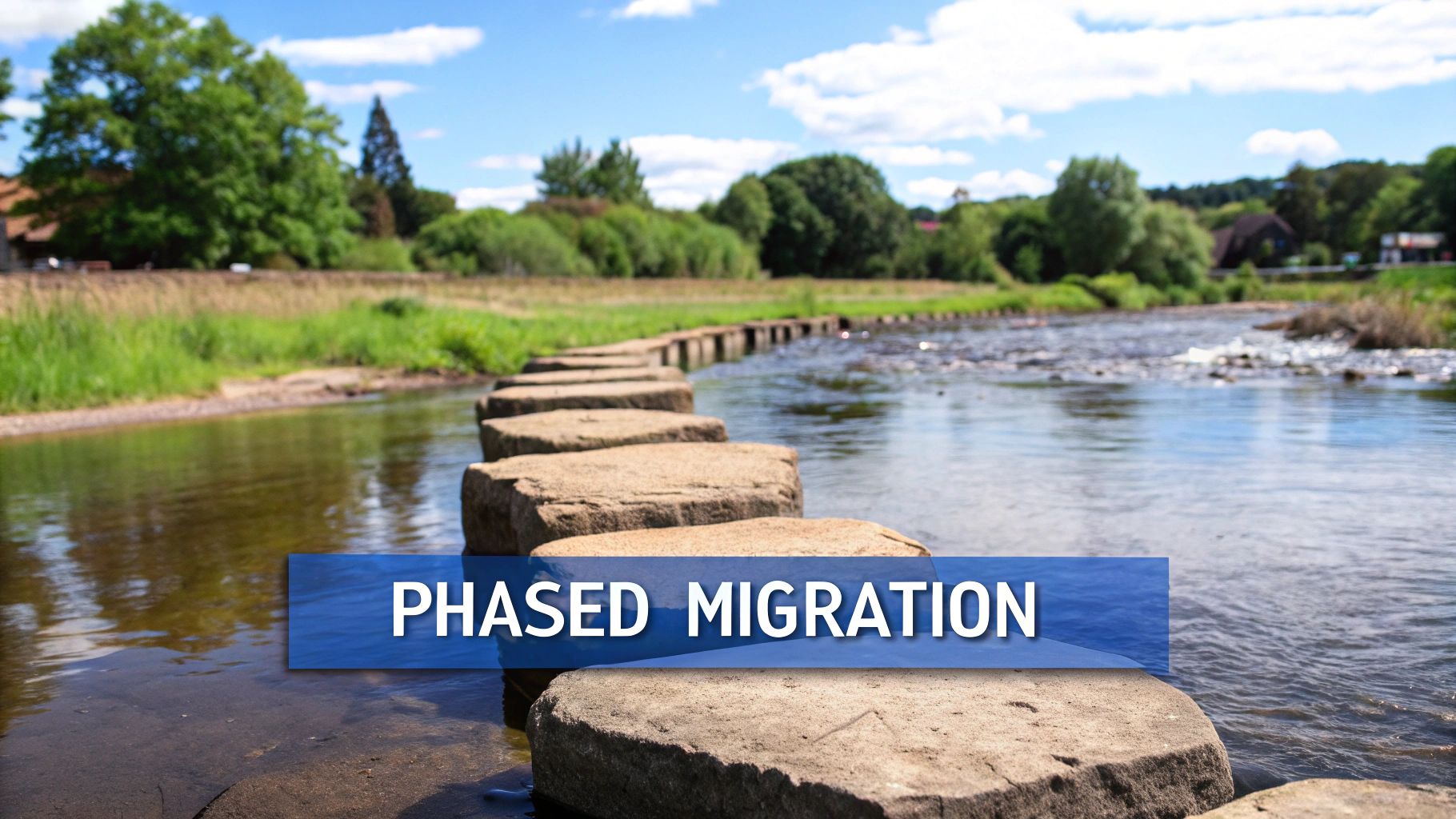
For a B2B organization migrating from an older CRM to a new Salesforce instance, this could mean moving data by business unit, geographical region, or even by data object complexity. For instance, the first phase might only involve migrating fundamental Account and Contact records for a single sales territory. This allows the project team to identify and resolve unforeseen mapping issues or data transformation errors on a smaller scale, applying those lessons to subsequent, more complex phases like Opportunity and Quote data.
Why This Is a Critical Second Step
A phased approach significantly de-risks the entire migration project. It allows for early detection of problems, provides tangible progress for stakeholders to see, and minimizes operational disruption. If an issue arises during a single phase, it impacts only a subset of users and data, making it far easier to isolate, troubleshoot, and roll back if necessary, without jeopardizing the entire project timeline or business continuity.
Key Insight: The phased approach isn’t just about moving data in chunks; it’s a strategic learning process. Each phase provides invaluable feedback that refines the methodology, scripts, and validation criteria for the next, ensuring each subsequent step is more efficient and successful than the last.
Actionable Implementation Tips
To effectively implement a phased migration, your marketing and sales operations teams should:
- Define Clear Phase Boundaries and Success Criteria: Segment the migration logically, such as by department, data object (e.g., Leads first, then Contacts, then Accounts), or a specific user group. For each phase, define explicit success criteria, such as “99.5% of migrated contact records pass all validation rules,” before proceeding to the next.
- Plan for Coexistence and Synchronization: During the transition, both the source and target systems will be live. Implement a robust data synchronization strategy using tools like an iPaaS (Integration Platform as a Service) to ensure data consistency. For example, any new leads created in the old system must be synced to the new Salesforce instance in near real-time.
- Start with Low-Risk Segments: Begin the migration with less critical data or a smaller, more tech-savvy pilot group of users. This creates a safe environment to test your migration processes and tools, gather user feedback, and build momentum and confidence for more critical phases.
Consider how a large enterprise might migrate its infrastructure to a new cloud platform. Instead of a single cutover, they could move services and regions in carefully planned phases over many months. This would allow them to manage complexity, address performance issues iteratively, and ensure a seamless experience for their users, a powerful example of this best practice in action at scale.
3. Robust Data Backup and Recovery Planning
Embarking on a data migration without a verified backup and a tested recovery plan is the digital equivalent of tightrope walking without a safety net. It introduces an unacceptable level of risk to your most valuable asset: your data. A robust backup strategy involves creating complete, point-in-time copies of your source data before, during, and after the migration process. This is one of the most fundamental data migration best practices, as it provides the ultimate failsafe against data corruption, migration failures, or unforeseen system issues.

For B2B RevOps teams managing complex Salesforce or HubSpot instances, this goes beyond a simple database dump. It means ensuring that all relational data, metadata, configurations, and custom code are included in the backup. The goal is not just to have a copy of the data but to have a complete, restorable snapshot of the entire system state, allowing you to roll back to a known good configuration if any part of the migration process fails.
Why This Is a Critical Safety Net
A comprehensive backup and recovery plan is your project’s insurance policy. It protects against catastrophic data loss and provides the confidence needed to proceed with complex migration phases. Knowing you can quickly restore the source system to its pre-migration state allows your team to troubleshoot issues without the immense pressure of irreversible data damage. It transforms a potential crisis into a manageable, albeit inconvenient, technical problem.
Key Insight: The success of your backup strategy is not measured by the ability to create a backup, but by the proven ability to restore from it. An untested backup is merely a hypothesis, not a recovery plan.
Actionable Implementation Tips
To build a reliable backup and recovery framework, your operations and IT teams should implement the following:
- Implement the 3-2-1 Backup Rule: This industry standard, popularized by firms like Veeam, dictates you should have at least three copies of your data, stored on two different types of media, with one copy located off-site. This diversification protects against a wide range of failure scenarios, from hardware failure to a site-wide disaster.
- Test Restore Procedures Religiously: Don’t just automate backup creation; schedule and execute regular test restores. Attempt to recover the entire dataset to a sandbox or staging environment to validate the integrity of the backup files and the effectiveness of your recovery documentation.
- Document and Train Extensively: Create a clear, step-by-step recovery guide that details every action required to restore the system. Ensure multiple team members are trained on this procedure to avoid having a single point of failure. This documentation should be stored in a location accessible even if the primary system is down.
A real-world event underscores the critical importance of having a verified, off-site backup. The logistics giant Maersk’s recovery from a devastating cyberattack was only possible due to a single, intact domain controller backup in a remote office, which allowed them to rebuild their entire global network.
4. Comprehensive Testing and Validation Framework
Executing a data migration without a robust testing framework is like launching a rocket without running pre-flight checks. You might get off the ground, but you’re risking catastrophic failure. A comprehensive testing and validation framework is a systematic process for verifying the integrity, completeness, and functionality of your data before, during, and after migration. This critical practice ensures the migrated data is accurate, reliable, and fully supports business operations in the new environment.

For B2B organizations, this goes far beyond checking if record counts match between the source and target systems. It involves validating complex data transformations, verifying that relational integrity between objects like Accounts and Opportunities is preserved, and ensuring that automation rules in the new CRM fire correctly. Effective testing confirms not only that the data arrived, but that it arrived in a usable, functional state that empowers sales and marketing teams.
Why This Is a Critical Post-Planning Step
Rigorous testing is the only way to guarantee that the migration meets business requirements and doesn’t introduce new problems. It mitigates the risk of data corruption, application errors, and operational disruptions post-launch. By systematically validating the data at each stage, you build confidence in the new system and ensure a smooth transition for end-users, much like a well-structured plan ensures successful customer onboarding best practices.
Key Insight: Testing is not a single event but a continuous process. It should encompass multiple layers, including unit testing of transformation scripts, system integration testing, performance testing under load, and, most importantly, user acceptance testing (UAT).
Actionable Implementation Tips
To build a successful testing and validation framework, your RevOps and IT teams should prioritize the following:
- Develop Test Plans Early: Create detailed test plans and scripts during the initial planning phase, not as an afterthought. Define clear success criteria for each test case, specifying what constitutes a pass or fail.
- Utilize Automated Validation Tools: Employ specialized data testing tools to automate the comparison of millions of records, identify discrepancies, and significantly reduce manual effort and human error.
- Involve End-Users in UAT: Your sales and marketing users are the ultimate arbiters of success. Involve them directly in defining UAT scenarios that reflect their real-world daily workflows. Their validation confirms that the data is not just technically correct but also functionally valuable.
- Maintain Representative Test Data: Use a sanitized but realistic subset of production data for testing. This ensures your tests accurately simulate the complexities and edge cases that will be encountered with the full dataset, preventing surprises at go-live.
A prime example is a large manufacturer’s system migration. The process required a comprehensive validation framework using automated tools to compare datasets, ensuring that critical production information was transferred with 100% accuracy, thereby preventing costly disruptions to their assembly lines.
5. Data Security and Compliance Management
Treating data security and compliance as an afterthought in a migration is a direct route to catastrophic data breaches, regulatory fines, and irreparable brand damage. A robust security framework isn’t a separate workstream; it’s woven into the very fabric of the migration plan. This essential practice involves implementing stringent controls to protect data at rest, in transit, and during processing, while ensuring adherence to regulations like GDPR or CCPA. Among all data migration best practices, this one carries the most significant legal and financial risk if ignored.
For B2B organizations, especially those handling sensitive customer information within CRM or marketing automation platforms, this means going far beyond basic password protection. It involves classifying data based on sensitivity (e.g., PII, financial data), encrypting the migration pipeline end-to-end, and enforcing strict, role-based access controls for every team member involved. The goal is to ensure that data remains protected from unauthorized access or exposure at every stage of its journey from the source to the target system.
Why This Is a Critical, Non-Negotiable Step
Neglecting security and compliance exposes your organization to severe penalties. For instance, a healthcare provider migrating patient data to a new cloud-based EHR system without maintaining strict HIPAA compliance risks crippling fines and legal action. Similarly, a public company must ensure SOX compliance is maintained during any system migration to guarantee the integrity of financial reporting data. This practice moves data migration from a purely technical exercise to a Governance, Risk, and Compliance (GRC) imperative.
Key Insight: Data migration is a high-risk event that significantly expands your data’s attack surface. Proactive security and compliance management isn’t just about avoiding fines; it’s about protecting your company’s most valuable asset and maintaining customer trust.
Actionable Implementation Tips
To embed security and compliance into your migration strategy, your RevOps, IT, and legal teams must collaborate on the following:
- Implement Data Classification and Handling: Before migration, classify all data assets according to their sensitivity level (e.g., Public, Internal, Confidential, Restricted). Define and enforce specific handling procedures for each classification, ensuring that highly sensitive data receives the highest level of protection.
- Utilize Compliant Tooling and Encryption: Select migration tools and platforms that are certified for relevant regulations. Enforce strong encryption for data both at rest in storage and in transit between systems using protocols like TLS 1.2 or higher.
- Maintain Rigorous Audit Trails: Ensure your migration process logs every action taken on the data, including who accessed it, when they accessed it, and what changes were made. These detailed logs are non-negotiable for demonstrating compliance during an audit and for forensic analysis in the event of a security incident.
A multinational B2B company preparing to centralize its European customer data into a HubSpot CRM provides a practical case. To ensure GDPR compliance, they conducted a pre-migration Data Protection Impact Assessment (DPIA). This process identified the need to anonymize certain data fields and implement a “right to be forgotten” workflow in the new system before the migration began, preventing a major compliance failure and building a foundation of trust with their European customer base.
6. Performance Optimization and Monitoring
A data migration’s success isn’t just measured by its accuracy but also by its efficiency. Performance optimization and monitoring involve a systematic approach to maximize data throughput, minimize downtime, and reduce the overall impact on source and target systems during the transfer. This practice transforms the migration from a monolithic, high-risk event into a controlled, observable, and efficient process. Without it, even a well-planned migration can grind to a halt, exceed maintenance windows, or degrade the performance of live business applications.
For a B2B company migrating its entire sales history from a legacy CRM to Salesforce, this means more than just a fast data dump. It requires tuning ETL processes to handle millions of Opportunity and Activity records without locking tables or overwhelming API rate limits. By monitoring network utilization and database load in real-time, the migration team can dynamically adjust data batch sizes and processing threads, ensuring the project stays on schedule without disrupting daily sales operations.
Why This Is a Critical Ongoing Step
Continuous monitoring and optimization prevent bottlenecks from derailing your migration timeline. By establishing performance baselines and tracking key metrics, you can proactively identify and resolve issues before they escalate, ensuring a smooth and predictable cutover. This focus on performance is one of the most vital data migration best practices for minimizing business disruption and adhering to strict project deadlines.
Key Insight: Optimal performance isn’t just about speed; it’s about control. A well-monitored migration allows you to balance throughput with system stability, making informed decisions to speed up, slow down, or pause the data flow as business needs dictate.
Actionable Implementation Tips
To effectively manage and optimize migration performance, your RevOps and IT teams should implement the following strategies:
- Establish Performance Baselines: Before the full migration, run tests with a representative subset of data to measure throughput, CPU and memory usage, and network latency. This baseline provides a benchmark against which you can measure the performance of the actual migration.
- Utilize Parallel Processing: Where possible, design your migration jobs to run in parallel. For example, migrate Accounts, Contacts, and Opportunities simultaneously as separate data streams. However, carefully monitor system load to avoid resource contention that could slow down the overall process. The principles of efficient system management here align with the broader goals of Sales Operations best practices, which also emphasize resource optimization.
- Implement Checkpoint and Resume Logic: For large datasets that take hours or days to migrate, build checkpoints into your ETL scripts. This allows the migration to be paused and resumed from the last successful checkpoint in case of a failure, saving significant time and preventing the need to restart from the beginning.
A prime example is a major social media platform’s migration of member data. They used highly optimized, parallel ETL processes and continuous monitoring to move petabytes of data between systems. By fine-tuning their approach and closely watching performance metrics, they were able to complete a massive migration with minimal impact on the live user experience, demonstrating the power of a performance-centric strategy.
7. Cross-functional Team Collaboration and Communication
A data migration is never just an IT project; it is a fundamental business transformation that impacts sales, marketing, finance, and customer service. Treating it as a siloed technical task is a direct route to misalignment, user resistance, and project failure. Effective cross-functional collaboration is one of the most vital data migration best practices, ensuring that technical execution is perfectly aligned with strategic business objectives from start to finish. This practice establishes a unified project team with clear roles, responsibilities, and communication channels.
For a B2B organization migrating its marketing automation platform, this means the RevOps team, IT specialists, marketing campaign managers, and sales leaders must work in lockstep. IT might handle the technical data extraction and loading, but the marketing team must define field mapping for lead scoring, and the sales team needs to validate that opportunity data and contact histories are preserved correctly. Without this constant dialogue, the new system may be technically sound but functionally useless for the teams who depend on it.
Why This Is a Critical Step
A collaborative approach breaks down departmental silos that often derail complex projects. It ensures that the migration’s goals are shared, potential roadblocks are identified early from multiple perspectives, and the final system meets the functional needs of its end-users. This proactive communication and shared ownership are essential for managing expectations, facilitating user adoption, and ultimately realizing the full business value of the new platform.
Key Insight: The success of a data migration is measured not by the technical completion of the data transfer, but by the successful adoption and utilization of the new system by business users. This can only be achieved through early and continuous collaboration.
Actionable Implementation Tips
To foster effective cross-functional collaboration, your project lead should:
- Establish a Core Migration Team: Form a dedicated team with representatives from every key stakeholder group (IT, RevOps, Sales, Marketing, Finance). Define and document roles, responsibilities, and decision-making authority clearly using a RACI (Responsible, Accountable, Consulted, Informed) chart.
- Implement a Communication Cadence: Schedule regular meetings, such as daily stand-ups for the core technical team and weekly or bi-weekly updates for the broader stakeholder group. Use collaborative tools for real-time updates and project management platforms for tracking technical tasks and dependencies.
- Create Centralized Documentation: Maintain a single source of truth, such as a shared workspace, for all project documentation. This includes the migration plan, data dictionary, testing scripts, and meeting notes, ensuring everyone is working from the same information.
Consider a large enterprise undergoing a massive IT transformation, requiring the migration of data and applications across numerous business units. The project’s success would be heavily dependent on a structured governance model that brings together leaders from IT, manufacturing, and marketing to coordinate dependencies and ensure business continuity. This model highlights how building the right revenue operations team structure is crucial for aligning teams toward a common goal.
7 Key Data Migration Practices Comparison
| Item | Implementation Complexity | Resource Requirements | Expected Outcomes | Ideal Use Cases | Key Advantages |
|---|---|---|---|---|---|
| Comprehensive Data Assessment and Profiling | High: Requires specialized tools and expertise | High: Time-consuming, specialized tools | Improved data quality, reduced migration risks | Early migration stages, complex datasets | Early issue detection, better planning |
| Phased Migration Approach | Medium-High: Managing multiple phases and states | Medium-High: Extended timelines and systems | Minimized downtime, flexible adjustments | Large-scale migrations, minimizing disruption | Reduced risk, controlled migration |
| Robust Data Backup and Recovery Planning | Medium: Complex backup strategies and testing | High: Storage and maintenance costs | Complete data protection and recoverability | Critical systems, high-risk migrations | Data loss prevention, compliance support |
| Comprehensive Testing and Validation Framework | High: Multi-layered testing, specialized tools | High: Significant time and expertise required | Ensured data integrity and process continuity | Validation-heavy migrations, regulatory needs | Early problem identification, user confidence |
| Data Security and Compliance Management | High: Complex security and compliance requirements | High: Security expertise and tools | Maintained privacy and regulatory compliance | Regulated industries, sensitive data | Risk reduction, audit readiness |
| Performance Optimization and Monitoring | Medium-High: Requires tuning and monitoring | Medium-High: May need extra resources | Faster migration, minimal system impact | Large datasets, performance-sensitive migrations | Reduced downtime, efficient resource use |
| Cross-functional Team Collaboration and Communication | Medium: Coordination of diverse teams | Medium: Communication tools, management effort | Improved project coordination and stakeholder engagement | Complex projects with multiple teams | Faster issue resolution, reduced conflicts |
From Blueprint to Reality: Partnering for a Successful Migration
Navigating the complexities of a major data migration project is not merely an IT task; it is a fundamental business initiative with the power to redefine your revenue operations. As we’ve explored, the journey from your legacy system to a new, optimized platform like Salesforce or HubSpot is paved with critical checkpoints. Moving beyond a simple lift-and-shift mentality requires embracing a structured methodology grounded in these essential data migration best practices.
Success hinges on a proactive, not reactive, approach. It begins long before the first data record is moved, with a meticulous Comprehensive Data Assessment and Profiling phase. This foundational step ensures you aren’t just migrating data, but migrating clean, relevant, and structured information that aligns with your future-state business processes. From there, adopting a Phased Migration Approach de-risks the entire project, allowing your team to learn, adapt, and build momentum without the immense pressure of a “big bang” cutover.
The Pillars of a Resilient Migration Strategy
However, even the best-laid plans require safety nets. This is where Robust Data Backup and Recovery Planning becomes non-negotiable, acting as your ultimate insurance policy against unforeseen technical glitches or data corruption. Simultaneously, a Comprehensive Testing and Validation Framework serves as your quality assurance engine, methodically confirming data integrity, system functionality, and user acceptance at every stage. This diligent validation is the only way to ensure the system you deliver is the one your team needs to succeed.
Furthermore, in today’s regulatory landscape, treating Data Security and Compliance Management as an afterthought is a critical error. Proactively embedding security protocols and compliance checks throughout the migration process protects your company’s most valuable asset-your customer data-and maintains brand trust. This commitment to quality extends beyond the go-live date, with ongoing Performance Optimization and Monitoring ensuring your new platform delivers sustained value and a superior user experience.
Key Takeaway: A successful data migration is a holistic endeavor. It requires treating each best practice not as an isolated checklist item, but as an interconnected component of a unified strategy. Technical execution must be seamlessly integrated with strategic planning, rigorous validation, and transparent communication.
Finally, the connective tissue holding the entire initiative together is Cross-functional Team Collaboration and Communication. A data migration impacts everyone from marketing and sales to finance and customer service. Establishing clear communication channels and ensuring alignment across departments transforms potential friction into collaborative problem-solving, fostering company-wide buy-in and a smoother transition for all stakeholders.
Mastering these data migration best practices empowers your organization to do more than just change systems. It enables you to build a resilient, scalable RevOps foundation that drives efficiency, unlocks deeper customer insights, and ultimately accelerates revenue growth. This isn’t just about moving data; it’s about moving your business forward.
Ready to ensure your next CRM or marketing automation migration is a strategic success? The experts at MarTech Do specialize in guiding B2B companies through complex data migrations within the Salesforce and HubSpot ecosystems, transforming technical projects into powerful catalysts for revenue growth. Let us help you build a RevOps foundation that scales with your business by visiting us at MarTech Do.