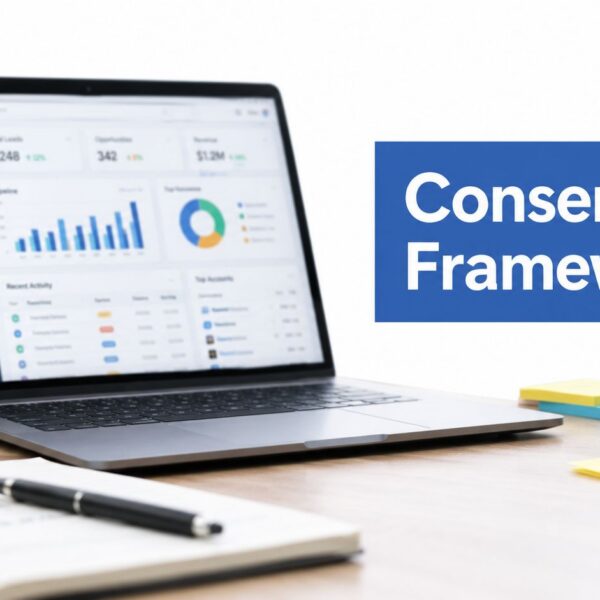

In business, ramp up is the period required for a new investment—whether a new sales hire, a marketing campaign, or a technology platform—to transition from a cost center to a revenue-generating asset. It’s the critical phase where potential is systematically converted into measurable performance.
This is not a passive waiting period. It is an active, operational process designed to bring a new resource to full productivity, guided by clear metrics and structured support within your core systems.
What Does Ramp Up Mean for Modern Revenue Teams?
Think of it like bringing a high-performance engine online. You wouldn’t just turn the key and hope for the best. Every component must be calibrated, tested, and integrated to deliver peak power.
The same principle applies in a B2B Revenue Operations (RevOps) setting. A new account executive, a HubSpot marketing automation sequence, or a new Salesforce integration are not “plug-and-play.” Each requires a deliberate, operational process to shift it from an expense into a growth driver.
This journey is often tracked on a “Ramp Curve,” which plots productivity against time. A steep curve signifies a fast, efficient ramp up—the goal of any RevOps leader. A shallow, flat curve is a red flag, signaling costly delays and likely deeper issues in your go-to-market engine. The objective is to make this curve as steep and predictable as possible.

From Theory to Practice
Grasping the concept is simple; executing it is the challenge. A successful ramp up depends entirely on the strength of your operational backbone. Without solid processes engineered within your CRM and marketing automation platforms, you are hoping for a positive outcome instead of building one.
An effective framework is built on three pillars:
- Structured Onboarding: Providing new hires with the tools, training, and explicit expectations needed to accelerate their time-to-value.
- System Enablement: Configuring your CRM and marketing automation tools (like Salesforce or HubSpot) to actively guide users toward productive, revenue-generating actions.
- Clear Milestones: Defining “fully ramped” with specific, measurable key performance indicators (KPIs) tracked within your systems.
In California’s tech scene, “ramp up” often means strategically accelerating the adoption of new MarTech to scale GTM operations. It’s a big deal. The state’s tech sector recently generated a staggering $542.5 billion in direct economic output, proving just how powerful well-executed growth strategies can be. You can find more detail on California’s tech industry trends and their economic impact.
Ultimately, a well-defined ramp up process transforms potential into predictable revenue. It’s the operational bridge between making an investment and realizing its full return.
When you execute this phase correctly, you build a scalable model for growth. You ensure every new person, campaign, or tool you onboard measurably contributes to your revenue goals.
The Three Core Areas of B2B Ramp Up
When we discuss “ramp up,” it’s not a monolithic concept. To manage it effectively, you must break it down into the distinct areas where your go-to-market teams operate. The underlying goal—achieving full productivity—remains consistent, but the execution and measurement differ depending on what you’re ramping.
In nearly every B2B organization, ramp up occurs in one of three critical areas. Each demands a specific playbook, a distinct set of metrics, and unique configurations within your CRM and marketing automation stack.

Sales Representative Onboarding
This is the classic definition of ramp up. It encompasses the journey a new account executive or SDR takes from their first day to becoming a fully contributing, quota-attaining member of the sales team. This involves more than product knowledge; it requires mastering the sales motion, the tech stack, and the processes that define how your company wins.
The key metrics are a combination of time and results. Inside Salesforce, your dashboards should track:
- Time-to-First-Deal: The number of days from start date to their first closed-won opportunity. This is a critical early indicator.
- Time-to-Full-Quota: The number of months until a new rep consistently achieves 100% of their target. This is the ultimate goal.
- Pipeline Generation Velocity: The rate at which they build a qualified pipeline week-over-week, measured against established benchmarks.
These KPIs provide a data-driven view of your onboarding and sales enablement programs’ effectiveness.
A well-structured sales ramp up is a direct reflection of your entire revenue operation. It tests the quality of your training, the clarity of your sales process, and the usability of your tech stack all at once.
New Product Adoption
Launching a new product or a major feature initiates another critical ramp up period. Here, the focus is on achieving key market penetration and user engagement goals within a defined timeframe. Success extends beyond initial sales; it involves proving the product’s value and establishing its position in the market.
For this type of ramp up, your CRM and marketing tools are your command center. You need to be watching:
- Market Penetration Rate: The percentage of your ideal customer profile (ICP) that has adopted the new offering.
- User Engagement Metrics: Are customers actively using the features? Product analytics tools integrated with your CRM, like Salesforce or HubSpot, provide these insights.
- Cross-sell/Upsell Pipeline: The number of new product opportunities created within your existing customer base.
The ramp up is complete when the product becomes a predictable, scalable part of your revenue stream, not just a “new initiative.” Building an effective GTM motion for a new product often forces you to re-evaluate your revenue operations team structure to ensure proper focus on driving adoption.
Marketing Campaign Optimization
Every marketing campaign undergoes its own ramp up. It begins at launch and concludes when the campaign transitions from an experiment to a reliable source of pipeline. This involves optimizing messaging, channels, and targeting until performance becomes predictable.
In a platform like HubSpot or Salesforce (with MCAE/Pardot), you should track this evolution from initial engagement to revenue.
- Phase 1 (Launch): Focus on top-of-funnel engagement—click-through rates and landing page conversions.
- Phase 2 (Optimization): Shift focus to lead quality and volume. Are you generating enough Marketing Qualified Leads (MQLs)?
- Phase 3 (Maturity): The primary KPIs become pipeline influence and, ultimately, marketing-sourced revenue.
A campaign is fully ramped when it consistently achieves its MQL and pipeline targets. It has proven its ROI and earned its place in your marketing mix.
Why Most Ramp Up Strategies Fail to Deliver
Many well-intentioned ramp up plans underperform, costing significant time and money for slow results. The issue is rarely a lack of effort; it’s a failure to address the underlying operational systems.
Too many companies treat ramp up as a one-time event—like new hire orientation—rather than a core, continuous operational function. This narrow view creates critical blind spots. A strategy can look perfect on paper but fail when it meets the reality of day-to-day execution. The failure isn’t one major event; it’s an accumulation of minor operational frictions.
The Leaky Bucket Analogy
Imagine your ramp up process as a bucket you need to fill with water (productivity). An effective strategy fills the bucket quickly and keeps it full. The reality for most companies is they are trying to fill a bucket full of holes.
Each leak represents a small, often overlooked inefficiency in your go-to-market engine. A single drip may seem insignificant, but dozens create a constant drain, making it impossible for the bucket—and your team’s productivity—to ever get full.
These leaks almost always fall into one of three categories:
- Process Gaps: A clunky lead handoff between marketing (MCAE/Pardot) and sales (Sales Cloud), or a vague sales methodology that leaves new reps guessing.
- Technology Misconfigurations: A poorly designed page layout in Salesforce that buries critical information, or broken lead routing rules in HubSpot that send qualified leads into a black hole.
- Enablement Breakdowns: Vital content like battle cards, case studies, or product one-pagers scattered across disconnected systems, forcing reps to search for information instead of selling.
Diagnosing the Root Causes
A long ramp up time is a symptom of a deeper operational issue. It takes the average B2B sales rep over five months to reach full productivity, and these hidden system drags are what extend that timeline. Before you can solve the problem, you must diagnose exactly where your process is failing.
A slow ramp up is almost never the individual’s fault. It’s a flashing red light indicating that your systems, processes, and enablement aren’t properly aligned to set them up for success.
Instead of asking, “Why is this new hire struggling?” a skilled RevOps leader asks, “What in our system is making their job harder than it needs to be?” Addressing these foundational gaps is the only way to break the reactive cycle and build a predictable, efficient GTM machine.
Actionable Strategies to Accelerate Ramp Up
This is where strategy becomes execution. RevOps leaders know that a fast, efficient ramp up is the direct result of a well-designed operational playbook. By integrating a structured onboarding experience with intelligent system configuration in platforms like Salesforce and HubSpot, you can systematically reduce the time it takes for new hires and initiatives to deliver value.
The objective is to move beyond simple checklists and build a supportive ecosystem that guides new team members toward success from day one. By eliminating friction and ambiguity, you enable them to focus on high-value activities instead of wasting time navigating internal processes or a confusing CRM.

Engineer a World-Class Onboarding Plan
A generic HR orientation is insufficient. Your onboarding must be a strategic program designed specifically for GTM roles, with clear milestones for the first 30, 60, and 90 days. This provides new hires with a clear path and builds momentum from the start.
- Days 1-30: Focus on Foundations. The first month is about total immersion. New hires should focus on learning the product, understanding your ideal customer profile (ICP), mastering the tech stack (Salesforce Sales Cloud, HubSpot Sales Hub), and shadowing top performers. Success is measured by knowledge acquisition, not output.
- Days 31-60: Drive Application. In month two, theory turns into practice within a controlled environment. Reps begin engaging prospects, qualifying leads using your defined methodology, and building their initial pipeline. Set realistic activity targets and provide intensive coaching and feedback during this phase.
- Days 61-90: Build Autonomy. The final stage of onboarding focuses on consistency and results. The new hire should now be managing their pipeline, running meetings independently, and moving toward 50-75% of their full quota. By the end of this period, they should operate with minimal supervision.
A well-structured 30-60-90 day plan does more than just train new hires; it provides a clear, measurable framework for managers to assess progress and intervene with targeted support before a new team member falls behind.
Optimize Your CRM for Guided Selling
Your CRM should be a co-pilot that actively guides reps through your sales process, not just a system of record. Strategic configurations within Salesforce or HubSpot can significantly reduce a new hire’s cognitive load and reinforce best practices.
In Salesforce:
- Use Path and Key Fields: On the Opportunity object, implement a visual Sales Path that clearly outlines your sales cycle stages. Highlight the key fields that must be completed at each stage to enforce data quality and process adherence.
- Automate Task Creation: Use Flow to automatically create follow-up tasks when an Opportunity moves to a new stage. For example, when a deal is set to “Needs Analysis,” a task can be auto-created for the rep to schedule a discovery call, ensuring no steps are missed.
In HubSpot:
- Leverage Playbooks: Build interactive Playbooks that provide reps with call scripts, discovery questions, and competitive talking points directly within the contact or deal record. This ensures messaging consistency and provides a valuable resource for new team members.
- Required Properties in Deal Stages: Configure your deal pipeline to require that specific properties be filled out before a deal can be advanced. This is an effective way to prevent reps from skipping crucial qualification steps.
The rapid scaling of RevOps platforms like Salesforce and HubSpot is central to measurable B2B growth, especially in competitive markets. North America’s MarTech sector, with California at its core, generated $130.81 billion in 2023 and is projected to hit $470.33 billion by 2030, driven by a blistering 20.1% CAGR. To see more about this trend, you can explore the detailed MarTech market outlook and growth insights.
This growth underscores the importance of not only having the right tools but optimizing them for maximum efficiency. Well-configured systems are foundational to both new hire success and effective customer onboarding best practices. To further accelerate this process, consider implementing an AI onboarding assistant that can provide instant, contextual answers and guidance to new hires.
Building Dashboards to Measure Ramp Up Success
If you can’t measure it, you can’t manage it. This is especially true for onboarding new hires. To understand what’s working, you must build the right dashboards in your CRM. These dashboards act as your command center, translating raw data from platforms like Salesforce and HubSpot into a clear, actionable performance narrative.
The goal is a single, consolidated view that shows who is on track, who is ahead of the curve, and—most importantly—who needs support before they fall behind.
Leading vs. Lagging Indicators: Seeing the Future and the Past
An effective ramp up dashboard clearly distinguishes between leading and lagging indicators. Leading indicators are inputs that predict future outcomes, while lagging indicators are the outputs that measure past performance. You must track both.
- Leading Indicators: These forward-looking metrics measure the effort a new hire is putting in. KPIs like calls logged, emails sent, meetings booked, and new pipeline created fall into this category. High activity here is a strong early sign of engagement and adherence to the playbook.
- Lagging Indicators: These results-based metrics measure the outcomes of that effort. Classic examples include quota attainment, deals won, and average deal size.
A balanced view is critical. If a rep has high leading indicators but poor lagging ones, it signals a need for coaching on closing skills or deal strategy. Conversely, if both are low, it flags a deeper issue with engagement or enablement.
Setting Up Your Dashboard in Salesforce and HubSpot
The real insight comes from tracking ramp up by cohort. This allows you to compare new hires who started in the same month against each other and against historical averages, answering the question, “Is this new group ramping faster or slower than the last one?”
Here’s how to implement this in common CRMs:
Salesforce Implementation
In Salesforce, use custom reports and dashboards. The key is to group your reports by the user’s hire date to create cohort views. From there, use summary formulas to calculate powerful ratios, like the number of activities per opportunity created. For a step-by-step guide, review our deep dive on how to create dashboards in Salesforce.
HubSpot Implementation
In HubSpot, the custom report builder is your primary tool. Create reports that pull in sales activities, deal data, and user properties (ensure you have a ‘Start Date’ custom property for users). Use bar or line charts to visualize how each cohort is progressing through their first 30, 60, and 90 days.
A well-built ramp up dashboard does more than just report numbers; it provides diagnostic insights. It turns you from a reactive manager into a proactive coach, armed with the data to make targeted, effective interventions.
Essential Ramp Up Metrics for Your RevOps Dashboard
To get started, here is a breakdown of the key metrics you should be tracking, separated by leading and lagging indicators, with notes on CRM implementation.
| Metric Category | Specific KPI | Platform Implementation Note |
|---|---|---|
| Leading (Activity) | Calls & Emails Logged | Filter activities by new user and group by ‘Hire Date’. Track weekly totals. |
| Leading (Activity) | Meetings Booked | Report on ‘Meeting’ or ‘Event’ objects where the creator is a new rep. |
| Leading (Pipeline) | Opportunities Created | Report on opportunities, filtered by ‘Created By’ (new rep) within their first 90 days. |
| Leading (Pipeline) | Total Pipeline Value | Sum the ‘Amount’ field on all open opportunities created by the cohort. |
| Lagging (Results) | Win Rate (%) | (Total Won Deals / Total Closed Deals) for opportunities owned by the new rep. |
| Lagging (Results) | Quota Attainment (%) | Requires a custom formula: (Total Closed Won Amount / Quota). |
| Lagging (Results) | Average Deal Size | Report on Closed Won opportunities, using the ‘Amount’ field’s average summary. |
| Lagging (Results) | Average Sales Cycle | Use the difference between ‘Create Date’ and ‘Close Date’ on won deals. |
Tracking these KPIs will give you a comprehensive view of how effectively your new team members are integrating and starting to perform.
Ultimately, your goal is to build a complete performance picture. To achieve this, connect your team’s efforts to the initial marketing touchpoints that sourced those leads. A robust marketing attribution dashboard is the final piece, helping you understand which channels deliver leads that your ramping reps can close most effectively.
Common Questions About Defining Ramp Up
Even the best-designed ramp up programs encounter challenges. As you implement your strategies, questions will arise. Here are answers to some of the most common queries from RevOps leaders to help you navigate potential pitfalls.
What Is a Realistic Ramp Up Time for a New B2B Sales Rep?
While every organization seeks a single number, the answer is: it depends. A reasonable benchmark for a new B2B SaaS rep is three to six months to reach full productivity—consistently hitting quota. However, this should not be treated as a universal standard.
Several factors influence this timeline:
- Product Complexity: Selling a simple tool has a much shorter learning curve than selling a complex enterprise platform requiring deep technical knowledge.
- Sales Cycle Length: If your typical deal closes in nine months, you cannot expect a rep to be fully productive in 30 days. Ramp time must align with the sales cycle.
- Onboarding Quality: A structured, hands-on onboarding program built within your core systems makes a significant impact. Providing a new hire with only a playbook is a recipe for a prolonged ramp.
- Lead Handoff Efficiency: The speed and quality of the lead handoff from marketing (in HubSpot or Pardot) to your new reps in Salesforce is critical. A clunky process can kill momentum.
Your objective is to define what “normal” looks like for your company. Analyze historical data in your CRM to set realistic expectations for new hires based on performance, not generic industry benchmarks.
How Can I Define Ramp Up for a Marketing Campaign in HubSpot?
When launching a new campaign in HubSpot, ramp up should be measured in distinct phases. Evaluating its final ROI on day one is premature and can lead to abandoning campaigns that simply need time to optimize.
Structure your analysis as follows:
- Phase 1 (Weeks 1–2) Engagement: First, confirm you are generating a response. Are you capturing attention? Monitor top-of-funnel metrics like Click-Through Rates (CTR) on ads and emails, and conversion rates on landing pages.
- Phase 2 (Weeks 3–6) Lead Generation: Next, determine if engagement is converting into qualified leads. Begin tracking Marketing Qualified Lead (MQL) volume and Cost Per MQL to ensure efficiency.
- Phase 3 (Week 7+) Pipeline Influence: This is the revenue-focused phase. The campaign should now be contributing to sales pipeline. Measure the MQL-to-customer conversion rate and track the pipeline value directly influenced by the campaign.
The ramp up is officially complete once the campaign consistently hits its targets for both MQLs and pipeline contribution, proving its value within your marketing mix.
My New Hires Are Struggling in Salesforce What Should I Check First?
When a new rep underperforms, avoid immediate conclusions about the individual. The problem often lies within the system or the enablement process. If new hires are struggling to use Salesforce effectively, begin by diagnosing their activity and data within the platform.
Start by building a simple dashboard showing their leading indicators: calls logged, emails sent, and opportunities advanced. If this activity is low, you likely have an enablement issue. They may not understand how to use the system or why it’s important. However, if activity is high but pipeline is flat, you are likely facing a process or data quality issue. They are busy but are not executing the right actions effectively within the CRM.
At MarTech Do, we help B2B companies build high-performance ramp up programs by aligning their people, processes, and technology. If you need to increase team productivity and build a more predictable revenue engine, let’s discuss what’s possible with your Salesforce and HubSpot stack. Learn more at MarTech Do.