In B2B operations, the distinction is critical. Upselling involves persuading a customer to purchase a more advanced version of a product they already own. Cross-selling is about recommending a related, but different, product that complements their existing solution.
For a B2B tech company, the application is clear: upgrading a Salesforce Sales Cloud license from Professional to Enterprise edition is an upsell. Adding Marketing Cloud Account Engagement (MCAE) to that same customer’s stack? That’s a classic cross-sell.
Defining Upsell vs Cross Sale for B2B RevOps
For leaders in RevOps, sales operations, and marketing operations, the distinction between upselling and cross-selling isn’t semantic—it’s foundational to building a scalable revenue expansion engine. These aren’t just sales tactics; they are distinct strategic plays demanding different data triggers, automation workflows, and measurement frameworks within your CRM.
Engineering a go-to-market strategy that maximizes customer lifetime value (CLV) and drives net revenue retention (NRR) hinges on mastering this difference. Let’s break down what these terms mean for professionals operating within complex B2B tech stacks like Salesforce and HubSpot.
Core Concepts of Upselling
Upselling is the process of guiding a customer to invest more in the product they are already using. You are directing them toward a more robust, feature-rich, or higher-tier version. The key is vertical movement within the same product line.
For a B2B SaaS company, this typically manifests as:
- Transitioning a client from a “Basic” to a “Pro” software plan.
- Increasing user seats or data storage capacity.
- Adding premium modules like advanced analytics or a dedicated support package.
The primary objective is to increase the Average Contract Value (ACV) by delivering more value from a solution the customer already knows, trusts, and relies on.
Core Concepts of Cross-Selling
Cross-selling, conversely, involves introducing a customer to a complementary product from a different product line in your portfolio. This strategy focuses on horizontal expansion of the customer’s investment with your company.
In the MarTech space, common examples include:
- A user of HubSpot‘s Sales Hub purchasing Marketing Hub to create a more unified GTM motion.
- A Salesforce Service Cloud customer adding a field service management module to their operations.
- An analytics software client purchasing a pre-built integration with a data enrichment tool like ZoomInfo or Clay.com.
Here, the goal is to solve an adjacent business problem. By doing so, you make your company’s ecosystem more integral to the client’s operations, which significantly increases customer stickiness and reduces churn.
Strategic Comparison: Upsell vs Cross Sale
From a RevOps perspective, this table outlines the fundamental differences between these two powerful growth strategies.
| Strategic Dimension | Upselling | Cross-Selling |
|---|---|---|
| Primary Goal | Increase the value of an existing product investment. | Introduce a new, complementary solution to solve an adjacent problem. |
| Revenue Impact | Primarily boosts Average Contract Value (ACV) and deal size. | Increases Customer Lifetime Value (CLV) and product adoption. |
| Customer Journey | Often triggered by usage limits, growth needs, or feature requests. | Triggered by identified pain points or strategic goals in other departments. |
| CRM Data Signals | High product usage, nearing contract limits, positive health scores. | Service tickets about integration, content engagement on other products. |
| Example Playbook | Upgrade a HubSpot user from the Starter to the Professional tier. | Sell Marketing Cloud Account Engagement to a long-time Salesforce Sales Cloud user. |
While both strategies aim to grow revenue from your existing customer base, the playbooks, timing, and data signals you monitor are fundamentally different. Knowing which lever to pull—and when—is what separates proficient RevOps from elite RevOps.
A Framework for Choosing Your Expansion Strategy
Knowing when to execute an upsell versus a cross-sell is not about guesswork; it requires a data-driven framework that leverages your CRM to understand the customer’s journey. For a RevOps professional, making the right play at the right time is how you drive predictable revenue. A misstep can appear pushy and increase churn risk. This framework helps you identify and act on the right contextual triggers.
A robust expansion plan is built on understanding how smart sales strategies for sustained business growth create long-term value. The guiding principle is simple: every recommendation must solve a real customer problem—one they have now or one that is imminent. It cannot be solely about hitting internal targets.

Analyzing CRM Data for Expansion Triggers
Your Salesforce or HubSpot instance is a goldmine of behavioral data that signals which strategy to deploy. Before outreach, your team must analyze these data points to build a value-first case for either an upsell or a cross-sell.
Here’s what your operations team should be tracking:
- Product Adoption Levels: Are they using the core features of their current plan? High adoption indicates they are realizing value and are likely ready for more advanced capabilities (a clear upsell signal). Low adoption signals a need for support, not a larger contract.
- Usage Metrics: Are they approaching their limits for user seats, data storage, or API calls? Hitting these ceilings is one of the most organic triggers for an upsell conversation.
- Customer Health Scores: A consistently high health score indicates satisfaction and openness to new ideas. A low score is a red flag; resolve existing issues before attempting to sell more.
- Support Ticket History: Analyze patterns in support tickets. Are they frequently asking about features unavailable in their current tier? This is a textbook upsell cue. Are they asking how to integrate with other systems? That’s a perfect opening for a cross-sell.
A customer’s behavior within your platform is the most honest feedback you will ever receive. When they hit a product limitation, they are implicitly asking for an upsell. When they ask for an integration, they are explicitly asking for a cross-sell. Your job in RevOps is to listen and automate the response.
When to Prioritize an Upsell
An upsell is the logical next step when a customer is achieving great results with your product but is constrained by their current plan. The conversation should be framed around removing friction and empowering them to achieve more with a tool they already trust.
Prime Upsell Scenario
Consider a mid-market client on Salesforce Sales Cloud Professional Edition. Their team has grown from 10 to 25 users. Their sales manager submits a support ticket asking how to build more complex automation rules and customize sales processes—both of which are restricted on their current plan.
The trigger is clear. Their operational needs have outpaced their software tier. Upselling them to the Enterprise Edition directly solves their stated pain points by providing the advanced workflow automation and customization they require.
When to Execute a Cross-Sell
A cross-sell is most effective when your customer is stable and successful with your core product but faces another business problem your ecosystem can solve. This isn’t about giving them more of what they have; it’s about expanding your footprint and becoming a more integral part of their GTM tech stack.
Prime Cross-Sell Scenario
Imagine a B2B company that has been a satisfied Salesforce Sales Cloud user for two years. Their adoption rates are high, and their health score is excellent. During a quarterly business review, they mention their marketing team is struggling to generate qualified leads and prove ROI, relying on spreadsheets and a basic email tool.
This is a classic cross-sell opportunity. They don’t need a more powerful CRM—they need a marketing automation platform. Introducing them to Marketing Cloud Account Engagement (formerly Pardot) solves a separate, well-defined business challenge and connects their marketing efforts directly to the sales data inside the Salesforce ecosystem they already depend on.
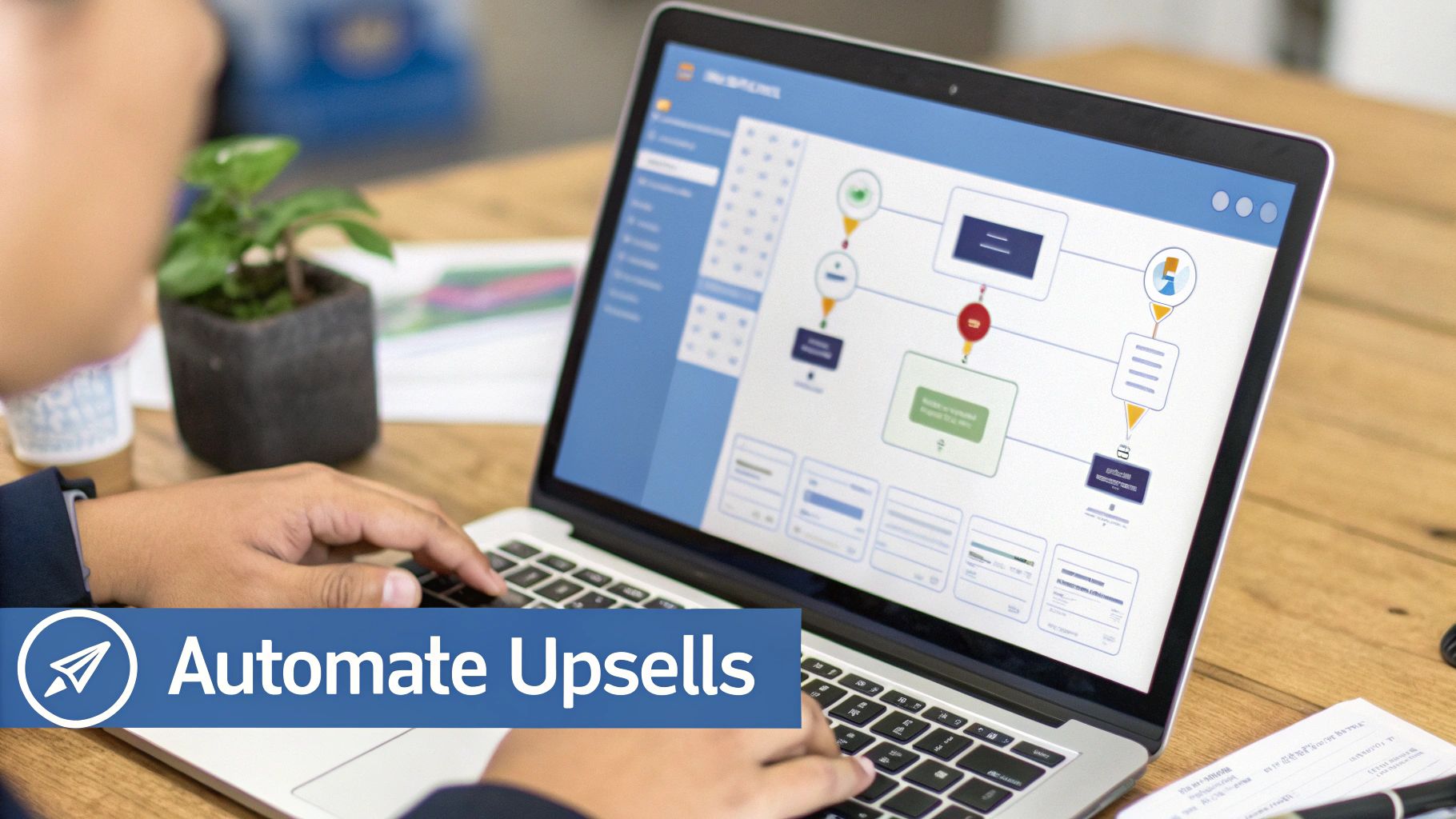
Automating Upsell Plays in Salesforce
Transitioning from a manual decision framework to a scalable, automated system distinguishes top-tier RevOps teams. For B2B companies running on Salesforce, automating upsell plays is essential for building predictable revenue expansion. By implementing intelligent workflows, you can systematically surface the best opportunities and ensure no high-value account is overlooked.
The core principle is to let customer data drive your sales motions. Instead of relying on an Account Executive’s intuition or manual account reviews, you can use Salesforce Flow to build an always-on engine that flags customers ready for an upgrade. This approach ensures every play is timely and relevant because it’s based on clear behavioral signals, removing guesswork from the process.
Building the Foundation with Key Data Points
Before building any automation, ensure your Salesforce instance contains the necessary data. The effectiveness of your automation depends entirely on the quality of its inputs. An effective upsell automation relies on tracking specific metrics that signal when a customer is outgrowing their current plan.
Ensure these fields exist and are consistently updated on the Account or a related custom object:
- Product Usage Percentage: A formula field that calculates usage (e.g., API calls, contacts) against the contract limit:
Usage__c / Contract_Limit__c. - Customer Health Score: An aggregate score, often integrated from a customer success platform, providing a quick assessment of satisfaction and product adoption.
- Last High-Priority Support Case: A date field tracking the last critical support issue, which can indicate friction or advanced needs.
- Contract Renewal Date: The subscription term’s end date, which establishes a natural timeline for expansion conversations.
These data points are the fuel for your automation engine, providing the context required for intelligent, timely actions.
Crafting an Upsell Workflow in Salesforce Flow
With solid data, you can build a powerful record-triggered Flow to act on these signals. The goal is to create a workflow that not only identifies an opportunity but also initiates the sales process by creating clear, actionable tasks for the account owner.
This involves setting precise entry criteria and a sequence of automated actions. The example below illustrates a common B2B SaaS scenario where a customer approaching usage limits triggers an upsell play.
Workflow Example: Usage Threshold Trigger
Here is a step-by-step guide to creating a potent upsell automation in Salesforce Flow.
- Define the Trigger and Entry Criteria:
- Object: Account (or a custom “Subscription” object).
- Trigger: When a record is created or updated.
- Entry Criteria:
Product_Usage_Percentage__cis greater than0.85(85%).Customer_Health_Score__cis greater than75.Contract_Renewal_Date__cis more than60days from today.
- Create the Automated Actions:
- Action 1: Field Update: Update a custom picklist field on the Account record, such as
Expansion_Status__c, to “Upsell Opportunity.” This simplifies reporting and dashboard creation. - Action 2: Task Creation: Automatically create a new Task for the Account Owner with a compelling subject line.
- Subject: “Upsell Alert: [Account.Name] has reached 85% usage.”
- Due Date: Today + 2 business days.
- Comments: “This account demonstrates high product usage and a strong health score. Review recent activity and schedule a call to discuss upgrading their plan to support their growth.”
- Action 3: Email Alert: Send an automated email notification to the Account Owner and their manager, summarizing the opportunity and linking directly to the Salesforce record for immediate action.
- Action 1: Field Update: Update a custom picklist field on the Account record, such as
By automating this process, you transform a reactive sales function into a proactive one. The system, not an individual, is responsible for flagging the opportunity, ensuring consistency and scalability across your entire customer base.
The Strategic Value of Automation
While this guide focuses on upselling, the principles of CRM automation are foundational to both upsell vs cross sale strategies. For example, a similar workflow could trigger a cross-sell play if a customer logs a support ticket containing keywords related to another product you offer.
Interestingly, while upselling is a powerful tactic, broader market data suggests its counterpart can be even more impactful. In the Canadian retail sector, cross-selling has proven far more effective than upselling, with e-commerce sales data revealing a striking disparity. For B2B firms like those served by MarTech Do, integrating Salesforce or HubSpot for cross-sell automation can mirror this success; research shows that 88% of customer data platform users report cross-sell improvements, with 41% seeing significant gains, versus upselling’s narrower appeal. You can explore more about these trends in Canadian e-commerce statistics from StatCan.
Ultimately, building these automated plays in Salesforce empowers your RevOps team to engineer a system that capitalizes on customer success signals. It ensures your account managers spend their time on high-value conversations, armed with the data needed to frame the expansion as a natural and logical next step for the customer.
Building a Cross-Sell Engine in HubSpot
While Salesforce is a powerhouse for automating upsell plays, HubSpot provides an equally potent ecosystem for building an intelligent cross-sell engine. For B2B teams operating on HubSpot’s Marketing and Sales Hubs, the real leverage comes from connecting customer data, content engagement, and workflow automation. This is how you systematically identify and act on expansion opportunities.
Instead of manual account reviews, a well-architected HubSpot cross-sell engine uses customer behavior as its primary trigger. It transforms your CRM from a static database into a proactive system that identifies which customers need which complementary products and then initiates the right sales and marketing plays at the optimal moment. This is the foundation of a scalable, repeatable process for account growth.
Segmenting Customers with Active Lists
Effective cross-selling begins with precise segmentation. In HubSpot, Active Lists are the ideal tool for this. They allow you to dynamically group customers based on specific signals that suggest a need for another of your products. Your objective is to identify satisfied customers who are succeeding with their current solution but also exhibiting signs of related business challenges.
Before building a workflow, refine your Active Lists. Here are a few examples:
- Current Product Stack: Use custom properties to track product ownership. A classic example is a list for “Sales Hub Customers who are NOT Marketing Hub Customers.”
- Content Engagement: Monitor how customers interact with content related to your other products. Create lists for anyone who has viewed a specific product page, downloaded a related case study, or attended a relevant webinar.
- Company Properties: Use firmographics like company size or industry to filter accounts, as these often correlate with the need for a particular solution.
These lists serve as the entry criteria for your automated cross-sell campaigns, ensuring every outreach is timely and relevant.
Designing a Cross-Sell Workflow
Once your segments are defined, use HubSpot Workflows to automate nurturing and the sales handoff. The goal is to educate the right customers on the value of a complementary product and alert the sales team as soon as buying intent is detected. This process aligns marketing and sales for maximum efficiency.
Let’s walk through a practical example: a workflow designed to cross-sell Marketing Hub to existing Sales Hub customers.
- Enrollment Triggers:
- Set the primary enrollment trigger to your Active List of “Sales Hub Customers.”
- Add a behavioral trigger to refine the audience, such as
Contact has viewed the Marketing Hub pricing page at least 2 times.
- Nurturing Sequence:
- Delay: Wait three business days before initiating outreach.
- Educational Email: Send an automated email addressing a common pain point for Sales Hub users that Marketing Hub resolves, such as poor lead quality or attribution gaps.
- Case Study: After another short delay, send a case study demonstrating how a similar company achieved its goals by adding Marketing Hub.
- Intent-Based Sales Handoff:
- If/Then Branch: Check if the contact clicked a link in any nurture emails.
- Task Creation: If a link was clicked, automatically create a task for the contact owner in Sales Hub. Ensure the task description provides context: “Cross-Sell Opportunity: [Contact Name] is engaging with Marketing Hub content. Follow up to discuss their lead generation goals.”
- Internal Notification: Send an email or Slack notification to the account manager for immediate action.
This automated approach ensures every potential cross-sell opportunity is nurtured with relevant content. It also ensures sales reps engage only when a customer has demonstrated clear interest, creating an efficient system that respects everyone’s time while maximizing revenue potential.
The Power of a Unified Platform
This strategy is effective because it leverages the integrated power of the HubSpot Marketing Hub and Sales Hub. Marketing’s educational efforts directly prepare customers for timely, contextual conversations with Sales. This synergy is the key to executing a successful cross-sell vs. upsell playbook.
While upselling often hinges on a customer hitting a usage limit, cross-selling is about uncovering new problems you can solve. Market data consistently shows that cross-selling delivers a significant revenue advantage. According to Grandview Research, this trend is evident across many sectors. For companies on platforms like HubSpot, orchestrating cross-sell plays with lead scoring and automation can drive substantial performance lifts by addressing broader customer needs and deepening the entire relationship.
By building this engine, your RevOps team creates a predictable system for expanding customer lifetime value, improving retention, and driving long-term growth.
Measuring the ROI of Your Expansion Plays
An expansion strategy without measurement is merely a guess. If you only track top-line revenue from upsell and cross-sell deals, you are missing the complete picture. To prove the value of your RevOps initiatives, you must analyze KPIs that reflect customer health, retention, and long-term value.
Without a solid measurement framework, you operate without clear direction. You cannot identify which plays are effective, how to allocate resources, or how to articulate your team’s impact to leadership. This is where building insightful dashboards in platforms like Salesforce and HubSpot becomes essential; they transform raw data into a clear narrative of success.
Going Beyond the Initial Sale: Key Metrics That Matter
An increase in Average Contract Value (ACV) is positive, but it is only one piece of the puzzle. The most critical metrics demonstrate how your expansion efforts create sustainable growth and increase customer stickiness. The goal is to prove you are not just closing larger deals but building a healthier, more resilient customer base.
Focus your reporting on these core KPIs:
- Net Revenue Retention (NRR): This is the gold standard for measuring health in a B2B SaaS business. NRR calculates recurring revenue from existing customers, accounting for both expansion (upsells, cross-sells) and churn. An NRR over 100% proves you are growing revenue without signing any new logos.
- Customer Lifetime Value (CLV): This metric forecasts the total revenue you can expect from a single customer over their entire relationship with your company. Effective upsell and cross-sell plays directly increase CLV by making your company more integral to their operations and extending their purchasing lifecycle.
- Product Adoption Rate: It is crucial to track what your customers are using. A successful cross-sell should not just be a closed deal; it should lead to high adoption of the new product. This confirms it is solving a real problem and making your entire ecosystem more indispensable.
Building a comprehensive view of your expansion efforts requires looking past the initial sale. True success is measured by how these plays impact long-term customer value and retention, which is why a deep understanding of how to measure marketing ROI is fundamental for any RevOps leader.
Building Your Dashboards in Salesforce and HubSpot
Your CRM must be the single source of truth for expansion performance. Both Salesforce and HubSpot offer robust reporting tools to create dashboards that visualize progress and share insights across the organization. The objective is not just to have charts, but to create at-a-glance views that answer critical business questions instantly.
Here’s a breakdown of the essential metrics to track for a clear picture of your upsell and cross-sell campaign performance.
| Metric | Relevance to Upselling | Relevance to Cross-Selling | Where to Track in CRM |
|---|---|---|---|
| Net Revenue Retention (NRR) | Directly measures the impact of upgrades and tier expansions on retaining and growing revenue from existing customers. | Shows how adding new products or services to an account contributes to overall revenue growth and offsets churn. | Build a custom report on your Opportunity or Deal object, segmenting by new business vs. expansion and factoring in churn data. |
| Customer Lifetime Value (CLV) | Increases as customers move to higher-value plans, indicating a longer, more profitable relationship. | Grows as customers integrate more of your products into their stack, increasing their dependency and total spend. | Track average deal size and purchase frequency per account over time. Many CRMs have fields for calculating this. |
| Product Adoption Rate | Not directly applicable, but you can track feature adoption within tiers to identify candidates for the next upgrade. | A critical post-sale metric. Low adoption of a cross-sold product signals a failed play, even if the deal closed. | Integrate product usage data from platforms like Pendo or Mixpanel into the CRM contact or account record. |
| Expansion MRR/ARR | Shows the direct monthly or annual recurring revenue gained from customers upgrading their existing subscriptions. | Tracks the new recurring revenue generated by selling additional, distinct products to current customers. | Create a report that filters deals by “Expansion Type” (e.g., Upsell, Cross-Sell) and sums the recurring revenue amount. |
| Expansion Win Rate | Measures the percentage of upsell opportunities that successfully convert to closed-won deals. A key indicator of sales effectiveness. | Calculates the success rate for cross-sell opportunities. Comparing this to the upsell win rate can reveal strategic gaps. | Use standard deal stage reporting, filtered by the opportunity type to isolate and compare upsell vs. cross-sell plays. |
Tracking these KPIs will provide a richer understanding of your expansion engine’s health and enable you to make data-backed decisions to refine your playbooks.
By building and regularly reviewing these reports, you can continuously optimize your approach, demonstrate the tangible business impact of your work, and justify the investment required to scale your RevOps function.
Common Upsell and Cross-Sell Questions Answered
Even with well-defined playbooks, recurring questions arise when implementing upsell and cross-sell strategies. For RevOps leaders, addressing these correctly is crucial for avoiding costly mistakes and achieving a return on your efforts.
Let’s address the most common questions from B2B leaders operating within Salesforce and HubSpot environments, moving from theory to practical advice for training your teams and proving the value of your expansion programs.
What Is the Biggest Mistake Companies Make When Trying to Upsell?
By far, the most common mistake is pushing an upsell prematurely. This is often driven by a quarterly revenue target rather than a genuine, data-backed reason that benefits the customer. An upsell should feel like a natural next step in their journey, not a forced sales motion.
Asking a client to upgrade before they have realized the full value of their initial purchase is tone-deaf and can lead to churn. You can avoid this by establishing CRM automation triggers based on customer milestones, such as hitting product usage thresholds, maintaining a positive health score, or reaching a specific point post-onboarding. Using data ensures the upsell conversation is helpful, not just a premature pitch.
How Can We Train Our Sales Team to Cross-Sell Effectively?
Effective cross-sell training is rooted in consultative selling and a deep understanding of your entire product ecosystem. Your reps must be coached to uncover customer problems, not just recite a list of available products.
Your training program must include:
- Realistic role-playing scenarios focused on identifying expansion opportunities during routine check-ins and business reviews.
- Creating a ‘solution map’ that visually connects common business challenges to your different product offerings.
- Analyzing CRM data like support ticket themes or feature requests to spot relevant cross-sell opportunities before a call is made.
Finally, ensure your compensation plan properly rewards expansion revenue. If it is not an incentivized, core component of the sales role, it will remain an afterthought.
Can Marketing Automation Support Both Upsell and Cross-Sell Efforts?
Absolutely. In fact, scaling either strategy is impossible without it. For cross-selling, a platform like HubSpot or Marketing Cloud Account Engagement can execute highly targeted nurture campaigns triggered by specific behaviors, such as a customer downloading a whitepaper related to a product they do not own.
For upselling, automation is ideal for educating customers on premium features they are not yet using. You can build a workflow that triggers an educational email sequence when a customer approaches their current plan’s limits, preparing them for a productive conversation with their account manager.
The real leverage is achieved when marketing automation and sales execution are synchronized. Marketing uses data-driven content to initiate the conversation, and sales engages at the optimal moment with context and relevance to close the deal. This alignment is the foundation of any successful expansion strategy.
Which Strategy Delivers a Better ROI: Upselling or Cross-Selling?
The answer depends on your business model and immediate goals.
Upselling often delivers a more direct and immediate ROI by increasing the average contract value (ACV) from a single deal. It is the most straightforward method for generating more revenue from your most successful customers.
Cross-selling, on the other hand, tends to yield a higher ROI over the long term by improving customer stickiness and lifetime value (CLV). When you embed more of your products into a client’s operations, your solution becomes more difficult to replace, providing a powerful defense against churn.
For most B2B SaaS companies, a balanced mix of both is optimal. Ultimately, the most telling metric is Net Revenue Retention (NRR), as it captures revenue from both upselling and cross-selling while factoring in churn, giving you the clearest picture of sustainable growth.
Ready to build a revenue engine that doesn’t just acquire customers, but grows them? MarTech Do specializes in auditing and optimizing the Salesforce and HubSpot stacks for B2B companies, turning your CRM into a proactive expansion machine. Let’s engineer your go-to-market strategy for maximum ROI. Schedule your consultation with us today.