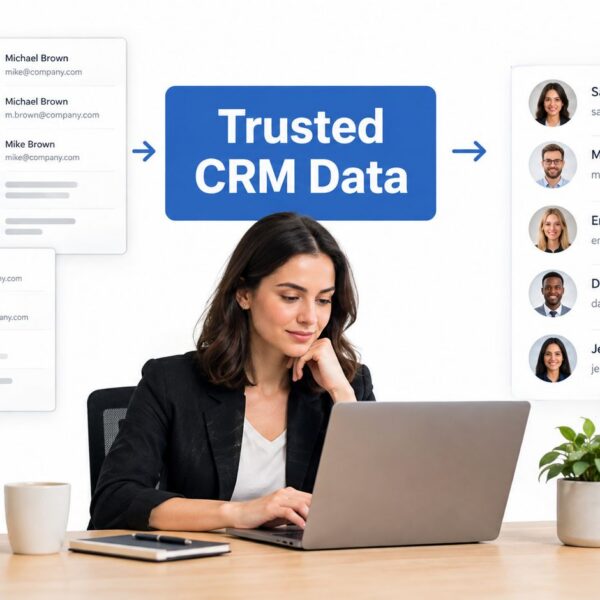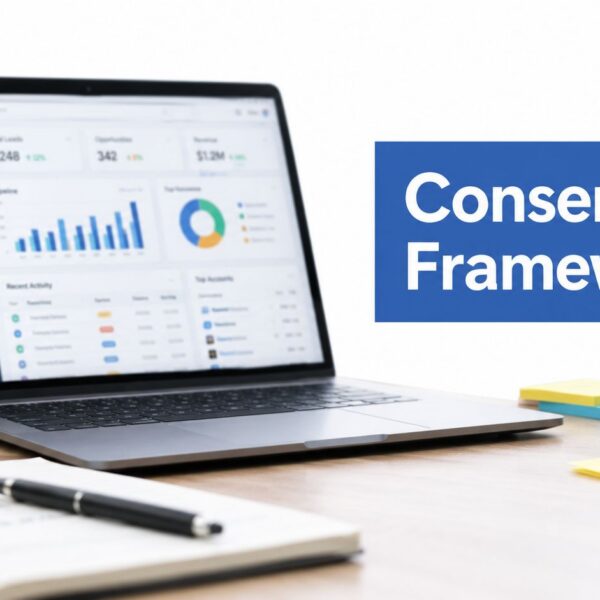

At its core, Salesforce Sales Cloud is the customer relationship management (CRM) platform engineered to run your entire sales process. It’s the single source of truth where everything lives—from initial lead capture to closed-won deals and post-sale engagement. For B2B companies, it’s the operational foundation for building meaningful customer relationships and achieving predictable revenue.
What Is Salesforce Sales Cloud and Why It Matters for B2B Growth
Sales Cloud is not just another piece of software; it’s the command centre for your entire revenue engine. Picture a pilot’s cockpit, where all critical data—leads, opportunities, pipeline health, and customer interactions—is centralized into a single, coherent view. This empowers your teams to make strategic, data-driven decisions instead of operating on scattered information.
For professionals in Revenue Operations, Marketing Operations, or Sales Operations, this unified view is essential. It’s the mechanism for streamlining complex sales cycles, building deeper customer connections, and creating a sustainable competitive advantage. It allows you to shift from reacting to the market to proactively engineering revenue based on reliable data.

A Strategic Asset for Revenue Operations
On the surface, Sales Cloud excels at managing and automating the sales cycle. However, its true power is unlocked when leveraged as a strategic asset. By centralizing all data and processes, it becomes the single source of truth that aligns your marketing, sales, and service teams, ensuring they are all working toward the same GTM objectives.
This alignment directly impacts business-critical functions:
- Process Standardization: Enforce a consistent sales methodology across the entire organization, ensuring every lead and opportunity is managed according to best practices.
- Data-Driven Decisions: Transform raw data into actionable insights with real-time dashboards and reports, enabling accurate forecasting and performance tracking.
- Enhanced Productivity: Automate repetitive administrative tasks, freeing sales representatives to focus on high-value activities: engaging prospects and closing deals.
In a modern B2B organization, SFDC Sales Cloud is the operational backbone connecting every customer-facing team. It ensures every interaction, from the first marketing touchpoint to post-sale support, is tracked and contributes to a complete view of the customer journey.
The platform’s influence is particularly significant in competitive markets. In Canada, the CRM market is experiencing robust growth, with a projected compound annual growth rate (CAGR) of approximately 14% for 2025–2026. Salesforce dominates this landscape with over 30% of the market share, positioning Sales Cloud as a primary choice for Canadian businesses aiming to scale effectively. You can find more insights on the Canadian Salesforce ecosystem from iTechCloud Solution.
Ultimately, a well-configured SFDC Sales Cloud instance provides the infrastructure to build a repeatable, scalable, and predictable revenue machine—an essential component for any B2B company serious about long-term growth.
Digging into the Core Capabilities for Revenue Operations
To fully grasp what makes Salesforce Sales Cloud indispensable, one must look beyond the “CRM” label and recognize it as a powerful engine for revenue optimization. Its features are not a random assortment of tools; they are the components a RevOps team uses to engineer a predictable, scalable sales machine. This is about providing your GTM motion with the structure and insight required to turn ambitious goals into measurable results.
For any B2B company, particularly those navigating long or complex sales cycles, mastering these core functions is paramount. It’s what differentiates a sales team running on intuition from one executing with precision, guided by data.

Mastering Lead and Opportunity Management
At its foundation, Sales Cloud is designed to manage the journey from a new lead to a signed contract. The strategic value lies in how it orchestrates that journey.
Consider Lead Management the entry point to your sales process. This is where every signal of interest—from a webinar registration, content download, or event check-in—is captured. An optimized system instantly ingests that lead, scores it based on conversion probability, and routes it to the appropriate representative. This automation eliminates manual sorting, prevents lead leakage, and significantly reduces response times.
Once a lead demonstrates genuine potential, it is converted into three interconnected records: an Account, a Contact, and an Opportunity. This is where Opportunity Management begins. An Opportunity is a dynamic record tracking every call, email, key stakeholder, competitor, and milestone throughout the deal cycle.
For RevOps professionals, this level of detailed tracking is invaluable. It creates a standardized, 360-degree view of every deal in the pipeline. This clarity enables leadership to identify bottlenecks, provide targeted coaching, and ensure universal adherence to the defined sales playbook.
Building a Predictable Pipeline and Forecast
A healthy pipeline is the lifeblood of a sales organization, and Sales Cloud provides the framework to manage it with discipline. You can define clear sales stages that accurately reflect your GTM motion, ensuring every opportunity is correctly categorized. This structure is critical for preventing “revenue leakage”—deals that stall due to a lack of a clear next step or follow-up.
This clean, structured pipeline data flows directly into one of the most vital functions for business leadership: forecasting. Sales Cloud’s forecasting tools replace guesswork with data science.
- Forecast Categories: Opportunities are automatically grouped into categories like Pipeline, Best Case, and Commit, giving leadership a realistic view of expected revenue.
- Real-Time Adjustments: Sales managers can review their team’s forecasts and apply their own judgment, adjusting numbers based on qualitative field intelligence.
- Historical Analysis: By tracking forecast accuracy over time, you can continuously refine your prediction models, building credibility with the board and investors.
This methodical approach transforms forecasting from an art into a reliable science, supporting strategic financial planning and hiring decisions. It is a key reason the platform is central to so many growth strategies. In fact, IDC projects the Salesforce economy in Canada will create approximately 71,700 new jobs and generate roughly CAD 36.8 billion in new business revenues from 2022 to 2026. You can discover more about Salesforce’s economic impact in Canada.
Here’s a breakdown of how these features directly support RevOps objectives.
Sales Cloud Core Feature Breakdown for RevOps
| Feature | Description | Primary RevOps Benefit |
|---|---|---|
| Lead Management | Captures, scores, and routes inbound leads to the appropriate sales reps automatically. | Increased Speed-to-Lead: Reduces lead decay and boosts conversion rates by ensuring prompt follow-up. |
| Opportunity Management | Provides a 360-degree view of every deal, tracking stages, activities, and key stakeholders. | Improved Sales Velocity: Standardizes the sales process, making it easier to identify and resolve bottlenecks. |
| Pipeline Management | Organizes all open opportunities into defined sales stages for a clear view of the entire funnel. | Reduced Revenue Leakage: Ensures no deal is overlooked and that next steps are always clearly defined. |
| Collaborative Forecasting | Aggregates opportunity data into forecast categories (Commit, Best Case, Pipeline) for revenue prediction. | Enhanced Forecast Accuracy: Builds credibility with leadership and enables more reliable financial planning. |
| Reports & Dashboards | Visualizes sales data, KPIs, and performance metrics in real-time, customizable formats. | Data-Driven Decision-Making: Provides clear visibility into performance, enabling continuous process optimization. |
This table illustrates how each component functions not merely as a “sales tool” but as a strategic lever for the entire revenue operation.
Gaining Insight with Reports and Dashboards
Vast amounts of data are useless without interpretation. Sales Cloud excels here, transforming the information captured across leads, opportunities, and accounts into clear, actionable insights through its robust reporting and dashboard engine.
Reports allow you to analyze sales data in virtually any configuration. You can build reports to track essential KPIs like lead conversion rates, average deal size, and sales cycle length. Dashboards then visualize this data with charts and graphs, providing a live view of business health.
A typical sales leader’s dashboard might display:
- Pipeline Generation by month and source.
- Team Leaderboard ranking reps by closed-won revenue.
- Sales Activity Metrics such as calls logged and meetings booked.
- Forecast vs. Quota to track progress toward targets.
These visual tools give leadership a real-time pulse on performance, making it simple to spot trends, identify coaching opportunities, and make informed, data-backed decisions. For a RevOps professional, this is mission control—the mechanism for measuring process efficacy and pinpointing areas for optimization.
Integrating Sales Cloud into Your Revenue Tech Stack

A world-class CRM never operates in isolation. Its true power is unleashed when it becomes the central hub of your entire revenue technology stack. For B2B companies, integrating SFDC Sales Cloud with other key platforms is a strategic imperative. This connectivity transforms disconnected data points into a seamless, automated customer journey.
A properly integrated ecosystem enables the free flow of data between marketing, sales, and customer success. This eliminates manual data entry, reduces human error, and establishes a single source of truth that the entire organization can trust. The objective is an environment where each platform enhances the others, creating a complete, 360-degree view of the customer.
Core Integrations for a Seamless GTM Motion
For most B2B organizations, the most critical integrations link marketing automation platforms directly with Sales Cloud. These connectors, both native and third-party, form the foundation of an aligned go-to-market (GTM) strategy, ensuring marketing efforts translate directly into fuel for the sales engine.
Here are the two most common integrations in B2B tech stacks:
- Marketing Cloud Account Engagement (Pardot): As a native Salesforce product, MCAE offers a deep, out-of-the-box integration. It provides bidirectional sync of prospect and customer data, allowing sales reps to view a lead’s complete marketing engagement history directly within the Salesforce record. This capability powers intelligent lead scoring, assignment rules, and accurate attribution reporting.
- HubSpot Marketing Hub: Many companies leverage HubSpot’s user-friendly marketing tools alongside the robust sales architecture of SFDC Sales Cloud. A well-architected integration syncs new leads, contact updates, and key marketing activities, enabling the sales team to act on buying signals from HubSpot without leaving their CRM.
These connections are fundamental. To explore this topic further, review our detailed guide on CRM and marketing automation integration.
A well-architected integration does more than move data; it translates marketing activities into sales context. It equips representatives with the intelligence needed for more relevant and timely conversations. This alignment is the foundation of modern RevOps.
Advanced Integrations for Data Enrichment and Intelligence
Beyond the core marketing-to-sales connection, advanced integrations can elevate your GTM engine from efficient to truly intelligent. These tools inject valuable third-party data directly into your CRM, deepening your understanding of accounts and contacts and enabling more sophisticated GTM engineering.
For instance, integrating data enrichment providers like ZoomInfo or Clay.com automates the process of appending firmographic, technographic, and contact data to your records. This ensures your data is not only accurate but also complete, giving sales teams the context required to identify and engage high-fit accounts.
To effectively sync Sales Cloud with other systems in your stack, it’s crucial to understand how to automate your data pipelines. This process ensures that information from disparate sources is consolidated cleanly and reliably within your CRM. That clean data flow is the backbone of any scalable and trustworthy revenue operations framework.
Ultimately, a thoughtfully integrated SFDC Sales Cloud becomes the central intelligence hub of your entire revenue operation. It aggregates data from every touchpoint, delivers actionable insights to your teams, and provides the unified view required to drive predictable, scalable growth.
Getting Implementation and Optimization Right
Deploying or optimizing Salesforce Sales Cloud is not merely a technology project—it’s a fundamental change to how your revenue teams operate. A successful implementation is built on three pillars: clean data, clear processes, and a commitment to continuous improvement. Neglecting these fundamentals will quickly degrade even the most powerful CRM into an unreliable data repository.
For RevOps leaders, the objective is to build a system that not only supports the current sales motion but is also scalable for future growth. This requires a disciplined approach, beginning with data integrity and extending to intelligent automation and performance measurement.
Start with Obsessive Data Hygiene
Your Salesforce instance is only as valuable as the data it contains. Inaccurate, incomplete, or duplicated data leads to flawed reports, frustrated users, and poor business decisions. Establishing strong data hygiene is not a one-time task; it is an ongoing discipline.
A successful Sales Cloud implementation depends entirely on data quality. Adhering to essential data management best practices is non-negotiable. This discipline is what transforms your CRM into a trusted source of truth for the entire organization.
Key starting points include:
- Standardize Naming Conventions: Establish and enforce consistent formats for account names, job titles, and addresses. For example, decide between “Senior Vice President,” “SVP,” and “Sr. VP,” and apply it universally. This simple rule eliminates duplicates and simplifies reporting.
- Use Validation Rules: Leverage Salesforce’s built-in tools to require specific fields (e.g., phone number, industry) before a record can be saved. This is the most effective way to ensure critical information is captured at the source.
- Schedule Regular Clean-Ups: Designate a data steward responsible for running reports that identify duplicates and inaccuracies. A regular audit-and-merge cadence maintains system integrity.
Design a Smooth Lead-to-Account Handoff
The process of converting a lead into a qualified opportunity is one of your most critical GTM motions. A clunky handoff creates friction, slows down follow-up, and leads to lead leakage. In Salesforce, this is addressed through intelligent lead-to-account matching and routing.
Your system should be configured to automatically check if a new lead belongs to an existing account. This prevents multiple sales reps from engaging the same organization and ensures the lead is routed to the account owner, who already has the necessary context and relationship.
For RevOps, the goal is to engineer a frictionless handoff between marketing and sales. An automated and intelligent lead routing process ensures the right lead is delivered to the right rep with the right context, instantly—eliminating manual triage and accelerating speed-to-lead.
Build a Smarter Lead Scoring Model
Not all leads are created equal. A robust lead scoring model enables your sales team to focus its energy on prospects demonstrating genuine purchase intent. This involves assigning points based on both demographic fit and behavioural signals.
Scoring Components
- Explicit Fit Data: This measures how well a lead matches your Ideal Customer Profile (ICP). Assign points for job title, industry, company size, and geography. A “VP of Marketing” from a target account should score significantly higher than an “Intern” from a non-target company.
- Implicit Behavioural Data: Award points for actions that indicate interest. Examples include visiting a pricing page, downloading a case study, or attending a webinar. A series of high-value actions signals active engagement.
By combining these two scores, you create a single, unified lead score. Paired with a grade (e.g., A, B, C, D), this provides your sales team with an immediate snapshot of a lead’s quality and urgency, allowing them to prioritize their efforts effectively. For a complete walkthrough, our guide on how to implement a CRM system covers these principles in detail.
Map Your Sales Process and Attribution
Your Salesforce configuration should mirror your team’s actual sales process. This involves customizing opportunity stages to match the real-world steps reps take to close a deal, from “Initial Qualification” and “Discovery” to “Negotiation” and “Closed Won.”
Equally important is defining the entry and exit criteria for each stage. What must be accomplished before a deal can advance from “Discovery” to “Solution Design”? Perhaps the rep must confirm budget and identify all decision-makers. Enforcing these rules brings discipline to your pipeline and improves forecast accuracy.
Finally, implement multi-touch attribution models to understand true marketing effectiveness. Instead of assigning all credit to the last touchpoint before a deal closes, use models like linear or U-shaped to distribute credit across all marketing interactions that influenced the opportunity. This provides a much clearer picture of marketing ROI and informs future investment decisions.
Using AI and Data Cloud to Supercharge Sales Performance
The modern power of Sales Cloud extends beyond logging calls or tracking deals. Leading revenue teams are transforming it from a system of record into a system of intelligence that actively improves sales execution. This evolution is driven by Salesforce’s AI, Einstein, and the unifying capabilities of Data Cloud.
Instead of representatives manually sifting through lead lists to prioritize outreach, AI performs the analysis for them. It surfaces the prospects most likely to convert, allowing your team to focus their time on high-probability opportunities. This represents a fundamental shift in sales operations.

From Reactive to Predictive Sales Motions
Salesforce Einstein integrates predictive insights directly into your team’s daily workflow. It continuously analyzes historical data—examining won and lost deals—to identify the patterns that correlate with success. This transforms your CRM from a passive database into an active performance coach.
This provides your team with clear, actionable recommendations. For instance, Einstein can monitor an open opportunity and flag it as “at-risk” if email engagement declines. It might also suggest the specific next best action to re-engage the prospect and advance the deal.
Key applications include:
- Predictive Lead Scoring: A significant advancement over traditional rule-based scoring, machine learning analyzes thousands of data points to identify which leads are genuinely sales-ready.
- Opportunity Insights: Einstein functions as an intelligent assistant, surfacing critical updates that might otherwise be missed, such as a key champion leaving their company or a competitor’s name appearing in an email thread.
- Automated Activity Capture: This feature automatically logs emails and calendar events, saving valuable time and ensuring the CRM data is complete and accurate for analysis.
Unifying Customer Data for Deeper Insights
If Einstein is the brain, Data Cloud is the central nervous system. Its primary function is to eliminate data silos. It ingests and harmonizes information from disparate systems—your marketing automation platform, ERP, and customer support tools—and unifies it into a single, comprehensive customer profile.
This single source of truth is the key to meaningful personalization. When a sales rep can view every touchpoint in one place—from a recently read blog post to the latest support ticket—they are equipped to have highly relevant and timely conversations.
When you combine Einstein’s predictive intelligence with the unified data from Data Cloud, SFDC Sales Cloud becomes a proactive engine for growth. Your team is no longer just managing a pipeline; they are anticipating customer needs and uncovering opportunities that were previously invisible.
This combination offers a significant competitive advantage. While Salesforce reported that its Data Cloud paid-customer growth was approximately 130% year-over-year globally, other data indicates that only about 12% of Canadian firms had integrated AI into their operations as of mid-2025. This gap presents a substantial opportunity for Canadian businesses to gain a first-mover advantage. By adopting these tools now, you can build a more intelligent and effective sales organization before your competitors. The full details are available in the report on Salesforce Data Cloud momentum.
What’s Next? From Good to Great with Sales Cloud
Maximizing the value of Sales Cloud is an ongoing commitment, not a one-time project. It requires a clear strategic vision centered on rigorous data hygiene, a sales process mapped directly to the system, and a cohesively integrated tech stack. A strategic partner can be instrumental in this journey, transforming your CRM from a data repository into the true engine of your revenue operations.
At MarTech Do, we specialize in helping B2B companies translate these best practices into reality. Our expertise lies in ensuring your technology stack actively supports your go-to-market strategy, driving growth rather than creating friction.
Work With RevOps Experts Who Get It
Our entire approach is built on delivering measurable ROI by strengthening the foundations of your revenue operation. We provide focused expertise to solve common challenges and unlock your platform’s full potential.
Our core services include:
- Deep-Dive System Audits: We conduct a comprehensive review of your current Sales Cloud configuration to identify process gaps, data integrity issues, and hidden opportunities for optimization.
- Full Implementation & Migration: Whether you are adopting Sales Cloud for the first time or migrating from another CRM, we manage the entire project, ensuring a smooth transition built on sound RevOps principles from day one.
- RevOps-as-a-Service: For companies requiring ongoing strategic guidance, we act as an extension of your team, providing continuous support to refine processes, enhance reporting, and ensure your system evolves with your business.
CRM excellence is achieved when your technology, processes, and people are perfectly aligned. Our mission is to provide the expertise and hands-on support to bridge those gaps, ensuring your SFDC Sales Cloud is a powerful asset for predictable growth.
If you are ready to move beyond a basic setup and engineer a truly optimized RevOps machine, our team is prepared to assist. We bring the strategic insight and practical experience necessary to make Sales Cloud a cornerstone of your success.
Ready to discuss your specific challenges and goals? Book a no-obligation consultation with our RevOps experts today and take the next step toward mastering your CRM.
Got Questions About Salesforce Sales Cloud? We’ve Got Answers.
When marketing and RevOps leaders evaluate Salesforce Sales Cloud, several common questions arise. Whether you are considering a new implementation or seeking to optimize an existing instance, clear answers are essential for making informed decisions.
We understand your practical concerns regarding scalability, user adoption, and return on investment. Let’s address some of the most frequent questions we encounter from B2B decision-makers.
Will Sales Cloud Keep Up as My B2B Company Grows?
Absolutely. Scalability is a core design principle of Sales Cloud. The platform is architected to grow with your business, from a startup with a small sales team to a global enterprise with thousands of representatives. This is achieved through a flexible data model and the ability to activate more advanced features as your operational complexity increases.
For example, a new company may find the Professional Edition sufficient for its initial needs. As its sales process matures, it can seamlessly upgrade to the Enterprise Edition to access workflow automation and API capabilities without a disruptive migration.
How Long Does It Actually Take to Implement?
The timeline depends on project complexity. A straightforward implementation for a small team with clean data can often be completed in four to six weeks. Conversely, a complex deployment for a large organization with significant data migration and customization can extend from three to six months or longer.
Key factors influencing the timeline include:
- Data Migration: The volume and cleanliness of the data being transferred from legacy systems.
- Customization: The extent of custom fields, objects, and workflows required to map to your specific sales process.
- Integrations: Connecting Sales Cloud to other business-critical systems, such as Marketing Cloud Account Engagement or an ERP, adds technical complexity and time.
What’s the Biggest Roadblock to Getting Reps to Use It?
The primary obstacle to user adoption is rarely the technology itself; it’s resistance to changing established habits. Sales representatives are accustomed to specific workflows and may perceive a new CRM as an administrative burden that impedes their ability to sell.
The key to successful adoption is demonstrating the “what’s in it for me” from day one. When reps see that Sales Cloud provides them with higher-quality leads, clarifies their next best actions, and reduces manual data entry, they become active proponents of the system. Comprehensive training and clear communication of the strategic “why” from leadership are non-negotiable.
At MarTech Do, we help B2B companies overcome these hurdles and transform SFDC Sales Cloud into the revenue engine it was designed to be. See how we can help at https://martechdo.com.